
Your engine shakes at a stoplight. Acceleration feels weaker than usual, and the check engine light comes on. But the car still starts and drives, so you decide to deal with it later.
That decision can become expensive if a bad fuel injector is causing the problem.
A fuel injector delivers a carefully measured amount of fuel into the engine. When it becomes restricted, leaks, or stops working, combustion can suffer. Depending on the failure, continued driving may damage the catalytic converter, contaminate engine oil, or create more serious engine problems.
Not every injector fault is equally dangerous, though. Understanding the difference can help you decide whether to schedule a repair or stop driving immediately.
Quick Answer: Ignoring a bad fuel injector can lead to worsening misfires, reduced power, poor fuel economy, hard starting, catalytic converter damage, and—in severe cases—engine wear or failure. An external fuel leak creates an immediate fire hazard. A flashing check engine light, severe shaking, or strong gasoline smell means you should stop safely and arrange professional assistance.
What Happens If You Keep Driving With a Bad Fuel Injector?
The consequences depend on how the injector fails.
A clogged injector may deliver too little fuel, causing hesitation, lean combustion, or misfires. A leaking injector can deliver excessive fuel, creating rich-running conditions, flooding, or fuel dilution of the engine oil.
An electrically failed injector may stop delivering fuel to one cylinder altogether.
In some cases, the problem remains a drivability complaint for a while. In others, secondary damage can develop much sooner.
For example, certain fuel-related misfires can send unburned gasoline into the exhaust, where it may overheat the catalytic converter.
This is why a bad fuel injector should be diagnosed promptly rather than ignored until the car stops running.
7 Problems a Bad Fuel Injector Can Cause If You Ignore It
1. Engine Misfires That Become More Frequent
Each cylinder needs the correct amount of fuel to produce consistent power.
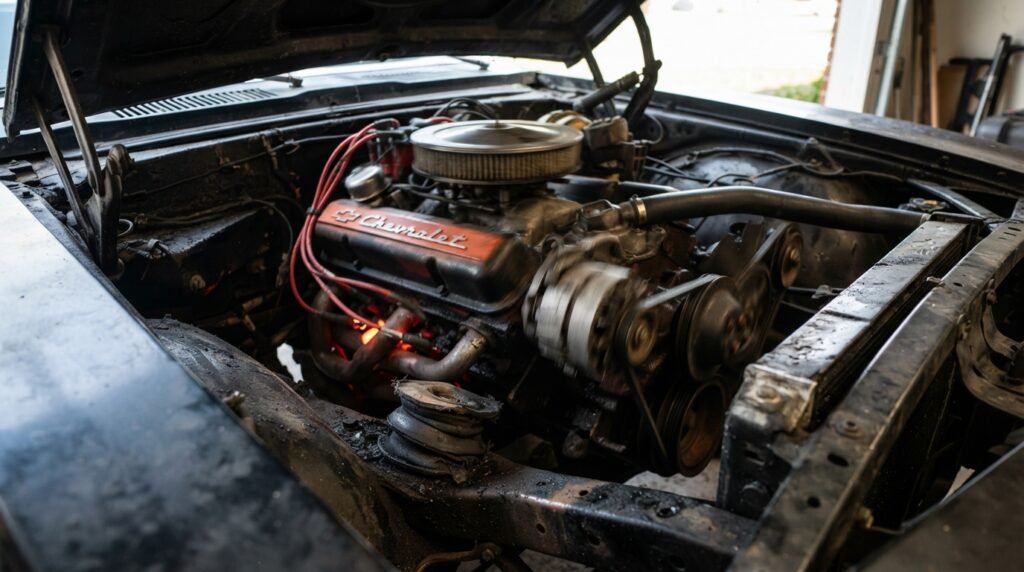
When an injector delivers too much, too little, or no fuel, that cylinder may misfire. You might feel shaking at idle, stumbling during acceleration, or a noticeable loss of smoothness.
Repeated misfires can increase exhaust temperatures and create additional problems.
A flashing check engine light may indicate an active misfire capable of damaging the catalytic converter. For a closer look at the different causes, see our guide to engine misfire symptoms.
2. Catalytic Converter Damage
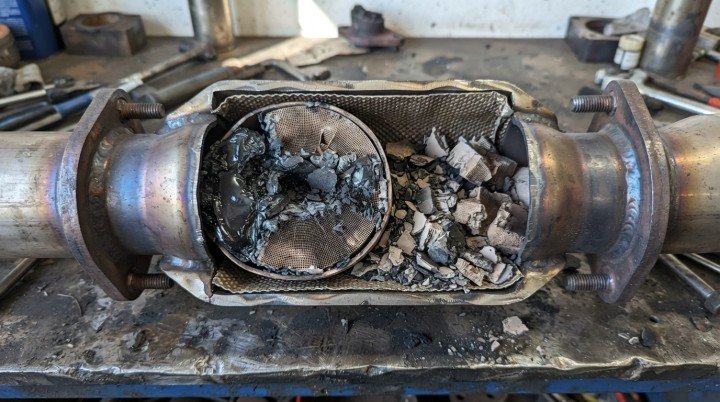
A catalytic converter treats harmful exhaust gases. It isn’t designed to handle large amounts of unburned fuel from persistent misfires.
When excess fuel burns inside the converter, temperatures can rise enough to damage its internal structure.
That may turn an injector repair into a much more expensive exhaust-system repair.
Not every injector fault damages the converter. The greatest concern involves misfires or excessively rich conditions that allow unburned fuel into the exhaust.
3. Poor Acceleration and Unexpected Power Loss
A restricted injector may provide enough fuel at idle but struggle when you press the accelerator.
The engine can hesitate, stumble, or feel weak while climbing a hill or merging onto a highway.
Unexpected power loss is more than an inconvenience when you’re entering fast-moving traffic.
Because ignition faults, airflow problems, and low fuel pressure can cause similar symptoms, our guide to a car losing power when accelerating can help you understand the other possibilities.
4. Increased Fuel Consumption
A leaking injector may supply more fuel than the engine needs. Poor atomization can also interfere with efficient combustion.
You may notice falling MPG, black exhaust smoke, or an unusual fuel smell.
However, poor fuel economy alone doesn’t prove injector failure. Tire pressure, driving conditions, ignition problems, and sensor faults can also increase fuel consumption.
Check our guide on why a car uses too much fuel before assuming the injectors are responsible.
5. Fuel Dilution and Cylinder-Wall Damage
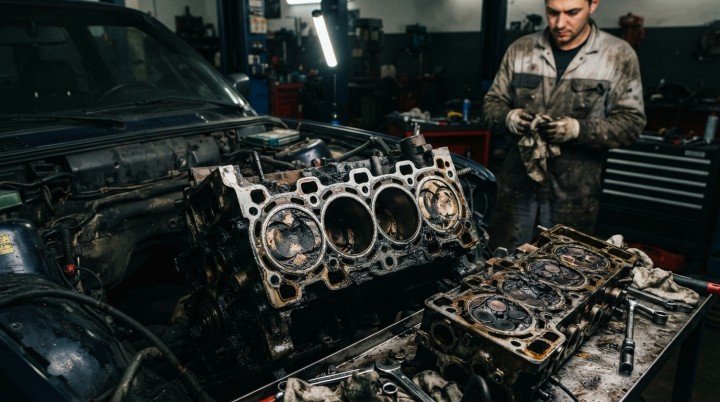
A severely leaking injector can allow excessive gasoline into a cylinder.
That fuel may wash away some of the protective oil film on the cylinder wall. It can also pass the piston rings and enter the crankcase, diluting the engine oil.
Fuel-contaminated oil may not lubricate engine components as intended, increasing the risk of wear.
Possible clues include an unusually high oil level, a gasoline smell in the oil, difficult starting, or repeated rich-running symptoms.
These signs require professional evaluation. Don’t continue driving a vehicle suspected of severe fuel dilution.
6. Hard Starting, Stalling, or No-Start Problems
A leaking injector may allow fuel pressure to fall after shutdown or flood a cylinder with excess fuel.
A restricted or electrically inactive injector can create the opposite problem: insufficient fuel delivery.
Either condition may contribute to long cranking, rough starts, or stalling.
Fuel-pump problems, sensors, electrical faults, and other issues can produce similar symptoms, so the injector should be tested before replacement.

7. Serious Engine Damage in Severe Cases
Severe fuel-delivery problems can sometimes cause major engine damage.
Insufficient fuel under heavy load may contribute to abnormal combustion or excessive temperatures in certain engines. Significant internal fuel leakage can compromise lubrication.
In rare extreme flooding situations, enough liquid fuel may collect in a cylinder to create a hydrolock risk.
These are possible severe outcomes—not the normal result of every faulty injector. Early diagnosis greatly reduces the chance of allowing a manageable problem to escalate.
Clogged vs. Leaking vs. Stuck-Open Fuel Injector: Which Is Worse?
Before deciding how serious the problem is, it helps to understand what the injector is actually doing wrong.
| Failure Type | Typical Effect | Main Concern |
|---|---|---|
| Partially clogged | Reduced fuel delivery | Lean operation, hesitation, misfire |
| Internally leaking | Excess fuel enters a cylinder | Rich running, flooding, oil dilution |
| Stuck open | Severe or uncontrolled overfueling | Cylinder flooding and lubrication damage |
| Electrical failure | Injector does not operate correctly | Misfire or inactive cylinder |
| External injector or seal leak | Fuel escapes the system | Fire hazard |
| Poor spray pattern | Uneven fuel atomization | Incomplete combustion and deposits |
An external gasoline leak is the most immediate safety concern. Internal failures vary in severity depending on the engine, operating conditions, and how much fuel delivery is affected.
Can You Drive With a Bad Fuel Injector?
A mild rough idle without other warning signs may allow a short, careful trip to a nearby repair facility. But that isn’t a guarantee of safety, and the cause must still be confirmed.
Do not continue driving if you notice:
- Visible gasoline leakage or a strong raw-fuel smell.
- A flashing check engine light with severe shaking.
- Repeated stalling or unpredictable power loss.
- Heavy smoke, overheating, or loud abnormal engine noises.
- Fuel-contaminated engine oil or suspected severe injector flooding.
Stop in a safe location, shut off the engine when appropriate, and arrange professional assistance or towing. If gasoline is leaking, avoid flames, sparks, and attempts to restart the vehicle.
For other warning-light scenarios, read our guide to what your check engine light means.
How Long Can You Drive With a Bad Fuel Injector?
There is no reliable number of miles or days.
A slightly restricted injector might cause mild symptoms for some time. A severe leak or active misfire could create damage much sooner.
The problem may also worsen without much warning.
Rather than trying to estimate how many miles remain, arrange diagnosis as soon as symptoms appear. If the vehicle has severe misfires, fuel leakage, or unpredictable power loss, don’t drive it to the shop.
8 Warning Signs Your Fuel Injector May Be Failing
- Rough idle: The engine shakes or runs unevenly while stopped.
- Misfires: You feel repeated stumbling or uneven power.
- Hesitation: Acceleration becomes delayed or inconsistent.
- Poor fuel economy: MPG drops without an obvious driving change.
- Hard starting: The engine cranks longer than normal.
- Check engine light: The computer detects a fuel, circuit, or combustion problem.
- Fuel smell: Excess fuel or an external leak may be present.
- Stalling or power loss: Fuel delivery may be too inconsistent to maintain normal operation.
None of these symptoms confirms a bad fuel injector by itself. Our detailed fuel injector symptoms guide explains how the signs differ between restricted, leaking, and electrically failed injectors.
Bad Fuel Injector or Something Else? Check These Before Replacing It
Replacing an injector because of a misfire code is a common way to waste money.
A gasoline engine also needs reliable ignition, correct airflow, adequate fuel pressure, and healthy mechanical components. A failure in any of these areas can resemble injector trouble.
- Confirm the affected cylinder. Read stored and pending codes, freeze-frame information, and misfire data. A P0302 code identifies a misfire on cylinder two, not necessarily a defective injector.
- Check ignition components. Worn spark plugs and weak coils can create nearly identical symptoms. Compare the evidence with our guide to bad ignition coil symptoms.
- Check fuel pressure. A weak pump, pressure-control problem, or supply restriction can affect several cylinders.
- Inspect the intake system. Vacuum leaks and incorrect airflow measurements can create lean conditions and hesitation.
- Inspect injector wiring. Damaged connectors, poor electrical supply, or control-circuit faults may prevent a good injector from operating.
- Rule out mechanical problems. Low compression, valve trouble, and incorrect timing can also cause persistent misfires.
- Confirm injector performance. A technician may use injector balance testing, electrical measurements, leak-down testing, or manufacturer-approved flow testing.
These checks are particularly important when the engine idles roughly or jerks during acceleration, because several systems can create those symptoms.
What Do the OBD-II Codes Mean?
| Code | Possible Diagnostic Direction |
|---|---|
| P0200–P0208 | Fuel injector circuit faults; exact applicability varies by engine. |
| P0300–P0308 | Random or cylinder-specific misfires. |
| P0171 / P0174 | Lean fuel-mixture conditions. |
| P0172 / P0175 | Rich fuel-mixture conditions. |
These codes identify detected conditions, not guaranteed failed parts. A P0171 code, for example, can result from an intake leak or fuel-pressure problem rather than a clogged injector.
Safety Note: Gasoline direct-injection and diesel common-rail systems can operate at extremely high pressure. Never loosen high-pressure fuel lines or remove injectors without the correct manufacturer procedure and equipment.
Can a Bad Fuel Injector Damage the Catalytic Converter?
Yes, particularly when the injector fault causes persistent misfires or excessive unburned fuel in the exhaust.
The catalytic converter can overheat as that fuel reacts inside it. Severe overheating may damage the converter’s internal material.
A flashing check engine light is an important warning of a potentially catalyst-damaging misfire.
However, a clogged injector doesn’t automatically destroy the converter. The risk depends on the resulting combustion problem and how long it continues.
Can a Bad Fuel Injector Ruin Your Engine?
In severe cases, yes.
An internally leaking injector can wash lubricating oil from cylinder walls and dilute crankcase oil. Certain severe lean-running conditions can also create damaging combustion temperatures or abnormal combustion under load.
Extreme fuel flooding can occasionally cause additional mechanical damage.
Most injector symptoms don’t mean the engine is already ruined. The important thing is to diagnose the failure before secondary damage develops.
How Much Does It Cost to Fix a Bad Fuel Injector?
Repair costs vary significantly by vehicle, engine design, location, and labor requirements.
As a broad US planning estimate, replacing one injector may cost several hundred dollars, while complex direct-injection repairs or multi-injector work can exceed $1,000.
| Repair | What Affects the Price |
|---|---|
| Diagnosis | Scan analysis, electrical tests, fuel-pressure or injector testing. |
| Injector cleaning | Cleaning method, removal requirements, and confirmed deposits. |
| Single injector replacement | Part cost, engine access, seals, and labor. |
| Multiple injector replacement | Number of injectors, engine layout, and additional labor. |
| Secondary damage repair | Possible catalytic converter, spark plug, or engine-related work. |
Port-injection systems and direct-injection systems may require different parts, seals, tools, and procedures.
Ask for an itemized estimate showing the diagnostic evidence, parts, labor, and any necessary programming or calibration.
Should You Clean or Replace a Bad Fuel Injector?
Cleaning can sometimes help an injector restricted by deposits, especially when testing confirms uneven fuel flow.
It won’t repair a failed electrical coil, damaged connector, cracked body, or worn internal sealing components.
A mechanically leaking injector may require replacement or specialist repair.
Fuel additives shouldn’t be treated as a guaranteed solution. If the engine has severe misfires or an active fuel leak, adding cleaner and continuing to drive is not an appropriate substitute for diagnosis.
Do You Need to Replace All Fuel Injectors at Once?
Not automatically.
If testing confirms one failed injector and the others operate correctly, replacing only the defective unit may be reasonable.
However, age, mileage, contamination, access difficulty, and manufacturer instructions can influence the decision.
Some direct-injection systems require new high-pressure seals, injector coding, or calibration after replacement.
Ask why a complete set is recommended and whether testing supports the additional expense.
What Should You Check After Replacing a Bad Fuel Injector?
A successful repair should correct the original complaint—not simply turn off the check engine light.
- Confirm that rough idle, misfires, or hesitation have improved.
- Check for fuel leaks using the approved procedure.
- Verify fuel trims and engine operation where appropriate.
- Complete required injector coding or calibration.
- Address fuel-contaminated engine oil if testing indicates dilution.
- Confirm that relevant diagnostic codes don’t return.
If the symptoms remain, further diagnosis is needed. The injector may not have been the only problem—or may not have been the cause at all.
Frequently Asked Questions
Will a bad fuel injector cause a check engine light?
It can. Injector circuit faults, misfires, and rich or lean fuel conditions may trigger the light. A scan code alone doesn’t prove the injector is defective.
Can a bad fuel injector cause black or white smoke?
Excess fuel or poor combustion can produce black smoke. White smoke has several possible causes, including condensation, coolant intrusion, and unburned fuel under certain conditions. Smoke color alone cannot confirm an injector problem. See our guide to black smoke from the exhaust.
Can a bad fuel injector make the car shake?
Yes. Incorrect fuel delivery can cause cylinder misfires and rough idle, making the engine or vehicle shake.
Will fuel injector cleaner fix a bad injector?
It may help certain deposit-related restrictions. It cannot repair electrical failure, damaged seals, or mechanical defects.
Can one bad fuel injector affect the whole engine?
Yes. One misfiring cylinder can reduce overall smoothness and power. Severe problems may also affect exhaust components or engine lubrication.
Is it safe to drive with a leaking fuel injector?
Do not drive with a suspected external gasoline leak. Internal leakage also needs prompt assessment because it can cause flooding, misfires, or fuel dilution.
Can a bad injector damage spark plugs?
Excessive fuel delivery can foul spark plugs in gasoline engines, potentially causing additional misfires.
Do I need to replace all fuel injectors at once?
No. The decision should depend on confirmed test results, engine requirements, injector condition, and repair economics.
Final Verdict: Don’t Ignore a Bad Fuel Injector
A bad fuel injector may begin with mild hesitation or rough idle, but some failures can lead to catalytic converter damage, fuel-contaminated oil, or serious engine problems.
External fuel leaks, severe misfires, and unpredictable power loss require immediate caution.
Before paying for a replacement, confirm that the injector—not an ignition coil, fuel-pressure problem, intake leak, or wiring fault—is actually responsible.
Prompt diagnosis is the best way to avoid unnecessary parts and prevent a smaller repair from becoming a much larger one.

Kevin Nicholas is an automotive mechanic and editor of The Effective Guide. He writes about warning lights, car problems, and diagnostic tools, helping drivers understand what to check before replacing a part.