
Last Updated on October 7, 2026
You added air to the tires, confirmed that none of them looked flat, and expected the horseshoe-shaped warning symbol to disappear. Instead, it remained on—or came back the next morning.
That does not automatically mean the dashboard is wrong. The pressure may have been checked while the tires were warm, one tire may still be below its specified setting, or the system may need time to update. A slow leak or TPMS malfunction is also possible.
Sorting through the common tire pressure light on reasons requires a specific order: verify the pressure correctly, observe whether the warning is solid or flashing, follow the vehicle’s update procedure, and then investigate leaks or electronic faults.
Tire Pressure Light On Reasons: What Does the Warning Mean?
The Tire Pressure Monitoring System, or TPMS, warns the driver when tire pressure becomes significantly different from the condition the system considers acceptable.
Vehicles generally use one of two designs.
A direct TPMS has a pressure sensor inside or attached to each monitored wheel. The sensor measures inflation pressure and transmits information wirelessly to a receiver. Some vehicles show the pressure of each tire, while others display only a general warning.
An indirect TPMS does not measure pressure inside the tire. Instead, it uses wheel-speed and other ABS data to identify changes in how a tire rotates. Because an underinflated tire may have a different rolling behavior, the system can detect a possible pressure difference.
This distinction matters after adding air. A direct system may need to receive updated sensor transmissions while the vehicle is driven. An indirect system may require calibration so it can learn the corrected tire condition.
Neither system replaces an accurate pressure gauge. A tire can be noticeably underinflated before it looks flat, and TPMS may not warn about every small pressure difference.
Tire Pressure Light Solid vs. Flashing—What’s the Difference?
Before resetting anything, observe exactly what the warning does when the vehicle starts.
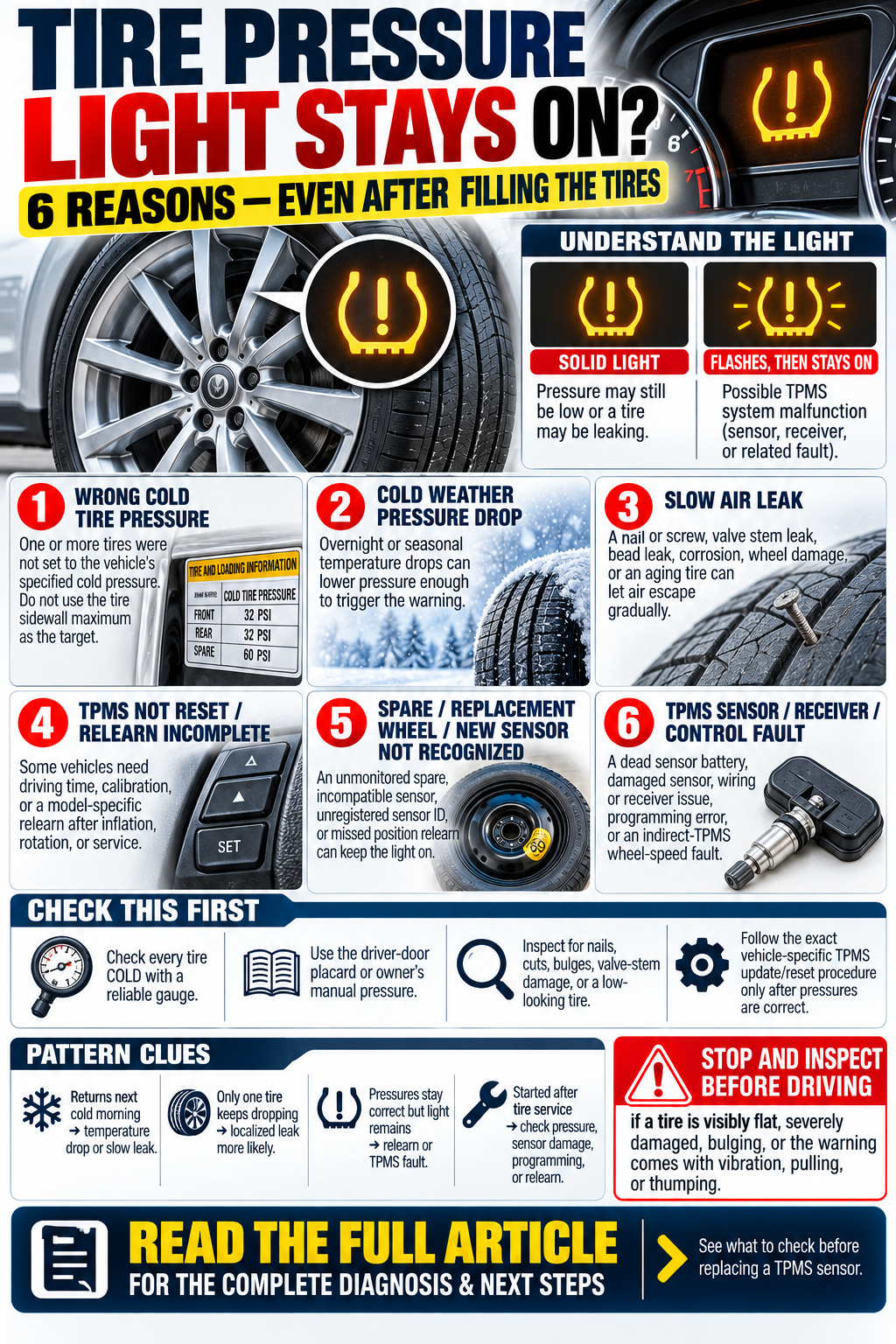
A Solid Warning Light
A light that comes on and remains solid commonly indicates that one or more tires are still underinflated. The pressure may have been set incorrectly, measured while the tires were warm, or lost again through a leak.
Some vehicles can also warn about overinflation or display a separate pressure message. Refer to the owner’s manual and individual tire-pressure display, if equipped.
A Flashing Light That Becomes Solid
On many U.S.-market vehicles, a TPMS symbol that flashes for approximately one minute at startup and then remains illuminated indicates a system malfunction rather than an ordinary low-pressure warning.
Possible explanations include an unrecognized sensor, dead sensor battery, damaged sensor, incompatible replacement wheel, missing communication, or system fault. When this happens, TPMS may not reliably warn the driver if a tire later becomes underinflated.
A Brief Startup Light
The symbol may illuminate briefly during the normal dashboard self-test and then switch off. This is generally normal if it does not remain on or begin a malfunction flashing sequence.
| Warning Pattern | What It May Mean | What to Check First |
|---|---|---|
| Light stays solid | A tire may still be underinflated or losing air | Measure every tire when cold |
| Light flashes at startup, then stays on | Possible TPMS malfunction | Sensor communication, IDs, and system codes |
| Light returns the next cold morning | Temperature-related pressure drop or slow leak | Compare cold readings over several days |
| Light appears after tire service | Pressure, reset, relearn, or sensor problem | Review the tires and procedures affected by the service |
| Light appears with vibration, pulling, or thumping | Major pressure loss or tire damage may exist | Stop safely and inspect before continuing |
| Pressure display shows a dash or no reading | The vehicle may not be receiving that sensor’s signal | Test the affected sensor and verify its ID |
What Should You Do Immediately After Filling the Tires?
Start with the pressure label on the driver’s doorjamb, door edge, fuel door, or another location specified by the manufacturer. The owner’s manual can help if the label is missing or unclear.
Use the vehicle manufacturer’s recommended cold inflation pressure. Do not use the maximum-pressure number molded into the tire sidewall as the routine target. That sidewall figure describes the tire’s limit under specified conditions, not necessarily the pressure selected for your vehicle’s weight and handling.
For the most useful reading, check the tires before driving when they are cold. Tires are commonly considered cold after the vehicle has been parked for several hours or driven only a very short distance at moderate speed.
Measure every road tire with a dependable gauge. Front and rear specifications may differ, so do not assume that all four require the same setting. Check the spare as part of regular maintenance and determine from the owner’s manual whether the vehicle monitors it.
After adjusting the pressures, reinstall the valve caps and look for nails, cuts, bulges, damaged valve stems, or a tire sitting noticeably lower than the others. Do not drive on a visibly flat, severely damaged, or bulging tire.
Next, follow the vehicle-specific TPMS procedure. The warning may go out after several minutes of driving, or the system may require a reset or calibration through a button or dashboard menu. Do not initiate calibration until every tire has been set correctly; otherwise, the system may learn an incorrect baseline.
1. One or More Tires Are Still at the Wrong Pressure
The most straightforward explanation is that the tires were filled—but not to the correct cold specification.
A pressure reading taken immediately after highway driving can be higher because driving generates heat. If a warm tire is adjusted down to the cold placard value, it may become underinflated after cooling. The light can then remain on or return the following morning.
The air pump’s built-in gauge may also be inaccurate. Confirm the final pressure with a separate, dependable gauge instead of relying only on the pump display.
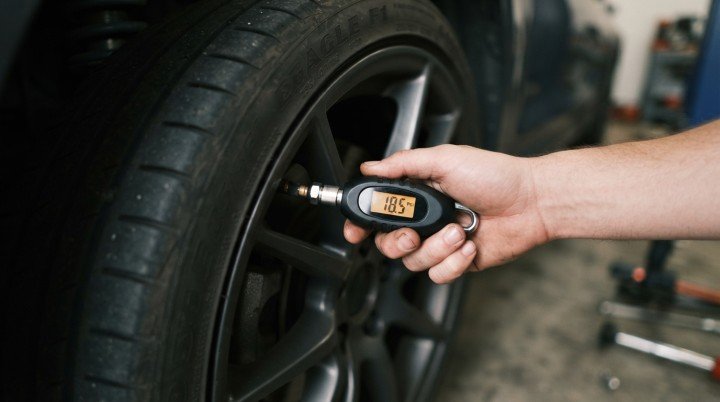
Other common mistakes include using the sidewall maximum, overlooking one tire, applying the front specification to the rear, or stopping as soon as the tire “looks full.” Visual appearance is not an accurate pressure measurement.
If the vehicle displays individual readings, compare them with a manual gauge. The display may update slowly and can differ slightly, but a large or persistent disagreement may point toward a gauge, sensor, or system issue.
Adding excessive air to force the warning off is unsafe. Overinflation can reduce ride comfort and impact absorption, alter the contact patch, and contribute to uneven wear. Use the specified cold pressure rather than guessing above it.
2. Cold Weather Lowered the Pressure Again
Air pressure changes with temperature. When the outside temperature falls overnight or between seasons, a tire that was only slightly above the warning threshold can drop low enough to illuminate the TPMS symbol.
This often creates a recognizable pattern: the warning appears during a cold morning, then goes out after the tires warm while driving. The light may return after the vehicle sits and cools again.
Do not release air simply because the reading rises during a normal drive. Tire-pressure recommendations are generally based on cold measurements, and some increase as the tire warms is expected.

Instead, let the tires cool and adjust them to the door-jamb specification. Recheck them when the weather changes significantly.
Temperature should not become an automatic explanation for recurring pressure loss. If one tire drops faster than the others, needs frequent refilling, or remains low after the weather stabilizes, inspect it for a puncture, valve leak, bead leak, or wheel problem.
The next two tire pressure light on reasons are separated by one simple test: recheck the tires when they are cold.
If a tire has lost pressure again, air is escaping or temperature has changed. If every tire remains at the correct specification but the warning stays on, the system may not have updated or completed its calibration.
3. The Tire Has a Slow Air Leak
Adding air corrects the pressure reading at that moment, but it does not seal the path through which air escaped. A small leak may take hours or days to lower the pressure enough for the warning to return.
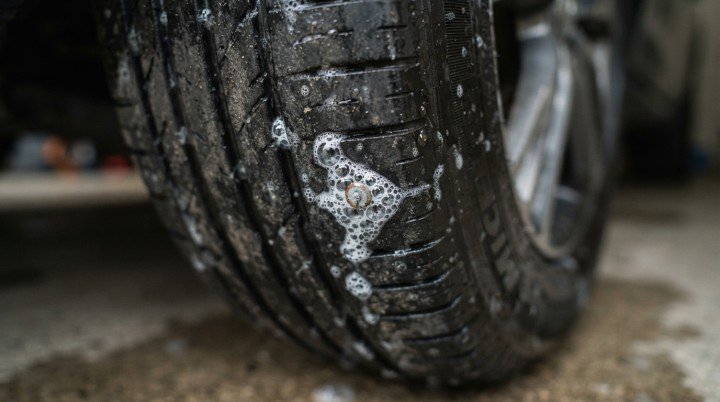
A nail or screw in the tread is a common cause, but the leak may be too small to produce audible hissing. Leaving the object in place does not make the tire safe; removing it without being prepared for rapid air loss can make the situation worse. Have the tire inspected and repaired according to professional tire-repair standards.
Air can also escape through the valve assembly. A loose or damaged valve core may leak from the center of the stem. Cracked rubber, corrosion, physical damage, or a deteriorated TPMS sensor seal can allow air to escape around the base.
The tire bead—the area where the tire seals against the wheel—can develop a leak because of corrosion, debris, improper installation, or damage. A bent or cracked wheel may create a similar problem, particularly after the vehicle hits a pothole, curb, or road hazard.
Other potential leak points include:
- A previous puncture repair
- Damage around the tread or shoulder
- Cracks caused by tire age
- A damaged TPMS valve-stem seal
- Corrosion on the wheel’s sealing surface
- An impact-damaged wheel or tire
A soap-and-water solution may reveal bubbles at an accessible leak point, but it cannot confirm that the tire is structurally safe. Some damage is visible only after the tire is removed from the wheel. A puncture’s location, size, angle, and internal damage determine whether professional repair is possible.
Sidewall damage, a bulge, exposed cords, severe cracking, rapid pressure loss, or evidence that the tire was driven while nearly flat may require replacement instead of repair. Do not continue driving on a tire with these signs.
Why Does My Tire Pressure Light Keep Coming Back?
Record each tire’s cold pressure rather than repeatedly adding air without tracking the result. Write down the readings before inflation, after correction, and again the following morning or after the period recommended by a technician.
The pattern can reveal useful information:
- If every tire drops by a similar small amount after a major temperature decrease, weather may be responsible.
- If only one tire loses pressure, a localized leak is more likely.
- If a tire loses several PSI quickly, avoid driving until it is inspected.
- If pressures remain stable but the light stays on, investigate calibration or a TPMS malfunction.
- If the dashboard identifies different tires at different times, sensor position data or a recent rotation may need attention.
Natural air loss occurs gradually, but frequent refilling should not be considered routine. A tire that repeatedly triggers the warning needs leak testing.
Do not depend only on the dashboard’s individual pressure display. Confirm readings with a reliable gauge because the display may update slowly, show rounded values, or stop receiving data from a sensor.
4. The TPMS Has Not Reset or Completed Its Relearn
Correct pressure does not always make the warning disappear immediately. The next step depends on whether the vehicle uses direct pressure sensors or an indirect wheel-speed-based system.
Some direct systems recognize the corrected pressure automatically after receiving new sensor transmissions. The vehicle may need to travel above a certain speed for a specified period before the receiver updates each wheel.
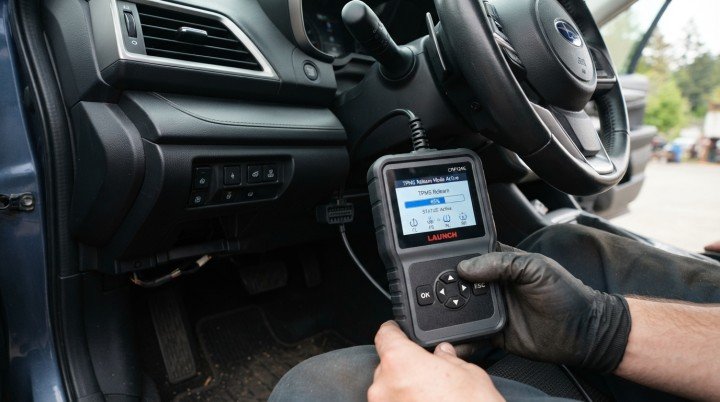
Other direct systems require a relearn procedure after sensor replacement, wheel replacement, or tire rotation. Relearning allows the control module to recognize sensor identification numbers or associate each sensor with its wheel position.
An indirect system may require calibration after pressure adjustment, rotation, or tire replacement. Calibration establishes a new reference condition from wheel-speed data. The vehicle then learns normal tire behavior during subsequent driving.
Depending on the vehicle, calibration may begin through:
- A dedicated TPMS button
- The instrument-cluster menu
- The infotainment display
- A scan tool
- A model-specific sequence involving the ignition or controls
Do not copy a reset procedure from a different make or model. Even vehicles from the same manufacturer may use different TPMS designs.
More importantly, do not reset or initialize the system until every tire has been adjusted to the correct cold pressure. An indirect system may learn an underinflated condition as its new baseline, reducing the usefulness of future warnings.
A reset does not repair a puncture, leaking valve, damaged sensor, or dead sensor battery. If the warning returns after a correct procedure, diagnose the underlying condition rather than resetting it repeatedly.
How Long Does It Take for the Tire Pressure Light to Go Off?
There is no universal time or distance. On some vehicles, the light turns off soon after the correct pressure is detected. Others require several minutes or miles of driving. An indirect system may need a longer period of cumulative driving to complete calibration.
The required speed, distance, time, road condition, and button or menu procedure vary by vehicle. Follow the owner’s manual instead of relying on a generic “drive for ten minutes” rule.
If the manual says the system updates automatically, drive under the specified conditions and observe the warning. If the vehicle requires initialization, complete the procedure exactly as written.
Afterward, allow the tires to cool and measure them again. If the light remains solid, confirm that no tire is below specification. If it flashes at startup and then stays on, treat it as a possible system malfunction rather than performing repeated inflation attempts.
| What Happens After Filling? | Possible Explanation | Best Next Check |
|---|---|---|
| Light turns off after driving | The system received updated information normally | Continue monthly cold-pressure checks |
| Light remains solid | Incorrect pressure, unresolved leak, or incomplete update | Verify every cold reading and the manual procedure |
| Light goes off but returns overnight | Temperature change or slow air loss | Compare next-morning pressures tire by tire |
| Light flashes at every startup | Sensor or system malfunction may be present | Test the TPMS instead of repeatedly adding air |
| One pressure reading is missing | The vehicle may not be receiving that sensor | Activate the sensor and verify its registration |
| Light started after rotation or tire replacement | Calibration, position relearn, or service-related fault | Review the correct post-service procedure |
5. A Spare, Replacement Wheel, or New Sensor Is Not Recognized
A direct TPMS identifies sensors by unique electronic ID numbers. If a sensor or complete wheel is replaced, the vehicle may need to learn the new ID before it can receive and display that tire’s pressure correctly.
Some vehicles learn new sensors automatically while driving. Others require a TPMS activation tool, scan tool, dashboard procedure, or prescribed sequence involving each wheel. Installing a compatible sensor does not guarantee that registration has been completed.
A seasonal wheel set can create the same issue. Winter or aftermarket wheels may have no sensors, incompatible sensors, or sensors that have not been registered with the vehicle. Even when two sensors operate at the same radio frequency, their protocol may not be compatible.
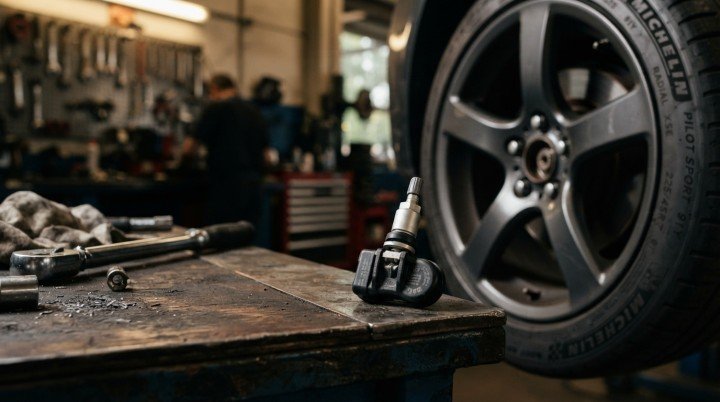
A compact spare can also trigger the warning. Many spare tires do not contain a TPMS sensor, although the design varies. If the original road wheel is removed and replaced with an unmonitored spare, the system may flash and then remain illuminated because it can no longer receive all expected signals.
Some vehicles store only one set of sensor IDs, while others can store multiple wheel sets. The correct set may need to be selected after changing seasonal wheels.
Why Is the TPMS Light On After New Tires or Tire Rotation?
New tires do not automatically mean new sensors. A tire shop may transfer the existing sensor assemblies to the replacement tires, install new sensors, or leave the sensors attached to the original wheels.
Several service-related problems are possible:
- A sensor was damaged during tire removal or installation
- The valve stem, seal, nut, or grommet was installed incorrectly
- A new sensor ID was not registered
- An incompatible replacement sensor was fitted
- Tire positions were not relearned after rotation
- An indirect system was not recalibrated
- The final cold pressures were set incorrectly
Rotation does not always require sensor reprogramming. Some vehicles automatically identify wheel positions, some show only a general warning, and others require position relearning. Follow the procedure for the exact make, model, year, and installed TPMS design.
If the warning began immediately after service, return to the work performed before assuming that an unrelated control module has failed.
6. A TPMS Sensor, Receiver, or Control System Has Failed
Direct TPMS sensors contain electronics, a pressure transducer, a radio transmitter, and usually a sealed internal battery. When that battery becomes weak or depleted, the sensor may stop transmitting or communicate intermittently.
Because the battery is commonly integrated into the sensor, the complete sensor assembly often requires replacement. However, serviceable components and procedures vary by design.
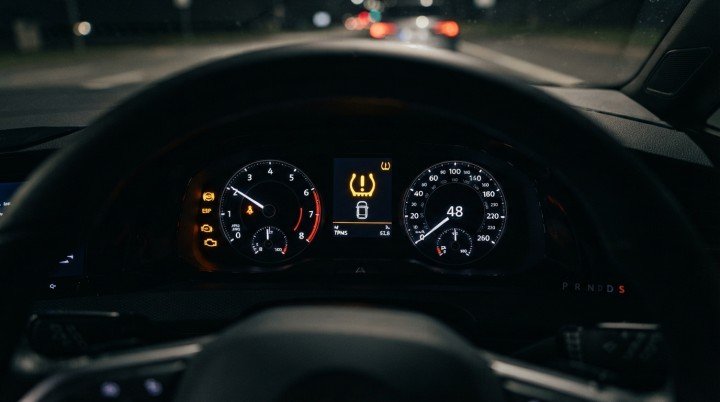
Physical damage can also cause failure. Moisture, corrosion, improper tightening, road impact, incorrect mounting tools, or incompatible seal materials may damage the valve-mounted sensor or create an air leak around it.
The problem may also exist outside the wheel. Possible system-level faults include:
- A damaged antenna or receiver
- Faulty wiring, connector, fuse, power supply, or ground
- A control-module communication problem
- Incorrect sensor programming
- Software or configuration errors
- Temporary radio-frequency interference
- A fault in wheel-speed data on an indirect system
One missing dashboard pressure reading can help identify a sensor that is not communicating, but it does not prove why the signal is missing. The sensor might be asleep, damaged, unregistered, incompatible, out of range, or unable to communicate with the receiver.
A TPMS activation tool can request data from each direct sensor near the wheel. If the tool receives pressure, temperature, battery-status information, and an ID from the sensor but the vehicle does not, registration or vehicle-side communication may be the problem.
Direct vs. Indirect TPMS—Why the Reset Procedure Is Different
| Feature | Direct TPMS | Indirect TPMS |
|---|---|---|
| What it monitors | Pressure measured by an in-wheel sensor | Changes in wheel-speed and tire behavior |
| In-tire sensor battery | Usually present | Not required |
| After sensor replacement | Programming or ID registration may be required | Not applicable to pressure sensors |
| After tire inflation or rotation | May update automatically or require position relearn | Calibration may be required |
| Common electronic problem | Dead, damaged, incompatible, or unregistered sensor | Failed calibration or wheel-speed-related fault |
| Useful diagnostic method | TPMS activation tool, module scan, and ID check | ABS data, tire comparison, and calibration check |
5. A Spare, Replacement Wheel, or New Sensor Is Not Recognized
A TPMS can monitor only the sensors or tire behavior it has been configured to recognize. Installing a compact spare, aftermarket wheel, winter tire set, or replacement sensor may therefore cause the warning to remain on.
Whether the spare tire is monitored depends on the vehicle. Some full-size spares contain pressure sensors, while many compact spares do not. Installing an unmonitored spare may cause the warning to flash or remain illuminated until the repaired full-size wheel is reinstalled and recognized.
A replacement direct-TPMS sensor also has a unique identification number. Depending on the vehicle, that ID may need to be registered with the control module. Installing the sensor without programming or relearning it can leave the system searching for the original sensor.
Compatibility matters as well. The replacement sensor must use the correct radio frequency, protocol, valve configuration, and application. A universal sensor may require programming before installation. A physically compatible sensor that transmits the wrong information may not communicate with the vehicle.
After tire rotation, some systems automatically learn the new wheel positions. Others require a position-relearn procedure so the dashboard displays the correct tire location. A failed position relearn may cause an incorrect tire to be identified or prevent the procedure from completing.
If the light appeared after changing wheels or installing a spare, check:
- Whether the installed wheel contains a compatible sensor
- Whether the sensor was programmed before installation
- Whether its identification number was registered
- Whether the vehicle requires a position relearn
- Whether the correct tire set is selected in the vehicle settings
- Whether the compact spare affects TPMS operation
Do not assume that replacing the tire also means the sensor was replaced. Tire and TPMS sensor service are separate operations.
Why Is the TPMS Light On After New Tires or Tire Rotation?
A warning that begins immediately after tire service often points toward something affected during that work.
The tires may have been inflated to a shop’s standard setting instead of the pressure specified on the vehicle placard. A direct sensor may have been cracked by mounting equipment, or its valve stem, seal, core, nut, or grommet may have been damaged.
An older sensor may also fail shortly after being disturbed, even when the technician did not obviously damage it. If a sensor was replaced, the new unit may not have been programmed or registered correctly.
Vehicles with indirect TPMS usually do not have pressure sensors inside the wheels. However, the system may require recalibration after tire inflation, rotation, or replacement. A difference in tire size, tread depth, or rolling circumference may also prevent normal operation.
Return to the service history before authorizing unrelated repairs. Confirm the tire pressures, parts installed, sensor IDs, calibration procedure, and warning behavior before and after the work.
6. A TPMS Sensor, Receiver, or Control System Has Failed
Direct TPMS sensors are exposed to vibration, heat, moisture, tire-service equipment, and repeated pressure changes. They also commonly contain sealed internal batteries that eventually lose capacity.
When a battery dies, the entire sensor is usually replaced because the battery is not designed to be serviced separately. Sensor life varies, so age alone does not confirm failure. A TPMS activation tool can determine whether each sensor responds and may display its identification number, pressure, temperature, signal, and battery-status information when supported.
Other direct-system problems include:
- A physically damaged sensor
- A corroded metal valve stem
- A leaking sensor seal or valve core
- An incompatible or incorrectly programmed sensor
- A receiver or antenna problem
- Damaged wiring, fuse, power supply, or ground
- A control-module or software fault
- Temporary radio-frequency interference
Indirect TPMS has no pressure-sensor batteries inside the tires. Its warning may instead result from unsuccessful calibration, mismatched tires, wheel-speed sensor faults, or ABS-related problems.
A flashing-then-solid light should not automatically lead to replacing all four sensors. The malfunction may involve only one sensor, registration data, a receiver, vehicle voltage, or another part of the system. Test every sensor and read the TPMS codes before buying parts.
Direct vs. Indirect TPMS—Why the Reset Procedure Is Different
How to Reset the Tire Pressure Light Safely
Begin with the vehicle parked safely and all tires cold. Set every road tire to the manufacturer’s placard specification and verify the results with an accurate gauge. Check the spare if the owner’s manual says it is monitored.
Next, follow the exact procedure in the owner’s manual. The vehicle may update automatically while driving, provide a calibration option in the dashboard menu, use a dedicated TPMS button, or require a scan or relearn tool.
Do not use a random online reset procedure intended for another model. Do not disconnect the battery simply to erase the light. Battery disconnection may remove useful diagnostic information and reset unrelated vehicle settings without repairing the fault.
Never initialize an indirect system while a tire is underinflated. Doing so may teach the system that the incorrect pressure and rolling condition are normal.
If calibration repeatedly fails or the light flashes before staying on, stop resetting it and diagnose the system.
Can You Drive With the Tire Pressure Light On?
First, slow down smoothly and find a safe place to inspect the tires. Do not continue driving if a tire is visibly flat, rapidly losing air, bulging, cut, separating, or producing vibration, pulling, thumping, or unusual handling.
If no obvious damage is visible, check every tire with a gauge. A tire can be dangerously underinflated without looking flat.
If the light is solid and the tires can be restored to the correct pressure, follow the owner’s manual and monitor them closely. If one tire loses air again, have it inspected rather than repeatedly refilling it.
If the light flashes and then stays on, the monitoring system may not function correctly. The tires may still be physically safe if their pressures and condition are verified, but you should not depend on TPMS to warn you of future pressure loss. Check pressures manually and arrange system diagnosis.
Follow any distance or speed restrictions for a compact spare or run-flat tire. TPMS does not override those limits.
How Mechanics Diagnose Tire Pressure Light On Reasons
A technician should begin with the tires rather than the dashboard electronics. Every cold pressure is measured with an accurate gauge and compared with the vehicle placard. The tires, valves, beads, wheels, and previous repairs are then checked for leakage or damage.
For a direct system, a TPMS activation tool can communicate with each sensor. This helps identify a missing transmission, incompatible sensor, incorrect ID, or possible low sensor battery. The registered IDs are compared with the sensors installed on the vehicle.
TPMS module codes may then be read with a compatible scan tool. A basic engine-code reader may not access this system. The receiver, antennas, fuses, voltage supply, grounds, wiring, and software may require testing if all wheel sensors respond correctly.
For an indirect system, the technician checks tire size, pressure, tread differences, ABS wheel-speed data, and calibration status. A wheel-speed sensor or ABS fault may prevent the system from learning or monitoring the tires properly.
Diagnosis should answer three separate questions:
- Are the tires physically safe and holding pressure?
- Is every required sensor or wheel signal available?
- Has the vehicle learned the correct tire condition and sensor information?
Frequently Asked Questions
Why is my tire pressure light on when all tires are fine?
The tires may have been measured while warm, the gauge may be inaccurate, the spare may be low, or the system may not have updated. A flashing-then-solid light can indicate a TPMS malfunction even when the pressures are correct.
Does the spare tire have a TPMS sensor?
It depends on the vehicle and spare type. Some full-size spares are monitored, while many compact spares are not. Check the owner’s manual rather than assuming either way.
Can cold weather keep the TPMS light on?
Yes. Lower temperature reduces tire pressure and can push a marginal tire below the warning threshold. Adjust the tires when cold, but investigate a leak if one loses pressure faster than the others.
Can I reset the TPMS light without a scanner?
Many vehicles allow automatic updating or dashboard calibration without a scanner. Others need a relearn tool, especially after sensor replacement. Use the model-specific procedure.
Why does the light flash and then stay on?
On many vehicles, this pattern indicates a TPMS malfunction. A sensor may be missing, damaged, unrecognized, or unable to communicate, although receiver, wiring, voltage, or control-system faults are also possible.
Can overinflating the tires turn the warning off?
It might move pressure above a warning threshold, but it is not a safe solution. Adjust each tire to the vehicle’s recommended cold pressure rather than adding excessive air.
Do nitrogen-filled tires prevent the TPMS light?
No. Nitrogen-filled tires can still lose pressure, develop punctures, leak at the valve or bead, and trigger TPMS. They still require regular cold-pressure checks.
How much does TPMS sensor replacement cost?
The cost depends on the vehicle, sensor type, programming requirements, valve hardware, and labor. Confirm which component has failed before replacing multiple sensors unnecessarily.
Final Takeaway
When the TPMS light remains on after inflation, do not begin by resetting it repeatedly. Confirm all cold pressures, use the door-jamb specification, and determine whether the warning is solid or flashes at startup.
If a tire loses pressure again, find the leak. If the pressures remain stable, complete the correct update or calibration procedure. If the light flashes or a wheel reading is missing, test the sensors, IDs, receiver, and control system.
Following this sequence makes the tire pressure light on reasons much easier to separate—and ensures that clearing the dashboard warning never takes priority over confirming that the tires are safe.
Kevin Nicholas is an automotive mechanic and editor of The Effective Guide. He writes about warning lights, car problems, and diagnostic tools, helping drivers understand what to check before replacing a part.