
Last Updated on October 7, 2026
A weak battery often gets blamed when an engine struggles to start. A fuel-system problem may be suspected when acceleration becomes sluggish, while rough idling can make an ignition coil or injector appear guilty. Sometimes those suspicions are correct. But the real problem may be a set of worn or fouled spark plugs.
Spark plugs ignite the air-fuel mixture inside a gasoline engine. When they cannot produce a strong, consistent spark, combustion may become incomplete or irregular. The result can affect starting, idling, acceleration, fuel economy, and emissions.
However, Bad Spark Plugs cannot be confirmed from one symptom alone. Ignition coils, fuel injectors, vacuum leaks, wiring faults, low compression, and fuel-pressure problems can produce similar behavior. The timing and combination of symptoms provide the most useful clues.
This article follows those clues through a normal drive—from starting the engine to waiting at a stoplight.
Quick Answer
Common signs of Bad Spark Plugs include extended cranking, rough idling, engine misfires, hesitation, sluggish acceleration, reduced fuel economy, a check engine light, and occasional stalling. Suspicion becomes stronger when several symptoms appear together and the spark plugs are already near or beyond the vehicle manufacturer’s recommended service interval.
This article focuses on gasoline engines. Diesel engines normally use compression to ignite fuel rather than spark plugs.
What Actually Happens to a Spark Plug?
Spark plugs do not always fail in the same way. Some wear gradually, while others become contaminated or damaged because of another engine problem.
| Spark-plug condition | What changes | Possible result |
|---|---|---|
| Worn electrodes | The gap may widen and require more firing voltage | Misfire under acceleration |
| Carbon fouling | Deposits interfere with the spark | Rough idle or hard starting |
| Oil or fuel fouling | Contamination covers the firing end | Repeated misfires |
| Overheating | Electrodes and insulation deteriorate | Weak or inconsistent ignition |
| Incorrect plug type | Heat range or fitment may be unsuitable | Premature failure |
According to NGK’s technical guidance, carbon fouling, excessive heat, an incorrect gap, and damaged ignition components can all interfere with normal spark-plug operation.
A fouled plug may also be evidence of a deeper fault. Oil deposits can point toward oil entering the combustion chamber, while dry black deposits may accompany an overly rich mixture. Replacing the plug without correcting the cause may allow the new one to foul again.
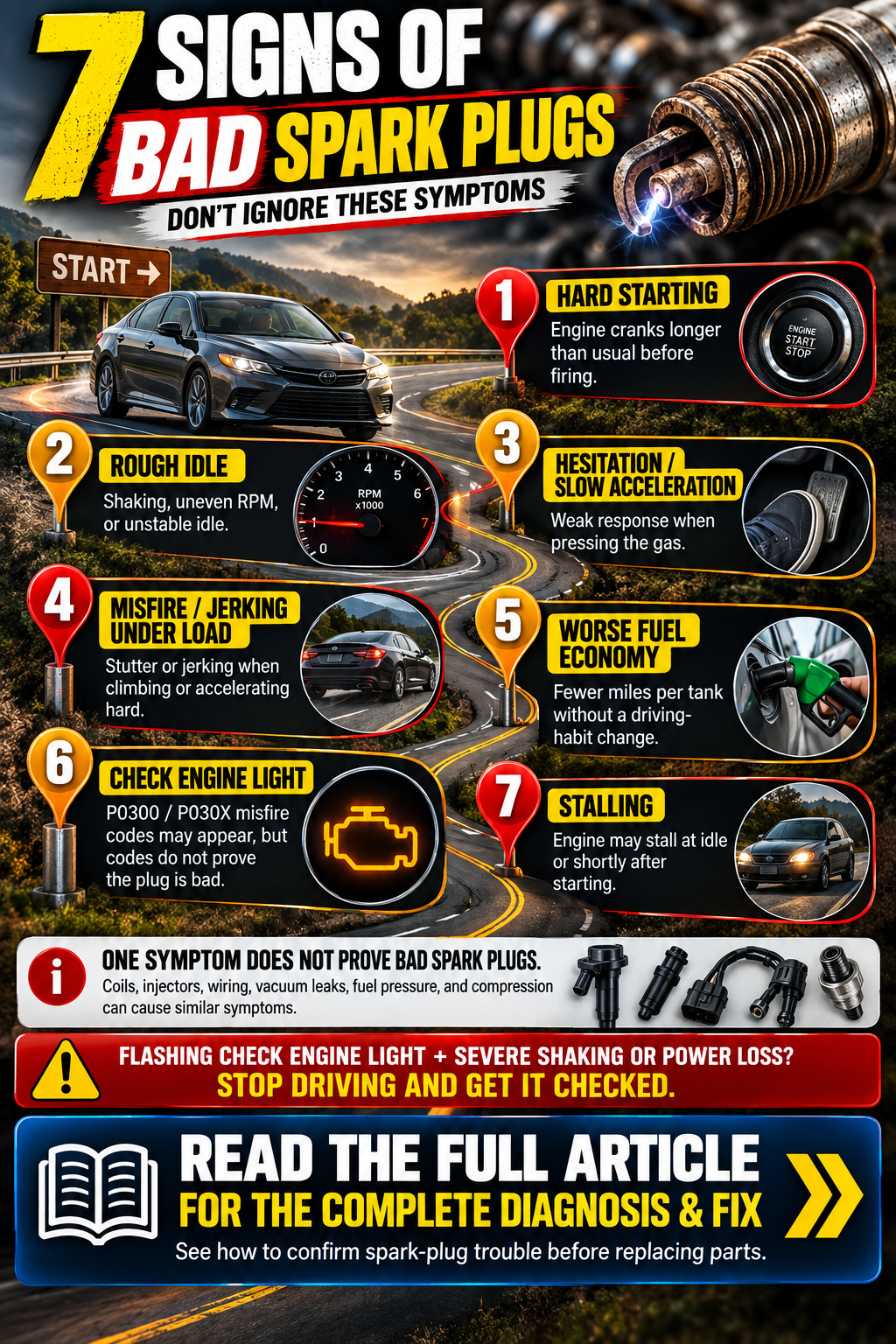
Checkpoint 1: Starting the Engine
The Engine Takes Longer to Start
The first clue may appear before the car moves. The starter turns the engine, but the engine cranks longer than usual before beginning to run. The problem may be more noticeable during a cold start, or the engine may start and then immediately struggle to remain running.
Worn or contaminated plugs may not consistently ignite the mixture during cranking. When several cylinders receive weak or irregular sparks, the engine can require more attempts to start.

The distinction between “no-crank” and “cranks but will not start” is important. If the engine does not turn and you only hear clicking—or the electrical system appears weak—the battery, starter, cables, or another electrical fault is more likely. Spark plugs become a stronger possibility when the engine turns normally but struggles to fire.
Hard starting still does not prove the plugs are responsible. Fuel delivery, ignition coils, sensors, compression, and incorrect air-fuel mixture must also be considered.
Checkpoint 2: Waiting at Idle
The Engine Idles Roughly or Shakes
After the engine starts, let its behavior at idle provide the next clue. A healthy engine should maintain a reasonably steady speed. If the vehicle begins shaking, the RPM fluctuates, or the exhaust note sounds uneven while you are stopped, one or more cylinders may not be contributing consistently.
A worn or fouled plug can miss individual combustion events. At higher engine speeds, the other cylinders may partially hide this imbalance. At idle, each missed event is easier to feel through the steering wheel, seat, or body of the vehicle. Rough idling and vibration are also listed among the common symptoms in Champion’s spark-plug guidance.
Still, rough idle is a shared symptom. A failing ignition coil, injector imbalance, vacuum leak, throttle-control issue, damaged engine mount, or low cylinder compression may create a similar sensation. The case for a spark-plug problem becomes stronger when rough idle appears alongside hard starting, hesitation, or a cylinder-specific misfire.
Checkpoint 3: Pulling Away
The Car Hesitates or Accelerates Slowly
The next clue may appear when you press the accelerator. Instead of responding immediately, the car may hesitate, feel unusually heavy, or take longer to gain speed. The loss of performance may begin gradually, making it easy to overlook.
Acceleration increases pressure inside the cylinders and raises the ignition system’s workload. Worn electrodes or an enlarged plug gap may require more voltage than the ignition system can reliably deliver. As a result, Bad Spark Plugs may perform acceptably at idle but struggle when the engine is placed under load.

Sluggish acceleration is not exclusive to spark plugs. A weak fuel pump, dirty fuel injector, airflow-sensor fault, restricted catalytic converter, or transmission problem may create a similar feeling. Spark plugs become more suspicious when hesitation occurs alongside rough idle, hard starting, or overdue maintenance.
Checkpoint 4: Accelerating Under Load
The Engine Misfires, Stutters, or Jerks
An engine misfire is one of the strongest spark-plug clues. You may feel a brief stutter, repeated jerking, or an interruption in power while merging onto a highway, climbing a hill, or accelerating harder than usual.
A plug that fails to ignite its cylinder at the correct moment interrupts the combustion cycle. If the failure occurs repeatedly, the engine may shake and its power delivery may feel uneven. The symptom can become more noticeable under load because firing the plug becomes more difficult as cylinder pressure rises.
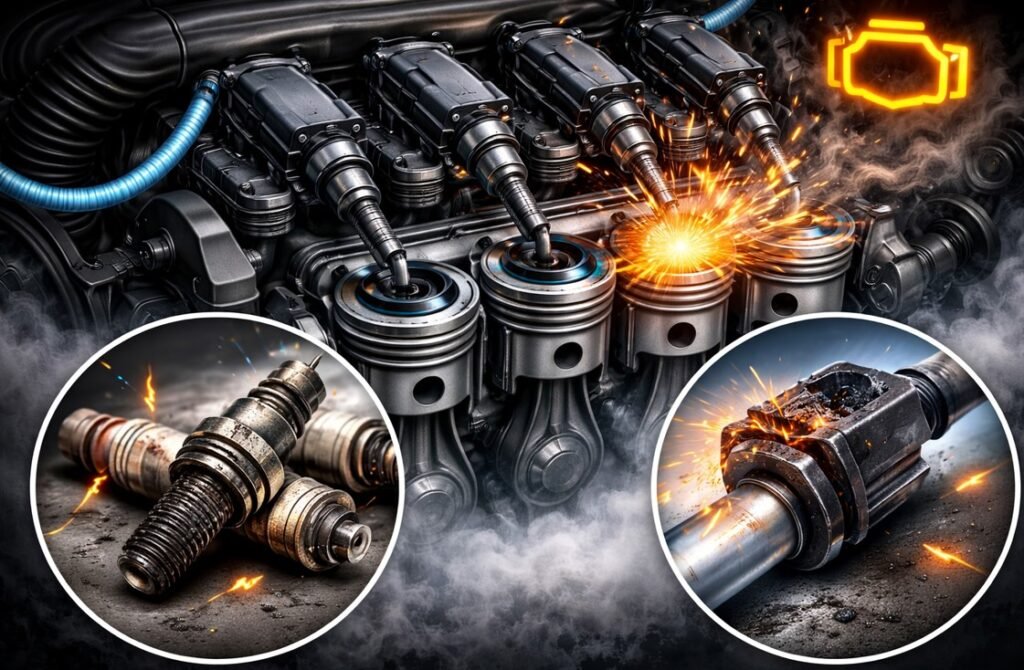
However, a misfire identifies a combustion problem—not the failed component. Ignition coils, plug wires or boots, injectors, wiring faults, vacuum leaks, and low compression can all cause misfires. Proper testing is necessary before replacing parts.
Checkpoint 5: Watching the Fuel Gauge
Fuel Economy Becomes Worse
You may notice that the car travels fewer miles between fill-ups even though your route and driving habits have not changed. Worn or fouled plugs can contribute to inefficient combustion, reducing the amount of useful power produced from the fuel entering the engine.
Poor fuel economy by itself is weak evidence. Tire pressure, traffic, cold weather, frequent short trips, air-fuel sensor faults, and fuel-system problems can also increase consumption. Compare mileage over several normal fill-ups instead of relying on one unusually short trip.
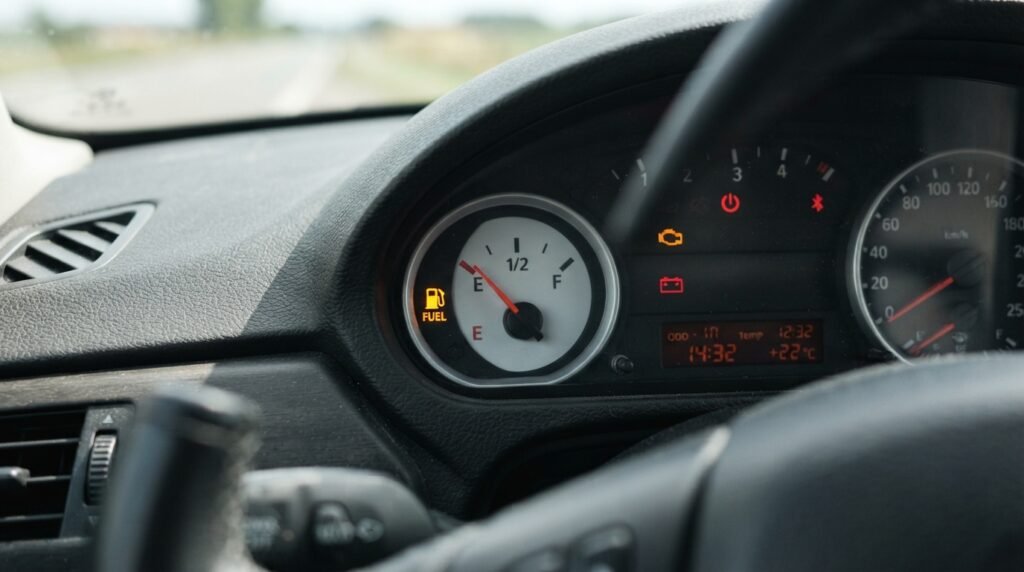
A fuel-economy drop becomes more meaningful when it appears with misfires, hesitation, rough idle, or a recent change in engine performance.
Checkpoint 6: Reading the Dashboard
The Check Engine Light Comes On
A misfire caused by Bad Spark Plugs may trigger the check engine light. A diagnostic scan might reveal P0300 for random or multiple-cylinder misfires, or a cylinder-specific code such as P0301, P0302, or another P030X code.
These codes do not prove that a spark plug has failed. They identify where or how the engine is misfiring. The plug, ignition coil, injector, wiring, air-fuel mixture, and compression may all need to be evaluated.

The behavior of the warning light also matters. A steady light generally means the car needs diagnosis soon. A flashing check engine light often accompanies a severe active misfire. If the vehicle is shaking heavily or losing substantial power, avoid continuing the trip and arrange prompt professional service because prolonged misfiring can damage the catalytic converter.
Checkpoint 7: Slowing Down or Stopping
The Engine Stalls at Idle or Shortly After Starting
The final clue may appear as the engine returns to idle. RPM can fall too low when you stop at an intersection, or the engine may shut off shortly after starting. It might restart normally, only to stall again when the vehicle slows down.
If several plugs are firing inconsistently, the engine may not produce enough stable combustion to maintain idle speed. One severely misfiring cylinder can also make a smaller engine more likely to stall.

Stalling still requires a broader diagnosis. Vacuum leaks, throttle-control faults, crankshaft or camshaft sensor problems, weak fuel pressure, and charging-system issues can produce the same symptom. If the car repeatedly stalls in traffic, stop driving it until the cause is identified, since an unexpected stall can reduce steering and braking assistance.
Reading the Seven Checkpoints Together
One symptom rarely confirms the diagnosis. The more convincing pattern is hard starting followed by rough idle, hesitation under load, a cylinder-specific misfire, and a maintenance history showing that the plugs are overdue.
How Are Bad Spark Plugs Properly Diagnosed?
Diagnosis should begin with the vehicle’s maintenance history and the manufacturer’s recommended replacement interval. A technician can then review trouble codes, freeze-frame data, and cylinder misfire counts to identify when and where the problem occurs.
A P030X code identifies a misfiring cylinder, but it does not identify the failed component. The spark plug must be evaluated alongside its ignition coil or wire, injector operation, wiring, and cylinder compression.
The plug’s condition can provide additional evidence. Worn electrodes suggest normal service-life deterioration, while carbon, oil, or fuel deposits may reveal another engine problem. Cracks, overheating, or an incorrect plug type can also explain premature failure.
Cleaning or Replacement: Which Makes Sense?
Cleaning may remove light deposits in limited situations, but it cannot restore an eroded electrode, repair damaged insulation, or correct an enlarged gap caused by wear. For modern vehicles, confirmed worn or damaged plugs are normally replaced with the exact specification recommended for the engine.
If Bad Spark Plugs are contaminated by oil, excessive fuel, or recurring carbon buildup, the underlying cause must also be corrected. Otherwise, replacement plugs may develop the same problem.
Spark-plug installation requires the correct part, gap requirements, and tightening specification. Incorrect installation can damage the plug or cylinder-head threads, so professional service is sensible when access or specifications are uncertain.
Can You Drive With Bad Spark Plugs?
A vehicle with mild symptoms may continue running, but delaying diagnosis can worsen fuel economy and place additional strain on the ignition and emissions systems.
Do not continue driving normally if the check engine light flashes, the engine shakes severely, power drops substantially, or the vehicle repeatedly stalls. Arrange prompt professional diagnosis, as an active misfire can damage the catalytic converter and make the vehicle unsafe in traffic.
Frequently Asked Questions
Can Bad Spark Plugs cause a no-start?
Yes, especially if several plugs cannot ignite the mixture. However, if the engine does not crank at all, investigate the battery, starter, cables, and electrical system first.
Should all spark plugs be replaced together?
They are commonly serviced as a complete set because they usually have similar age and wear. The correct decision depends on the engine design, maintenance history, and inspection results.
How long do spark plugs last?
There is no reliable universal interval. Plug material, engine design, and manufacturer requirements differ, so follow the schedule in the vehicle owner’s manual.
Final Thoughts
Bad Spark Plugs can reveal themselves during starting, idling, acceleration, cruising, or stopping. The seven main clues are hard starting, rough idle, hesitation, misfires, poor fuel economy, a check engine light, and stalling.
These symptoms are warnings rather than proof. Confirm the affected cylinder, rule out coils, injectors, wiring, and compression faults, and determine why the plug failed before approving replacement. That approach prevents unnecessary parts replacement and reduces the chance of the same problem returning.
Kevin Nicholas is an automotive mechanic and editor of The Effective Guide. He writes about warning lights, car problems, and diagnostic tools, helping drivers understand what to check before replacing a part.