
Last Updated on October 7, 2026
A dark cloud from the tailpipe is more than an unpleasant emission. It usually means the engine is receiving too much fuel, not enough air, or failing to burn the mixture completely. Understanding black smoke from exhaust causes begins with one important clue: exactly when does the smoke appear?
Smoke that occurs only during hard acceleration does not point in precisely the same direction as smoke that continues at warm idle. A puff at startup creates another diagnostic path. Before replacing an injector, sensor, or turbocharger, observe the smoke pattern and note any accompanying symptoms.
A gasoline engine should not produce persistent black exhaust smoke. Older diesel engines may occasionally produce a brief haze under a sudden load, but thick or recurring smoke—especially from a modern diesel with functioning emissions controls—deserves investigation.
Ignoring the condition can lead to poor fuel economy, reduced performance, fouled spark plugs, contaminated sensors, and damage to the catalytic converter or diesel aftertreatment system. If the vehicle produces heavy continuous smoke along with a flashing check engine light, severe misfiring, overheating, major power loss, or a strong raw-fuel smell, stop driving when it is safe and arrange an inspection.
Black Smoke From Exhaust Causes: What Does the Smoke Mean?
Black smoke is generally produced when some of the fuel entering the engine does not burn completely. The resulting carbon and soot leave through the exhaust as a dark cloud.
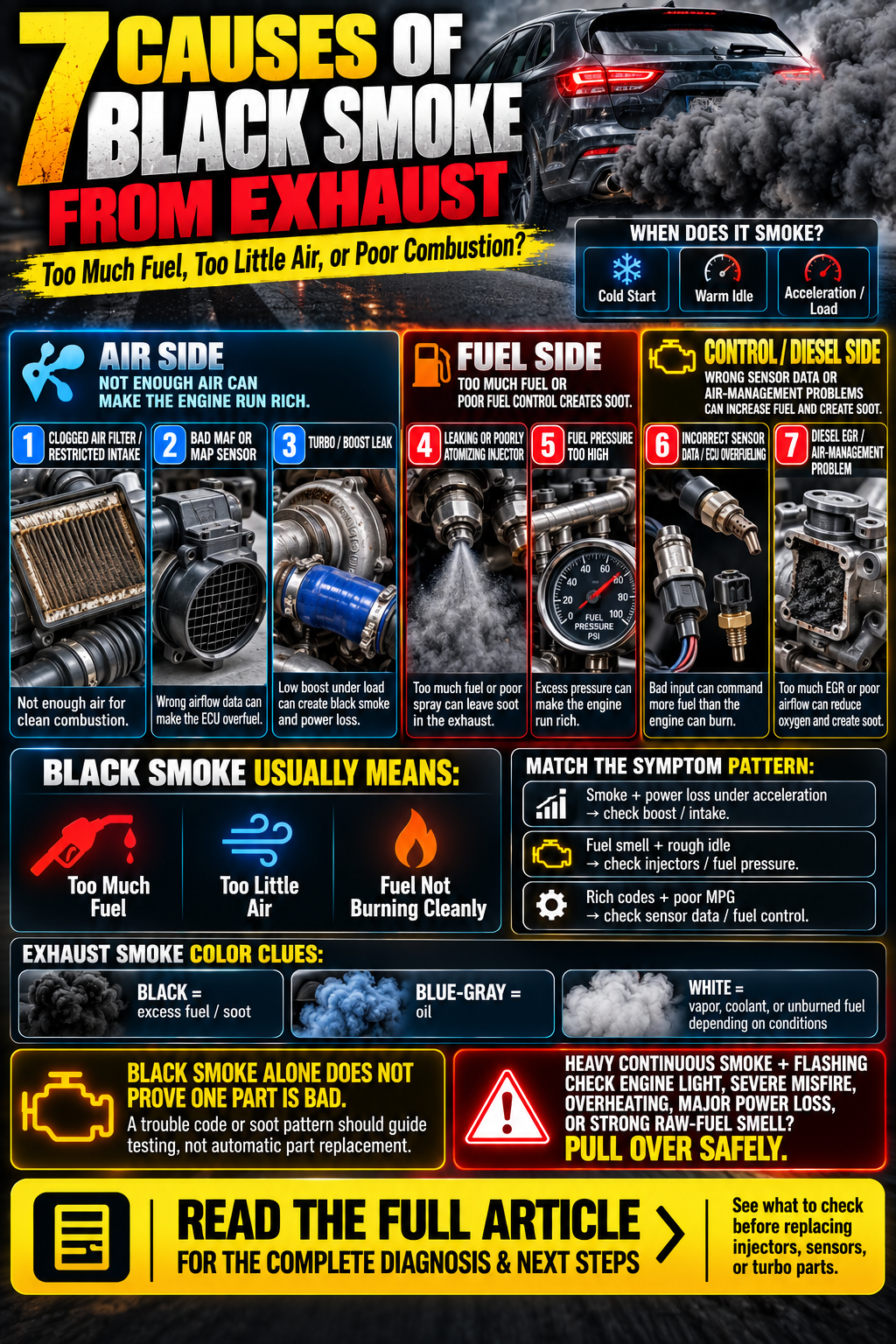
Mechanics often describe the condition as “running rich,” but excessive fuel is only half of the equation. The engine may be receiving the correct quantity of fuel while failing to receive enough air. Poor atomization can also prevent fuel from mixing and burning correctly.
The basic diagnostic possibilities are therefore:
- Too much fuel is entering the cylinders
- Too little air is reaching the engine
- Fuel is not being sprayed or burned efficiently
- Sensor information is causing the ECU to command incorrect fueling
The smoke color should also be confirmed before diagnosis begins. Blue or blue-gray smoke usually points more toward burning engine oil. Persistent white smoke or vapor may involve coolant, unburned fuel, condensation, or a cold-combustion problem, depending on the engine and circumstances.
Why Does My Car Blow Black Smoke When Accelerating?
Acceleration demands more fuel and airflow. On a turbocharged engine, it also requires the intake and charge-air system to build pressure quickly. A restriction, leak, or fuel-delivery problem that is difficult to notice at idle may become obvious as soon as the engine is placed under load.
Black smoke during acceleration may direct attention toward a restricted air filter, collapsed intake duct, split intercooler hose, inadequate turbo boost, or poorly atomizing injector. It may also occur when sensor data causes the ECU to deliver more fuel than the available air can burn.
Do not deliberately lug the engine or repeatedly accelerate to reproduce thick smoke. Record when the symptom occurs during normal operation and use scan data or a qualified technician to test it safely.
Use the Timing of the Smoke as Your First Diagnostic Filter
Different black smoke from exhaust causes become more likely depending on whether the engine is cold, warm, idling, or under load.
| When the Smoke Appears | Useful Diagnostic Direction | Other Clues to Notice |
|---|---|---|
| Immediately after a cold start | Leaking injector, incorrect temperature input, or excessive cold enrichment | Hard starting, rough running, or fuel odor |
| At warm idle | Injector leak, excessive fuel pressure, or incorrect sensor input | Uneven idle, poor MPG, or rich-condition codes |
| During acceleration | Restricted intake, boost leak, turbo problem, or injector fault | Power loss, hissing, whistling, or underboost code |
| Continuously while driving | Significant air-fuel control, fuel-delivery, or diesel air-management fault | Heavy fuel use, warning lights, and poor performance |
| After recent engine work | Loose intake hose, disconnected sensor, wiring issue, or incorrect installation | New codes or symptoms that began immediately after the repair |
This table provides a starting direction, not a final diagnosis. More than one failure can create the same smoke pattern.
The Air Side: When the Engine Cannot Breathe Properly
Cause 1: A Clogged Air Filter or Restricted Intake
An engine needs unrestricted airflow to burn its fuel efficiently. A heavily contaminated air filter, blocked airbox inlet, collapsed duct, or foreign material inside the intake can reduce the available oxygen.
The problem may be most noticeable during acceleration because airflow demand rises sharply. The vehicle may feel sluggish while producing a darker exhaust cloud under load.
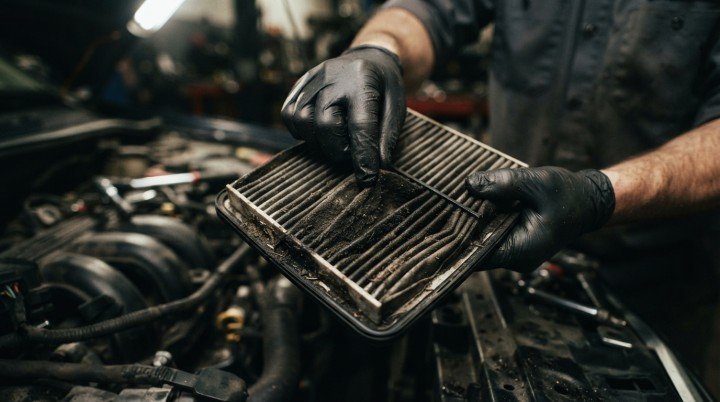
However, a dirty-looking filter is not proof that it caused the smoke. Modern gasoline engines can compensate for moderate restriction by measuring the reduced airflow and adjusting fuel delivery. A severe restriction—or a restriction combined with incorrect sensor data—is more likely to create visible black smoke. Diesel engines may show the effect more clearly when airflow becomes insufficient under load.
Inspect the entire intake path instead of replacing the filter and ending the diagnosis. Look for blocked openings, damaged ducts, loose connections, and anything that may be limiting airflow.
Cause 2: A Dirty or Faulty MAF/MAP Sensor
The mass airflow sensor measures incoming air on vehicles that use one, while the manifold absolute pressure sensor helps the ECU estimate engine load and airflow conditions. Incorrect information from either sensor can disrupt the fueling calculation.
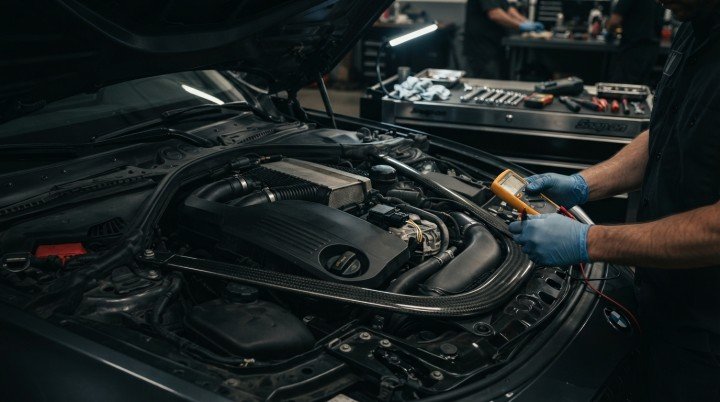
If a MAF sensor overreports airflow, or a MAP reading incorrectly suggests a heavier load, the ECU may command more fuel than the engine can burn cleanly. Wiring faults,
Follow the Air and Fuel Path to Find the Cause
Once the air filter, intake path, MAF sensor, and MAP sensor have been considered, the investigation should continue through the pressurized-air and fuel-delivery systems. The remaining black smoke from exhaust causes usually involve either a shortage of usable air, excessive fuel entering the cylinders, or inaccurate information causing the ECU to command the wrong mixture.
The timing of the smoke still matters. Smoke that appears mainly under acceleration points in a different direction from smoke that continues at warm idle.
Cause 3: A Turbocharger Problem or Boost Leak
On a turbocharged engine, the turbocharger compresses intake air so the engine can burn more fuel efficiently. If the engine does not receive the expected boost, there may not be enough oxygen to burn the commanded fuel completely.
This problem is especially relevant when a diesel vehicle produces black smoke during acceleration and simultaneously loses power.
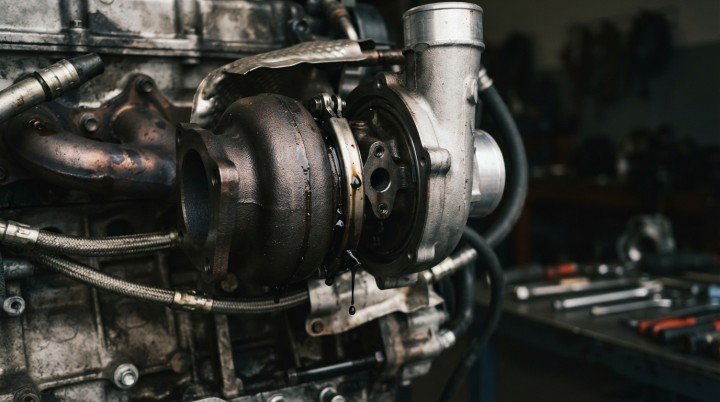
The turbocharger itself is not always responsible. Pressurized air can escape through:
- A split intercooler hose
- A loose charge-pipe clamp
- A cracked intercooler
- A damaged intake connection
- A leaking turbo outlet hose
You may hear a hiss or unusual rushing-air noise when accelerating. The vehicle may also store an underboost code or enter reduced-power mode.
Do not replace the turbocharger based on smoke alone. A technician should first inspect the charge-air system, review commanded versus actual boost, and test for leaks. A relatively inexpensive damaged hose can produce symptoms that resemble an expensive turbo failure.
Cause 4: A Leaking or Poorly Atomizing Fuel Injector
Fuel injectors must deliver a carefully measured amount of fuel in a controlled spray pattern. An injector can create black smoke in more than one way.
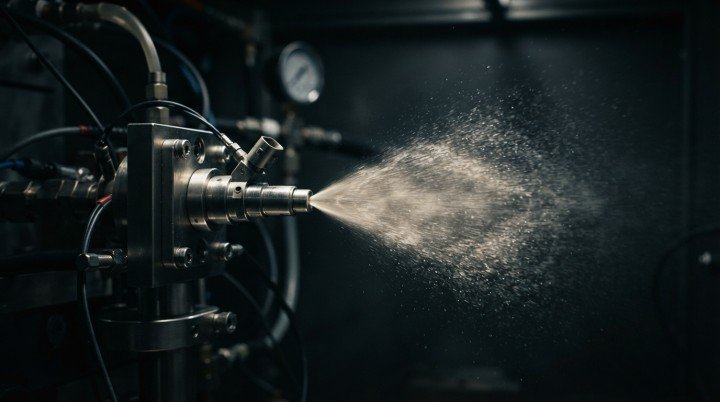
A leaking or stuck injector may allow too much fuel into a cylinder. An injector with a poor spray pattern may deliver droplets that do not mix and burn as efficiently as a fine mist. Both conditions can leave unburned carbon that exits as dark exhaust smoke.
Possible accompanying symptoms include:
- Rough idle
- Fuel odor
- Hard starting
- Misfire
- Reduced fuel economy
- Engine knock or abnormal diesel combustion noise
- Oil contaminated or diluted by fuel
Smoke at startup after the vehicle has been parked may raise suspicion of a leaking injector, while smoke under load may point toward an injector that cannot deliver fuel correctly at higher demand. These patterns provide direction but do not prove injector failure.
Injector cleaner may help with certain deposits, but it cannot repair an electrically failed, mechanically damaged, or internally leaking injector. Proper diagnosis may require a balance test, leak-down test, return-flow test, pressure analysis, or another manufacturer-specified procedure.
Cause 5: Excessive Fuel Pressure
Even properly functioning injectors can deliver too much fuel if system pressure is higher than commanded. The exact pressure-control design varies significantly between gasoline direct injection, port injection, and common-rail diesel systems.
Possible sources include a faulty pressure regulator, incorrect rail-pressure control, a restricted return circuit on applicable systems, a control-solenoid problem, or inaccurate pressure-sensor information.
High fuel pressure may be accompanied by:
- Rich-running codes
- Poor fuel economy
- Difficult starting
- Fuel-fouled spark plugs
- Rough operation
- Strong exhaust odor
- Black smoke at idle or during acceleration
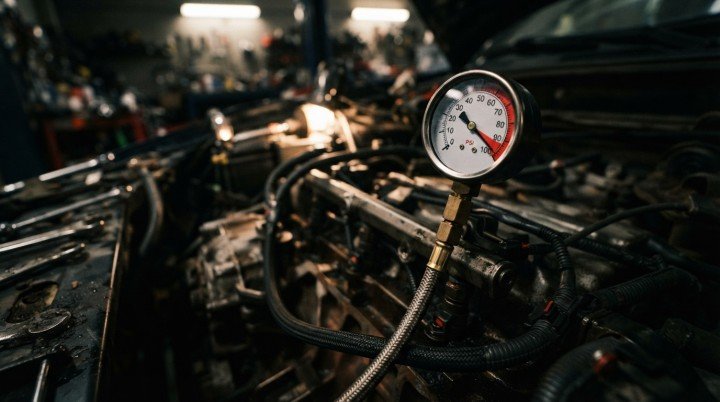
Fuel pressure should be measured and compared with vehicle-specific specifications. Replacing the regulator simply because the engine appears to be running rich can miss an electrical, sensor, pump-control, or injector problem.
Cause 6: Incorrect Sensor Data Is Making the ECU Add Too Much Fuel
The ECU calculates fuel delivery using information from multiple sensors. If one of those inputs is inaccurate, the ECU may command more fuel than the engine can burn.
Can a Bad O2 Sensor Cause Black Smoke?
A faulty oxygen sensor or air-fuel-ratio sensor can contribute to black smoke if its feedback causes the ECU to enrich the mixture incorrectly. However, an O2-sensor code does not automatically mean the sensor itself has failed.
A wiring problem, exhaust leak, injector fault, fuel-pressure problem, or another rich-running condition can affect the sensor reading. The sensor may simply be reporting the problem rather than causing it.
Engine coolant temperature is another important input. If the ECU incorrectly sees a fully warmed engine as extremely cold, it may continue commanding cold-start enrichment. This can increase fuel consumption, create rough running, and potentially produce dark exhaust.
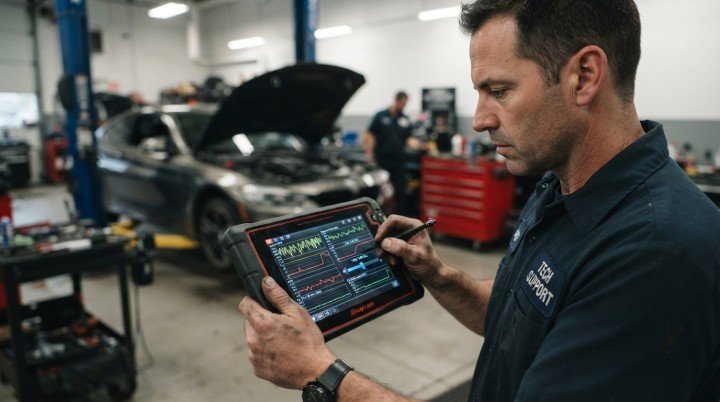
Diagnosis should include code status, freeze-frame information, coolant temperature plausibility, fuel trims, sensor response, wiring condition, and relevant service specifications.
Cause 7: A Diesel EGR or Air-Management Problem
A diesel engine relies on coordinated control of fresh air, exhaust-gas recirculation, boost pressure, and fuel injection. A fault in this system can leave insufficient oxygen available for clean combustion.
An EGR valve stuck farther open than commanded can allow excessive exhaust gas into the intake. Heavy deposits in the EGR passages or intake manifold can also disturb airflow. Possible results include sluggish acceleration, rough operation, reduced boost response, EGR-related codes, and black smoke.
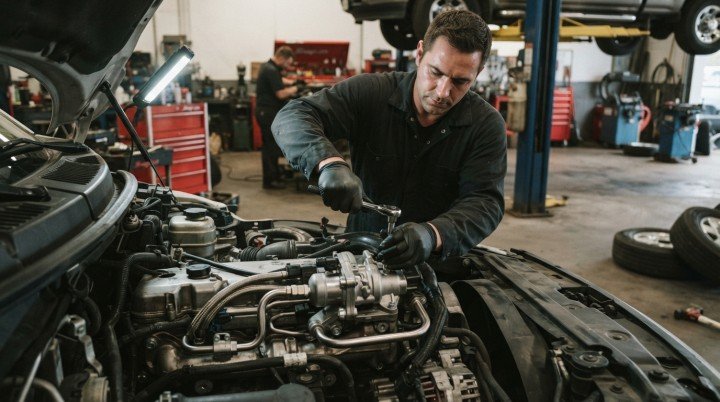
The EGR valve should not be blamed solely because it contains carbon. Commanded and actual EGR operation, intake airflow, boost pressure, wiring, and related components must be evaluated together.
Does a Blocked DPF Cause Black Smoke?
A diesel particulate filter is designed to capture soot before it leaves the tailpipe. A restricted DPF may cause warning lights, reduced power, high exhaust backpressure, or regeneration problems, but blockage alone does not neatly explain thick black smoke escaping from the tailpipe.
Visible tailpipe soot on a DPF-equipped vehicle can point toward excessive soot production, a cracked or damaged filter, an altered emissions system, or another aftertreatment fault. Diagnosis should therefore include both the engine-side cause and the condition of the emissions system.
Removing or disabling the DPF or other emissions equipment is not a proper repair and may violate emissions laws.
Match the Symptoms to the Correct Diagnostic Direction
| What You Notice | Diagnostic Direction | What Should Be Verified |
|---|---|---|
| Smoke and power loss during acceleration | Boost or intake-air problem | Turbo hoses, intercooler, leaks, and actual boost |
| Fuel odor with rough idle or one-cylinder misfire | Possible injector problem | Injector leakage, balance, spray, wiring, and cylinder condition |
| Rich codes with pressure above specification | Fuel-pressure control | Regulator, pressure sensor, control circuit, and return path where applicable |
| Cold reading from a fully warmed engine | Temperature input problem | Coolant sensor data, connector, wiring, and actual temperature |
| Diesel smoke with EGR-related codes | EGR and air-management fault | EGR command, airflow, boost, intake deposits, and related wiring |
| Heavy smoke from a DPF-equipped diesel | Excess soot plus possible aftertreatment problem | Engine fault, filter integrity, pressure data, regeneration history, and system tampering |
These symptom combinations help narrow the investigation, but none identifies a failed part by itself. The most reliable way to separate the different black smoke from exhaust causes is to combine smoke timing with trouble codes, live data, physical inspection, and vehicle-specific testing.
Black Smoke From a Gasoline vs Diesel Engine
The diagnostic order for black smoke from exhaust causes changes depending on whether the engine burns gasoline or diesel. Both can produce dark exhaust through incomplete combustion, but their fuel-delivery, air-management, and emissions systems operate differently.
Black Smoke From a Gasoline Engine
Visible black smoke from a modern gasoline vehicle usually indicates a seriously rich mixture. The engine may be receiving excessive fuel, incorrect sensor information, or insufficient air.
Useful diagnostic information includes:
- Short- and long-term fuel trims
- Oxygen or air-fuel-sensor activity
- Engine coolant temperature
- MAF or MAP readings
- Fuel pressure
- Injector operation
- Rich-condition trouble codes
Very negative fuel trims may show that the ECU is trying to remove fuel. However, fuel-trim interpretation depends on operating mode and vehicle design. A scan result must be compared with the smoke timing and other sensor readings.
Black Smoke From a Diesel Engine
A diesel engine normally operates with excess air, but it can create black soot when injected fuel does not receive enough oxygen or fails to mix and burn correctly.
Important areas include:
- Air-intake restriction
- Actual versus commanded boost
- Charge-air leaks
- Injector condition
- Rail pressure
- EGR operation
- Intake deposits
- DPF and aftertreatment condition
Older diesels may produce a brief haze under sudden load, but thick, recurring smoke from a modern emissions-equipped diesel should not be considered normal.
What Should You Check First?
Do not begin by replacing the injector, turbocharger, or oxygen sensor. Start with evidence that can divide the problem into air-side, fuel-side, or control-system categories.
First, record when the smoke appears. Note whether it occurs at cold startup, warm idle, steady driving, hard acceleration, or all the time. Also record power loss, rough running, fuel odor, unusual noises, warning lights, and recent repairs.
Next, scan every relevant module for current, pending, and stored codes. Save freeze-frame data before clearing anything. Codes involving rich operation, airflow, boost, fuel pressure, EGR, temperature sensors, misfires, or aftertreatment systems can help choose the next test.
Continue with a visual inspection of the air filter, intake ducts, electrical connectors, turbo hoses, intercooler connections, and recently disturbed components. A loose hose after an unrelated repair can cause a major airflow problem.
Live data should then be compared with vehicle-specific specifications. Depending on the engine, useful parameters may include:
- MAF or MAP readings
- Coolant temperature
- Fuel trims
- O2 or air-fuel-sensor data
- Commanded and actual boost
- Commanded and actual rail pressure
- EGR command and feedback
- DPF pressure and regeneration history
Fuel pressure, injector operation, and turbo performance should be tested before expensive components are replaced.
How to Fix Black Smoke From Exhaust
The correct repair depends entirely on the confirmed cause. There is no universal cleaner, reset, or replacement part that fixes every black-smoke condition.
A restricted air filter should be replaced with the correct filter. Split intake or intercooler hoses should be repaired, and loose clamps should be secured. A confirmed boost leak must be corrected before the turbocharger itself is condemned.
If airflow or temperature data is inaccurate, the sensor circuit should be checked for power, ground, signal integrity, connector damage, and wiring faults. Cleaning a MAF sensor may help when contamination is the issue, but only the approved cleaner and correct procedure should be used. Cleaning will not repair damaged electronics.
A leaking, electrically defective, or mechanically worn injector may require professional testing and replacement. Excessive fuel pressure must be traced to the actual pressure-control fault. Diesel EGR, intake, turbo, and aftertreatment repairs should follow manufacturer procedures.
Avoid guessing with parts or repeatedly clearing codes. Do not remove, disable, or program around emissions-control equipment as a shortcut.
Can You Drive With Black Smoke From the Exhaust?
A small, brief puff without other symptoms may allow you to move the vehicle to a safe location and arrange an inspection. Persistent or heavy black smoke deserves prompt attention because the engine is wasting fuel and may be overheating or damaging emissions components.
Stop driving as soon as it is safe if the smoke is accompanied by:
- A flashing check engine light
- Severe power loss
- Strong raw-fuel odor
- Rough running or repeated stalling
- Engine overheating
- Abnormal knocking
- Flames or extreme heat near the exhaust
- Smoke thick enough to reduce visibility
Excess fuel can foul spark plugs, contaminate sensors, dilute engine oil, and overheat a catalytic converter or diesel aftertreatment system. Exhaust fumes also contain harmful pollutants, so never run a smoking vehicle in a closed garage or other poorly ventilated space.
Common Black-Smoke Misdiagnosis Traps
The first mistake is assuming that black smoke always means a failed fuel injector. An air restriction, boost leak, sensor fault, or pressure-control problem may create a similar result.
Another mistake is replacing a sensor because its code appears on the scanner. The sensor may be accurately reporting a mixture problem caused elsewhere.
Gasoline and diesel engines should not be diagnosed with the same checklist. Gasoline fuel trims may provide valuable mixture information, while diesel diagnosis often depends more heavily on airflow, boost, rail pressure, EGR, and aftertreatment data.
A dark air filter also does not automatically prove that it caused the smoke. It should be replaced if restricted or due for service, but the vehicle should be rechecked afterward.
Finally, do not assume that a blocked DPF is the only explanation for diesel smoke. A functioning filter is intended to capture soot. Heavy smoke reaching the tailpipe may require inspection of the engine fault and the integrity or modification status of the aftertreatment system.
Black vs Blue vs White Exhaust Smoke
Confirming the smoke color can prevent the diagnosis from starting in the wrong system.
Black smoke usually represents soot caused by incomplete combustion, excess fuel, or insufficient air.
Blue or blue-gray smoke usually indicates that engine oil is entering the combustion process. Worn piston rings, valve seals, turbo seals, or crankcase ventilation problems may be involved.
Persistent white smoke may indicate coolant entering a gasoline engine, while diesel white smoke can also involve poorly burned fuel, low combustion temperature, injector problems, or other conditions. Thin vapor that disappears as a cold engine warms may simply be condensation.
Lighting conditions can make dark blue smoke look black. Check oil and coolant levels and note the odor and timing before deciding which system to investigate.
Frequently Asked Questions
Is Black Smoke Always Caused by Too Much Fuel?
Not exactly. The immediate condition is usually incomplete combustion, but it can result from excessive fuel, insufficient air, poor fuel atomization, low boost, or incorrect control inputs.
Why Does My Car Blow Black Smoke Only When Accelerating?
Acceleration increases fuel and airflow demand. A restricted intake, charge-air leak, weak turbocharger, injector problem, or fuel-control fault may become obvious only under load.
Can a Dirty Air Filter Cause Black Smoke?
Yes, if the restriction significantly reduces the air available for combustion. However, filter condition should be confirmed rather than assumed from appearance alone.
Can a Bad MAF Sensor Cause Black Smoke?
It can if inaccurate airflow information causes incorrect fuel delivery. Wiring faults, intake leaks, contamination, and other sensor inputs should also be checked.
Is Black Smoke Normal From a Diesel Engine?
Continuous or heavy black smoke is not normal. A brief haze may occur on some older diesels during a sudden load change, but recurring smoke on a modern diesel requires diagnosis.
Final Takeaway
Understanding black smoke from exhaust causes begins with one question: When does the smoke appear?
Smoke at idle, during cold startup, or under acceleration creates different diagnostic paths. After identifying the pattern, follow the system in order:
Air supply → Boost delivery → Fuel injection → Fuel pressure → Sensor inputs → EGR and aftertreatment
Black exhaust smoke is a warning that combustion is not occurring correctly. Treat it as a reason to test the system—not as proof that the first suspected component needs replacement. Finding the real cause early can restore fuel economy, prevent further damage, and stop a manageable fault from becoming an expensive repair.
Kevin Nicholas is an automotive mechanic and editor of The Effective Guide. He writes about warning lights, car problems, and diagnostic tools, helping drivers understand what to check before replacing a part.