
Last Updated on October 7, 2026
A car battery does not have to be completely dead before it becomes unreliable. It may still start the engine most mornings while gradually losing the reserve capacity needed for cold weather, longer parking periods, and high electrical demand.
That is why the earliest bad battery symptoms often appear as small changes rather than a total no-start. The engine may crank slightly slower, the lights may dim more than usual, or the vehicle may behave differently after sitting overnight.
Think of the battery as an electrical reserve. Starting the engine requires a short but powerful burst of energy. When that reserve begins shrinking, the battery may handle lights and accessories but struggle when the starter requests much more current.
This article primarily covers conventional 12-volt starter batteries in gasoline and diesel vehicles. Hybrids and electric vehicles also use low-voltage batteries, but their starting behavior and warning messages can differ.
Quick Answer
The most common bad battery symptoms include slow cranking, rapid clicking, inconsistent starting after parking, lights that dim sharply during startup, electronic resets, repeated loss of charge, and visible battery damage or an unusual odor.
However, these signs do not prove that the battery itself has failed. Loose connections, a faulty starter, an alternator problem, or an electrical drain can produce similar behavior. The battery, starting circuit, and charging system should be evaluated together.
The Timing of the Symptom Matters
To interpret bad battery symptoms correctly, pay attention to when the problem occurs. A symptom that appears before the engine starts may mean something different from the same symptom appearing while the vehicle is running.
| When It Happens | What You May Notice | What It May Point Toward |
|---|---|---|
| After several hours or overnight | Starting is slower or inconsistent | Weak battery, electrical drain, or poor connection |
| Before the engine starts | Dim cabin lights, weak accessories, or reset settings | Low battery charge or a connection problem |
| During cranking | Slow turning, clicking, or sharply dimming lights | Battery, cables, grounds, or starter circuit |
| Immediately after startup | Warning lights or unstable electrical behavior | Low voltage or charging-system problem |
| While driving | Battery light, dimming lights, or accessories losing power | Alternator, belt, wiring, or broader charging fault |
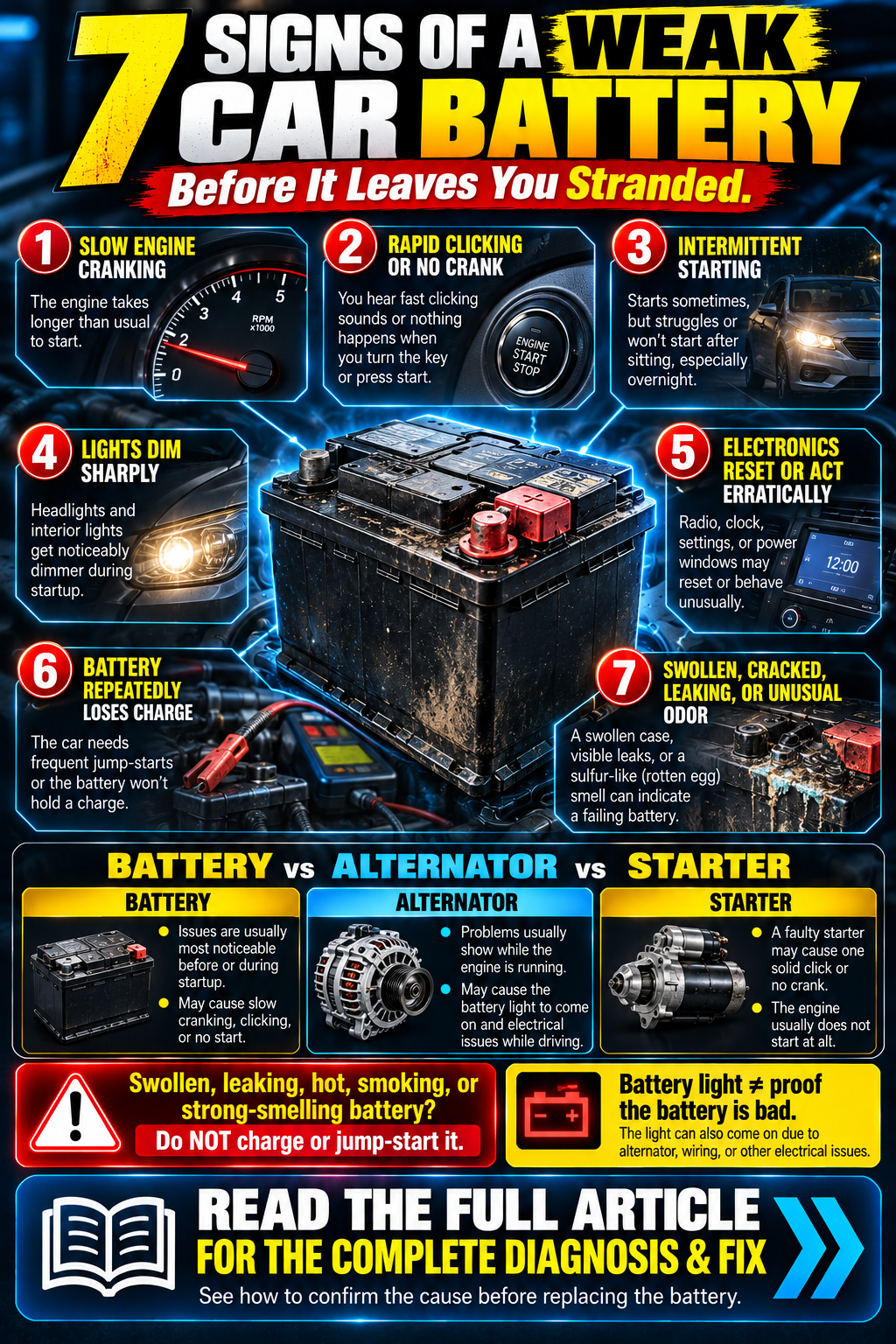
1. The Engine Cranks More Slowly Than Normal
The starter motor needs a large amount of electrical current to turn the engine. As a battery loses capacity, it may no longer deliver that current as quickly as it once did.
Instead of the engine turning with its usual strong, consistent rhythm, the cranking sound may become slower, heavier, or drawn out. The engine may still start, but the change in sound is an early warning that should not be ignored.
Cold weather can temporarily slow cranking because battery performance decreases and the engine becomes harder to turn. One slow start on an unusually cold morning does not automatically mean the battery is failing.

The pattern becomes more concerning when slow cranking happens repeatedly, appears in normal weather, or becomes worse after the vehicle sits overnight. A weak battery is one possibility, but loose terminals, damaged cables, poor grounds, a worn starter, or an engine-related issue can create a similar sound.
A professional battery test under load is more useful than judging the battery only by whether the engine eventually starts. A battery can have enough remaining energy for one successful start while still having very little reserve capacity.
2. You Hear Clicking but the Engine Does Not Crank
Rapid clicking during a starting attempt often means the starter solenoid is trying to engage, but the available electrical power drops too far under load. The solenoid disengages, the voltage recovers slightly, and the cycle repeats—creating a series of clicks.
This may happen because the battery is weak or discharged. It can also be caused by loose or corroded connections that prevent adequate current from reaching the starter.

One solid click is a different clue. It may point toward a failed starter motor or solenoid, although cable, ground, and battery problems must still be ruled out.
Working headlights or a functioning radio do not prove that the battery is healthy. Those accessories require much less current than the starter motor.
Avoid repeatedly holding the key or pressing the start button. Repeated attempts can overheat starting-system components without identifying the fault. If the vehicle continues clicking without cranking, have the battery, cables, grounds, and starter circuit tested before replacing parts.
3. Starting Becomes Intermittent or Worse After Sitting
A weakening battery may start the engine normally after a long drive but struggle several hours later or the following morning. This happens because the battery has less usable reserve and may no longer hold its charge as effectively while the vehicle is parked.
The pattern may seem random. The car starts properly for several days, cranks slowly once, works normally again, and then refuses to start after another night. Temperature changes can make the pattern more noticeable because cold conditions reduce available battery performance.
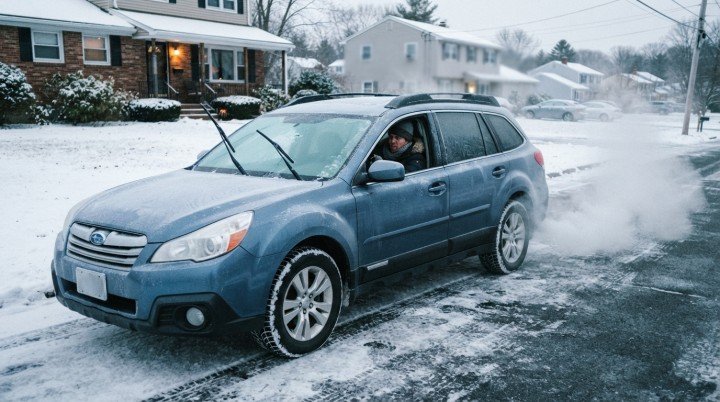
However, a battery that loses power while parked is not automatically defective. Modern vehicles use a small amount of electricity to maintain alarms, computers, keyless-entry systems, and memory settings. A faulty module, stuck relay, interior light, accessory, or wiring problem can draw more power than expected and discharge a healthy battery.
A charging-system problem can also leave the battery only partially charged before the vehicle is parked. In that case, the battery begins the night without its full reserve.
Reserve-timing clue: The vehicle starts more easily after recent driving but becomes unreliable after sitting.
The correct diagnosis should separate three possibilities: a battery that cannot hold a charge, a battery that was never fully recharged, and an external electrical drain. Replacing the battery without identifying the pattern may provide only a temporary solution.
4. The Lights Dim Sharply During Startup
A small, brief change in light brightness can be normal when the starter motor draws a large amount of current. The concern is a new or dramatic drop in brightness.
Headlights, dashboard illumination, or interior lights may become extremely dim when starting is requested. They may recover immediately after the attempt ends because the heavy starter load has been removed.
This pattern suggests that battery voltage is falling sharply under demand. A weak or discharged battery is a common cause, but loose terminals, damaged cables, poor grounds, or a failing starter can also create an excessive voltage drop.
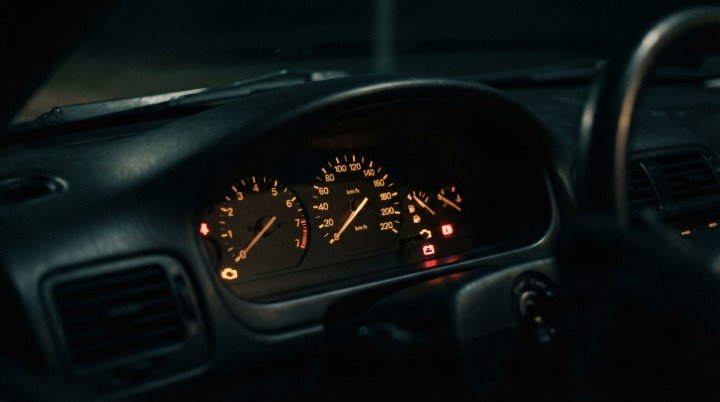
The timing is important. Lights that dim mainly during cranking point toward the battery or starting circuit. Lights that flicker or lose brightness while the engine is already running may indicate an alternator, belt, wiring, or broader charging-system problem instead.
Reserve-timing clue: The lights look acceptable before starting but lose most of their brightness as soon as the starter is requested.
A battery load or conductance test, combined with cable and ground checks, can show whether the battery itself is weak or whether electrical power is being restricted elsewhere.
5. Electronics Reset or Behave Erratically
Among the subtler bad battery symptoms, electronic resets are easy to overlook because the engine may still start.
The clock may return to a default time, saved radio stations may disappear, the infotainment system may restart, or previously stored settings may be lost. Interior lights can flicker, powered accessories may move unusually slowly, and several dashboard warnings may briefly appear together.
Some vehicles may also disable convenience features such as automatic engine stop-start when battery charge or battery health becomes too low. This does not prove battery failure, but it can be an early clue when combined with slow cranking or inconsistent starting.

These glitches occur because control modules need stable voltage. If available power drops too far during startup, some modules may shut down, restart, or store low-voltage fault codes.
One electronic problem by itself is more likely to involve that particular component, switch, fuse, or wiring circuit. Several unrelated systems resetting at the same time create a stronger reason to inspect the battery and its connections.
Reserve-timing clue: Multiple electronic settings or systems act abnormally immediately before, during, or after engine startup.
Do not assume that every warning light represents a separate failed system. A technician can check the battery’s state of health, stored low-voltage codes, terminal connections, and charging performance before individual electronic parts are replaced.
When Low Reserve Becomes a Breakdown Risk
The final bad battery symptoms indicate that the battery may no longer recover normally or that physical damage has developed. At this stage, repeated starting assistance is not a dependable solution, and visible battery damage requires extra caution.
6. The Battery Repeatedly Loses Its Charge
A healthy battery should retain enough energy to restart the engine after normal use and parking. If the vehicle repeatedly has little or no starting power, something is preventing the battery from remaining adequately charged.
The battery may have lost the internal capacity needed to hold energy. However, the same pattern can occur when the alternator does not recharge it, an electrical component continues drawing power while the vehicle is parked, or damaged connections interfere with charging.
The timing offers an important clue. Failure after a short parking period may suggest a severe battery or electrical problem. Gradual discharge after several days may involve an aging battery, normal vehicle draw combined with long periods of inactivity, or an excessive parasitic drain.
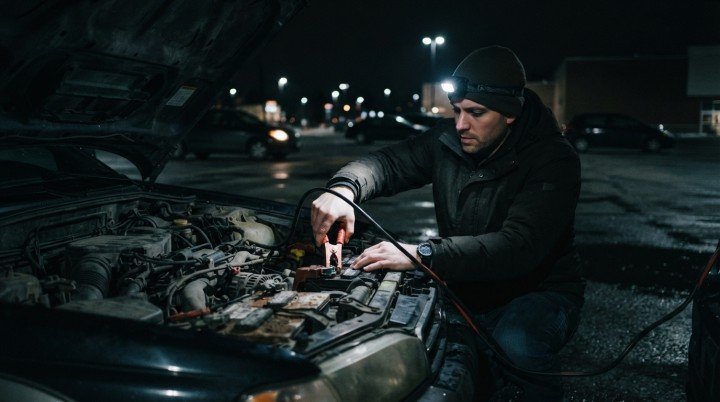
A vehicle that receives outside starting assistance and then operates normally has not necessarily been repaired. The added power only addresses the immediate shortage; it does not explain why the battery became discharged.
Reserve-timing clue: The battery temporarily recovers after charging or assistance but becomes weak again sooner than expected.
The next step should be a battery health test followed by charging-system and parasitic-draw checks. Replacing the battery alone may not solve the problem if another fault is repeatedly discharging it.
7. The Battery Case Is Swollen, Cracked, Leaking, or Smells Unusual
A battery should have a solid, evenly shaped case without wet areas, cracks, or bulging sides. Swelling can result from excessive heat, freezing damage, internal failure, or overcharging by the charging system.
Heavy corrosion around the terminals may develop from escaped vapor or leakage, although corrosion can also result from age and environmental exposure. A strong sulfur-like odor can indicate that the battery is venting or damaged.
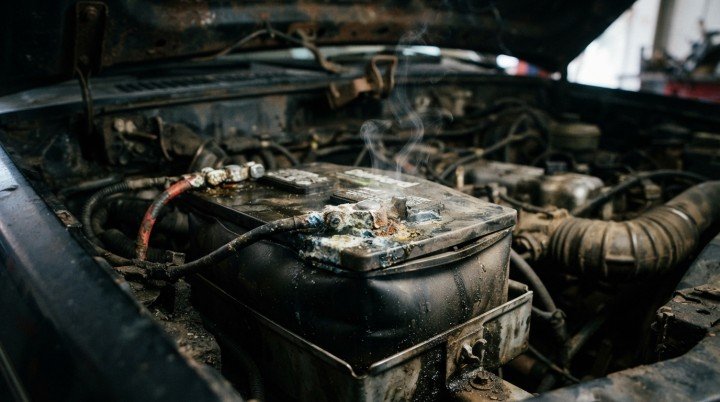
This is different from an ordinary starting problem. A swollen, cracked, leaking, unusually hot, smoking, or strongly odorous battery should not be touched, charged, opened, or jump-started.
Keep people away from the area, switch off the vehicle if that can be done safely, and arrange professional assistance. A damaged battery may require replacement, but the charging system should also be tested to determine whether overcharging contributed to the damage.
Reserve-timing clue: The warning is visible or noticeable around the battery rather than appearing only during startup.
The Battery Light Does Not Automatically Mean a Bad Battery
The battery-shaped dashboard light usually monitors the charging system. It may appear alongside bad battery symptoms, but it does not prove that the battery itself has failed.
A faulty alternator, voltage regulator, drive belt, cable, fuse, wiring connection, or battery sensor may trigger the warning. If the light remains on while driving, the vehicle may be operating on limited stored battery energy and could eventually lose electrical power.
Move to a safe location and arrange an inspection rather than driving farther to “recharge” the battery.
Weak, Discharged, and Failed Batteries Are Different
| Condition | What It Means | Can It Recover? | What Must Be Checked |
|---|---|---|---|
| Weak battery | Capacity or starting performance has declined | It may work temporarily, but continued reliability is uncertain | State of health and starting performance |
| Discharged battery | Stored energy is low, but the battery may still be healthy | Possibly, if it accepts and retains a proper charge | Reason for discharge and ability to hold charge |
| Internally failed battery | Internal damage prevents dependable operation | Usually not | Replacement need and possible charging fault |
| Battery drained by another fault | A charging problem or electrical draw removes stored energy | The battery may recover if it has not been damaged | Alternator, wiring, connections, and parasitic draw |
Weak Battery vs. Bad Alternator vs. Bad Starter
A battery problem is usually most noticeable before or during startup. Slow cranking, rapid clicking, and problems after parking fit this pattern.
An alternator problem is more likely to cause a charging warning, changing light brightness, unstable accessories, or loss of electrical power while the engine is running. It can later cause a no-start by leaving the battery discharged.
A starter problem may cause one solid click or no crank even when the battery and its high-current connections test healthy. Because these symptoms overlap, testing is more reliable than replacing the most familiar component.
Why Batteries Become Weak
Battery capacity declines with age, but lifespan varies with climate, vehicle design, driving habits, and battery type. Heat accelerates internal deterioration, while cold weather exposes a battery that already has limited starting capacity.
Frequent short trips, extended parking, vibration, poor connections, electrical drains, undercharging, and overcharging can also shorten battery life.
How a Technician Confirms the Cause
A complete diagnosis may include checking the battery’s state of charge and state of health, performing a starting or conductance test, inspecting cables and grounds, measuring charging performance, and checking for excessive electrical draw while parked.
The technician may also review battery age, specification, stored low-voltage codes, and battery-monitoring data. A resting voltage reading alone cannot reveal every internal battery problem.
Common Mistakes to Avoid
Do not assume that a successful start proves the battery is healthy or that the battery-shaped warning confirms battery failure. Repeated starting assistance should not replace diagnosis, and a new battery should not be installed without considering why the previous one became discharged.
Never handle or attempt to charge a swollen, leaking, cracked, smoking, or unusually hot battery.
Frequently Asked Questions
How long can a weak battery continue working?
There is no dependable estimate. It may continue starting for weeks or fail during the next cold start or parking period.
Can a battery test good and still fail soon?
Yes. Battery condition can be affected by temperature, state of charge, intermittent internal faults, and the type of test performed. A marginal result should be interpreted with the battery’s age and symptoms.
Does driving recharge a weak battery?
A healthy charging system may restore some energy to a merely discharged battery. Driving cannot reverse internal deterioration, and it will not solve an alternator fault or parasitic drain.
Can a bad alternator damage a new battery?
Yes. Undercharging can repeatedly leave it discharged, while overcharging can cause heat and internal damage. The charging system should be checked when battery problems return.
Should a swollen battery be jump-started?
No. Keep away from the battery and arrange professional service or towing.
Final Thoughts
Recognizing bad battery symptoms before complete failure can reduce the chance of an unexpected no-start. Focus on when the problem occurs: after parking, during cranking, immediately after startup, or while driving. Then have the battery, connections, starter, charging system, and possible electrical drain tested together before approving replacement.
Kevin Nicholas is an automotive mechanic and editor of The Effective Guide. He writes about warning lights, car problems, and diagnostic tools, helping drivers understand what to check before replacing a part.