
Last Updated on October 7, 2026
You press the brake pedal expecting the car to slow down smoothly. Instead, the steering wheel begins to tremble, the pedal pulses beneath your foot, or the entire vehicle shudders as speed drops.
When a car shakes when braking, brake rotors are usually blamed first. Rotor problems are common, but they are not the only possibility. Uneven brake pads, a sticking caliper, damaged tires, worn suspension parts, wheel-bearing play, and even unexpected ABS activation can produce similar symptoms.
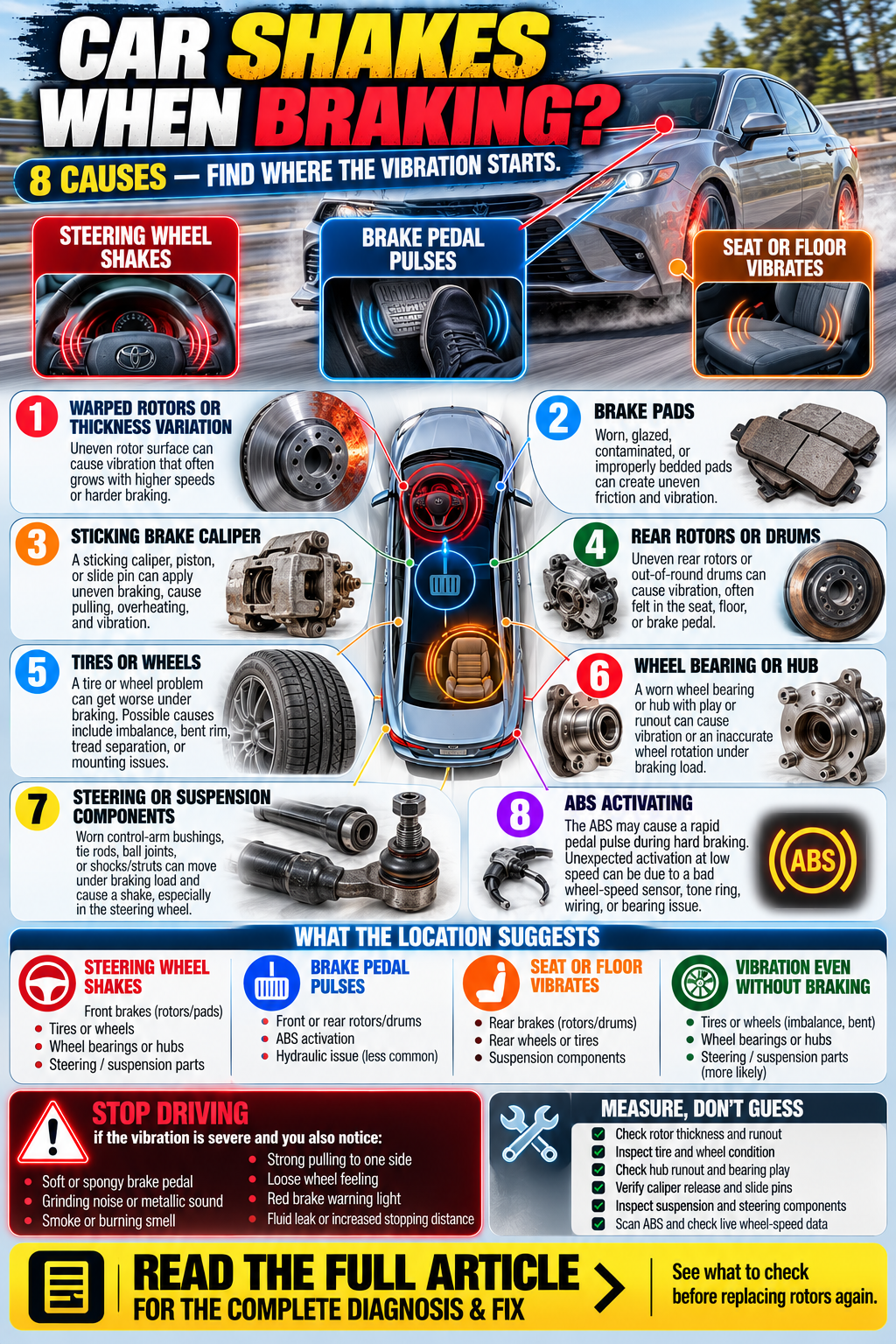
The location and timing of the vibration provide some of the most useful diagnostic clues. A shake felt mainly through the steering wheel may point toward the front of the vehicle, while movement through the seat or floor may direct attention toward the rear brakes, wheels, or suspension. However, these patterns only help narrow the search; they do not confirm which part has failed.
Before replacing anything, determine exactly where the vibration is coming from and under what conditions it appears.
Why Does a Car Shake During Braking?
Applying the brakes changes the forces acting on the vehicle. The brake pads clamp against the rotating discs, or the brake shoes press against the drums, converting motion into heat. At the same time, the vehicle’s weight shifts forward, placing additional load on its front tires, wheel bearings, steering components, and suspension.
If a brake disc has uneven thickness, a pad applies inconsistent friction, or a suspension joint moves under load, the resulting force may repeat with every wheel rotation. That movement can travel through the brake pedal, steering wheel, seat, or body of the vehicle.
This explains why a problem that seems minor while cruising can become much more noticeable once the brakes are applied.
Start by Finding Where You Feel the Vibration
Pay attention to the location of the shake before assuming the brake rotors need replacement.
| Where You Feel the Shake | Possible Area to Inspect | Useful Diagnostic Clue |
|---|---|---|
| Mostly in the steering wheel | Front brakes, front tires, wheel hubs, or steering components | Often becomes stronger during highway-speed braking |
| Through the brake pedal | Brake-disc variation, rear drums, or ABS operation | Notice whether the pulse is slow and rhythmic or rapid like ABS |
| Through the seat or floor | Rear brakes, rear wheels, tires, or suspension | The steering wheel may remain relatively steady |
| Throughout the entire vehicle | Tires, wheels, hubs, suspension, or multiple brake issues | Check whether vibration is also present without braking |
| Only near a complete stop | Unexpected ABS activation or a non-brake vibration | Watch for an ABS light or a rapid pedal pulse |
The timing matters as much as the location. Shaking only during braking points more strongly toward the braking system. Vibration that is already present at cruising speed and becomes worse during braking may originate from a tire, bent wheel, hub, wheel bearing, or suspension component.
What Should You Check First?
If your car shakes when braking, begin by answering a few practical questions.
Does it happen during every stop or only when braking from highway speed? Does the steering wheel move from side to side? Can you feel a pulse through the pedal? Does the car pull toward one side? Did the problem begin after new brakes, tire service, or wheel removal?
These details can prevent unnecessary parts replacement.
A mild vibration still deserves inspection, but certain symptoms require more urgent action. Stop driving as soon as it is safe if the vibration is severe or accompanied by a soft pedal, grinding noise, smoke, a burning smell, strong pulling, increased stopping distance, a red brake warning light, or a sensation that a wheel is loose. Continuing to drive under those conditions could make the vehicle harder to control.
1. Brake Rotor Thickness Variation or Excessive Runout
Brake rotor problems are the most familiar cause of brake shudder, but the phrase “warped rotors” does not always describe what has actually happened.
A brake disc should rotate evenly and maintain nearly uniform thickness around its friction surface. Disc thickness variation develops when some areas become slightly thicker or thinner than others. As those areas pass between the pads, they repeatedly push against the caliper piston. The movement can then be transmitted through the hydraulic system to the brake pedal and through the front suspension to the steering wheel.
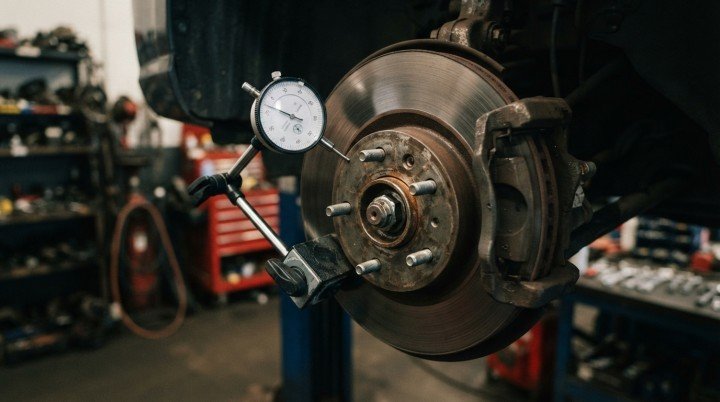
Lateral runout is different. It describes the side-to-side movement of the disc as it rotates. Excessive runout can eventually create uneven wear and thickness variation.
Several conditions can contribute to these problems:
- Rust or debris trapped between the rotor and hub
- Uneven friction-material deposits on the disc
- Improper rotor installation
- Incorrect or uneven wheel-fastener torque
- Excessive heat
- A damaged hub or worn wheel bearing
- Rotor wear below its allowable specification
What Rotor-Related Brake Shudder Usually Feels Like
Rotor-related vibration often becomes stronger as braking pressure or vehicle speed increases. A front-brake problem may shake the steering wheel, while a rear-disc problem may be felt more through the seat or pedal.
The pulse may also follow vehicle speed. It feels faster when braking at higher speed and gradually slows as the vehicle approaches a stop.
However, symptoms alone cannot prove that a rotor is defective. A technician should inspect the disc surface, measure its thickness at several points, and check lateral runout with a dial indicator. The hub mounting surface and wheel-bearing condition should also be examined if the measurement is outside the vehicle manufacturer’s specification.
Depending on rotor condition and manufacturer limits, the repair may involve cleaning the hub, correcting the installation, machining an eligible rotor, or replacing the rotors and pads as an axle set. Installing another rotor without correcting hub contamination, runout, caliper trouble, or improper wheel torque may allow the vibration to return.
2. Brake Pads Are Worn, Glazed, Contaminated, or Improperly Bedded
Brake pads must apply even friction across the rotor surface. If one pad is thinner than the other, the friction material is glazed, or its surface is contaminated, braking force may become inconsistent.
Glazing can occur when excessive heat hardens the pad surface. Contamination may result from grease, oil, brake fluid, or another substance reaching the friction material. New pads can also cause judder if they were not installed correctly, cannot move freely in the bracket, or did not establish an even transfer layer on the rotor during the bedding process.
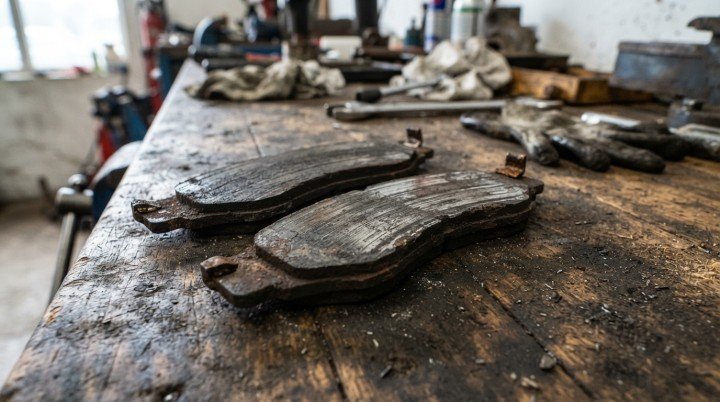
Uneven pad wear is especially important because it may be evidence of another fault rather than the main problem. A sticking caliper piston, seized slide pin, damaged brake hose, corroded bracket, or poorly fitted hardware can cause one pad to work harder than the other.
Common clues include reduced braking smoothness, squealing, pulling to one side, excessive brake dust on one wheel, or one wheel becoming hotter than the others. A visual inspection may reveal tapered wear, cracks, glazing, contamination, or a significant difference between the inner and outer pad thickness.
Replacing the pads alone may provide only temporary improvement if the caliper, rotor, or mounting hardware caused the uneven wear. Contaminated or badly glazed pads normally require replacement, while the rotors and caliper operation should be checked at the same time. The technician should also identify and repair the source of any fluid contamination before installing new friction components.
Rotor and pad problems explain many cases where a car shakes when braking, but they do not explain every pattern. The next section follows heat, speed, and pulling clues to investigate sticking calipers, uneven rear brakes, and tire or wheel problems.
The first two causes involve the friction surfaces that create braking force. The next group becomes easier to separate by observing when the vibration appears, whether it changes after repeated stops, and whether one wheel seems to be doing more work than the others.
When a car shakes when braking only after the brakes become hot, a dragging caliper or heat-related disc problem deserves attention. If the vibration is also present while cruising, the investigation should expand beyond the brake system to include the tires, wheels, hubs, and suspension.
What the Braking Pattern Can Reveal
A short description such as “the car vibrates” is not enough for an accurate diagnosis. The conditions that trigger the shake can reveal far more.
| When the Vibration Appears | Possible Area to Investigate | Additional Clue to Look For |
|---|---|---|
| During light, steady braking | Disc thickness variation, rear drums, or uneven pad deposits | A rhythmic pedal pulse that changes with vehicle speed |
| During hard braking | Brake-disc problem, loose suspension, or normal ABS operation | Determine whether the road is slippery and whether the pulse is rapid |
| After several stops | Dragging caliper, overheated pads, or heat-sensitive disc variation | Burning smell, pulling, or excessive brake dust at one wheel |
| While cruising and braking | Tire, wheel, hub, bearing, or suspension issue | Vibration changes with road speed even without using the brakes |
| Immediately after brake or wheel service | Installation, hub cleaning, wheel torque, bedding, or incorrect parts | The vehicle was smooth before the recent work |
These patterns are useful starting points, but multiple faults can produce nearly identical sensations. Actual brake, wheel, and suspension inspections are still necessary.
3. A Brake Caliper, Piston, or Slide Pin Is Sticking
A disc-brake caliper must apply and release the pads evenly. On a floating-caliper design, the piston pushes one pad toward the rotor while the caliper slides on guide pins to apply the opposite pad. If the piston or guides cannot move freely, braking force becomes unequal.
A sticking caliper may keep one pad partially applied after the pedal is released. The constant friction generates heat and can create hot spots, glazing, uneven pad deposits, and accelerated rotor wear. The vibration may be mild when the vehicle is first driven but become noticeably worse after several stops.
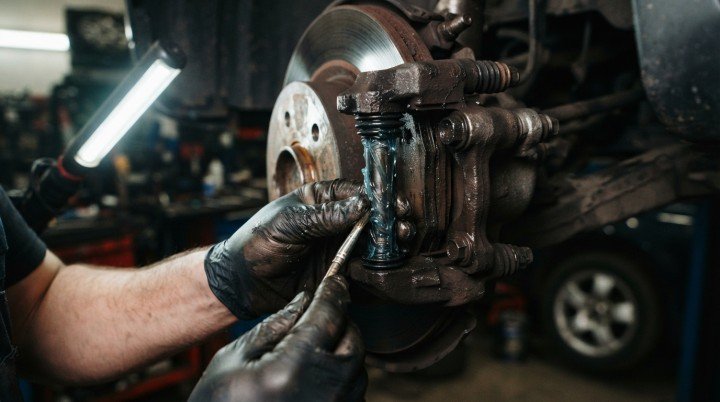
Other possible clues include the vehicle pulling toward one side, reduced acceleration, a burning smell, unusually heavy brake dust, or one wheel becoming much hotter than the others. The affected side may also have one pad that is significantly thinner than its matching pad.
A damaged flexible brake hose can imitate a seized caliper. Internal deterioration may allow hydraulic pressure to reach the caliper but prevent it from releasing normally. Replacing the caliper without checking the hose, guide pins, bracket, piston boot, and pad movement may leave the actual problem unresolved.
Heat comparison can help during professional diagnosis, but never touch a wheel, rotor, or caliper immediately after driving. Brake components can become hot enough to cause serious burns. Smoke, a strong burning odor, severe pulling, or a wheel that appears to be locking requires the vehicle to be stopped safely and inspected before further driving.
The proper repair depends on the cause. It may require servicing or replacing the guide pins and hardware, replacing the caliper or hose, and installing new pads and rotors if overheating has damaged the friction surfaces. Brake components on the opposite side of the same axle should also be inspected so braking remains balanced.
4. The Rear Brake Rotors or Drums Are Uneven
Front brakes perform much of the work during a stop, so they receive most of the attention. However, a rear-brake problem can also create a strong pedal or body vibration.
Vehicles with rear disc brakes can develop the same thickness variation, runout, corrosion, and uneven pad deposits found at the front. Because the vibration originates farther from the steering system, the driver may feel it more through the seat, floor, or brake pedal than through the steering wheel.
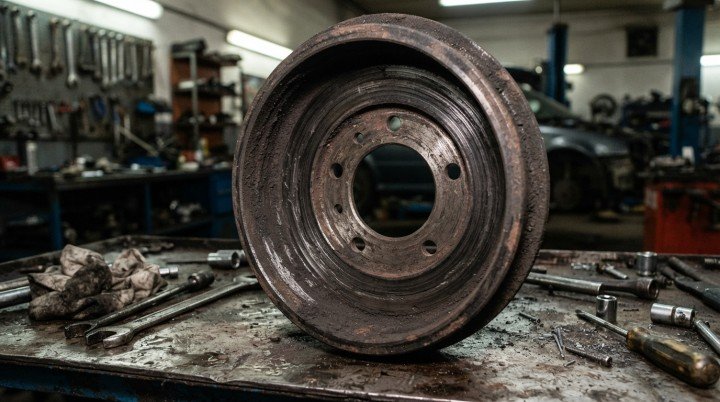
Vehicles with rear drum brakes have a different friction arrangement. Brake shoes press outward against the inside surface of a rotating drum. If that drum becomes out of round, develops uneven wear, or is installed incorrectly, the shoes may grab and release as it rotates. This can create a repeating pedal pulse or a shudder from the rear of the vehicle.
Contaminated shoes, weak or damaged return springs, sticking wheel-cylinder components, incorrect adjustment, and parking-brake hardware problems can also cause uneven rear braking. A parking brake that does not release fully may overheat the drum or rotor and make the problem worse.
Diagnosis requires more than looking at the outer surface. Rear discs should be checked for thickness variation, runout, scoring, and minimum thickness. Drums should be measured for diameter, roundness, heat damage, and surface condition. The shoes, wheel cylinders, adjusters, springs, parking-brake mechanism, and related hardware should be inspected at the same time.
5. A Tire or Wheel Problem Gets Worse Under Braking
A tire or wheel problem may not originate in the brakes at all. Braking simply changes vehicle load and makes an existing vibration easier to feel.
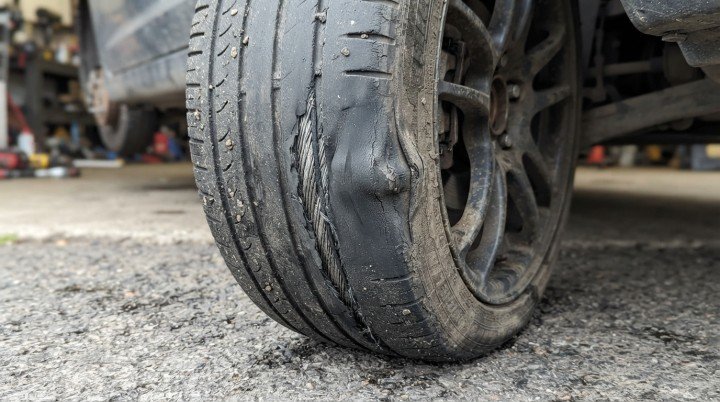
Common possibilities include an imbalanced wheel, a bent rim, uneven or cupped tread, a missing balance weight, incorrect tire pressure, or internal tire damage. A tire with a shifted or separated belt can produce a repeating shake that changes with vehicle speed and may become severe as weight transfers forward.
The most useful clue is whether the vibration exists without braking. If the steering wheel begins shaking within a particular speed range and continues while the vehicle is coasting, the tires and wheels should be inspected before brake rotors are automatically blamed. Braking may intensify the movement, but it may not be the original source.
A wheel can also be mounted incorrectly after service. Rust or debris between the wheel and hub, damaged mounting surfaces, or wheel fasteners tightened unevenly may prevent it from seating correctly. Loose wheel fasteners are an immediate safety concern and should be checked using the manufacturer’s specified procedure and torque—not guessed or tightened randomly.
Tire balancing can correct imbalance, but it cannot repair a bent wheel, separated tire, worn wheel bearing, loose suspension part, or brake-disc variation. Similarly, alignment may help prevent irregular tire wear, but alignment alone rarely eliminates a vibration caused by physical tire damage or brake judder.
Any tire with a bulge, exposed cords, severe deformation, rapid pressure loss, or visible tread separation should not be driven on. It should be replaced before the vehicle returns to normal road use.
Why Does a Car Shake When Braking at High Speeds?
High-speed braking increases both the frequency of wheel rotation and the energy the brakes must absorb. As a result, small amounts of disc thickness variation, wheel imbalance, hub runout, or suspension movement can become far more noticeable.
A steering wheel that remains smooth at highway speed but shakes only when the brakes are applied points more strongly toward the front braking system. If the steering wheel already vibrates before the pedal is pressed, a tire, wheel, hub, or wheel-bearing problem becomes more likely.
The distinction is not absolute. A worn control-arm bushing, for example, may remain relatively quiet while cruising but allow the wheel to move when braking force loads the suspension. A damaged tire may also become more noticeable during deceleration even though the brake system is working correctly.
If your car shakes when braking at highway speeds, avoid repeatedly testing it with hard stops. A controlled inspection should check the brakes, tires, wheels, hubs, and suspension rather than replacing rotors based only on the sensation.
The first five causes focus mainly on brake friction, heat, tires, and wheels. The final group involves components that support the rotating brake assembly or control the vehicle while it slows down.
If a car shakes when braking even after the pads and rotors have been replaced, the hub, wheel bearing, steering, suspension, and ABS system should not be overlooked.
6. The Wheel Bearing or Hub Has Play or Runout
The brake rotor, wheel, and tire all rotate around the hub and wheel-bearing assembly. If that foundation is damaged or no longer rotating accurately, even properly installed brake parts may produce vibration.
A worn wheel bearing may allow the wheel and rotor to move under braking load. Depending on the vehicle and severity of the wear, the driver might notice humming, growling, steering looseness, uneven tire wear, or vibration that changes while turning. However, some worn bearings create little noise, so the absence of a growl does not automatically rule them out.
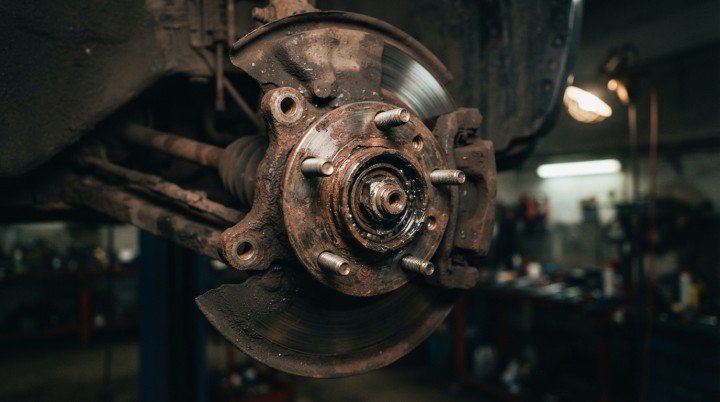
The hub can cause trouble even when its bearing feels tight. Rust, dirt, burrs, or damage on the hub’s mounting face may prevent the rotor from sitting completely flat. A small amount of hub runout can become more noticeable near the outer edge of the brake disc and may eventually contribute to disc thickness variation.
This is one reason brake vibration sometimes returns shortly after new rotors are installed. The replacement rotor may not be defective; it may have been mounted on a contaminated or inaccurate surface.
Diagnosis may include checking the wheel for excessive play, listening to the bearing while it rotates, measuring rotor runout, and then measuring bare-hub runout if necessary. The mounting surfaces should be inspected for corrosion and damage. All measurements must be compared with the vehicle manufacturer’s specifications because acceptable tolerances vary by model.
A damaged hub or bearing generally requires replacement. Cleaning the hub may correct an installation-related issue, but cleaning cannot repair looseness, internal bearing damage, or a distorted mounting surface.
7. Steering or Suspension Parts Are Worn
Braking transfers a significant portion of the vehicle’s weight toward the front axle. That load can expose movement in steering or suspension components that feels minor during steady cruising.
Possible sources include worn control-arm bushings, loose tie-rod ends, damaged ball joints, weakened struts or shocks, and loose mounting points. These parts help control wheel position. If they allow the wheel to move backward, forward, or sideways during braking, the driver may feel shaking through the steering wheel or body.
Control-arm bushings are especially relevant because they resist fore-and-aft wheel movement. A badly worn bushing may allow the wheel to shift when the brakes are applied and then move back when the pedal is released. The vehicle may also wander, pull, make a clunking noise, or show irregular tire wear.
Loose tie rods and ball joints can create similar symptoms, but they also affect steering control. Severe looseness is not merely a comfort problem; it can make the vehicle difficult to control and should be addressed promptly.
Struts and shocks do not normally create brake pulsation by themselves. However, worn dampers may allow excessive body movement or reduce the tire’s ability to remain controlled over uneven pavement. This can magnify another brake, tire, or suspension fault.
A wheel alignment does not repair worn parts. Alignment may be necessary after steering or suspension repairs, but adjusting the angles while a joint or bushing remains loose will not eliminate the underlying movement.
The correct inspection should check the steering linkage, control arms, bushings, ball joints, struts, shocks, and mounting points. Technicians may need to load certain joints during inspection because some looseness is not obvious when the suspension hangs freely on a lift.
8. The ABS Is Activating Normally—or at the Wrong Time
Not every pulsating brake pedal indicates a mechanical failure. During hard braking or a stop on a slippery surface, the anti-lock braking system may rapidly reduce and reapply pressure to prevent the wheels from locking.
Normal ABS operation can create:
- A rapid pulse through the brake pedal
- A buzzing or mechanical sound
- Brief vibration through the vehicle
- Changes in pedal resistance
When ABS activates under the correct conditions, the driver should continue applying firm, steady pressure instead of pumping the pedal.
The situation is different when rapid pulsation occurs during an ordinary low-speed stop on dry pavement. Unexpected ABS activation may result from inaccurate wheel-speed information.
Each ABS wheel-speed sensor monitors the rotation of its wheel. If one sensor briefly reports that its wheel has slowed or stopped while the others are still rotating, the control module may interpret the signal as impending wheel lock and activate ABS.
Possible causes include a damaged or contaminated sensor, corroded wiring, a poor connector, a cracked or rusty tone ring, excessive wheel-bearing clearance, or an incorrect sensor-to-ring air gap. Different tire sizes or significantly different rolling circumferences may also interfere with wheel-speed comparison on some vehicles.
An ABS warning light may appear, but not every intermittent signal problem immediately stores an obvious dashboard warning. Diagnosis should include scanning the ABS module—not only the engine computer—and comparing live wheel-speed readings during the conditions that trigger the pulse.
Replacing a sensor solely because a code mentions its circuit can lead to an unnecessary repair. The wiring, connector, tone ring, bearing, sensor mounting surface, and live signal should be inspected before the part is condemned.
Why Does My Car Shake After New Brakes?
New brake parts do not guarantee smooth braking if the original cause was missed or the installation introduced another problem.
Common possibilities include:
- Rust or debris left between the rotor and hub
- Rotor runout not measured after installation
- Wheel fasteners tightened unevenly
- Pads unable to move freely in the bracket
- Caliper guide pins not operating correctly
- Old hardware reused when replacement was required
- Incorrect parts installed
- Pads and rotors not bedded according to the manufacturer’s procedure
- A pre-existing tire, wheel, bearing, or suspension problem
Uneven wheel-fastener torque can distort how the assembly is clamped, while hub contamination can prevent the rotor from running true. Improper bedding may leave an inconsistent friction layer on the rotor surface. A dragging caliper can then overheat the new parts and damage them again.
The solution is not automatically another set of pads and rotors. The shop should confirm rotor thickness variation and runout, inspect the hub mounting surface, verify wheel torque, and check the caliper and surrounding chassis components.
If the vibration began immediately after service, return to the repair facility and describe exactly when it started. Avoid attempting repeated hard stops to “bed in” the brakes unless the brake or vehicle manufacturer specifies an appropriate procedure. Incorrect bedding attempts can create additional heat and make the condition worse.
How Mechanics Diagnose Brake Vibration
Accurate diagnosis follows evidence instead of assuming every shake comes from the rotors.
1. Confirm the Conditions
The technician should determine whether the vibration occurs during light braking, hard braking, high-speed stops, low-speed stops, or normal cruising. The location of the vibration—steering wheel, pedal, seat, or entire body—should also be recorded.
2. Inspect the Tires and Wheels
Tire pressure, tread condition, wheel damage, balance, mounting, and fastener condition should be checked. A damaged or separated tire must be addressed before further road testing.
3. Inspect the Brake Components
The pads should be compared for thickness and wear pattern. Rotors or drums should be checked for scoring, corrosion, heat damage, minimum dimensions, and contamination. Caliper pistons, guide pins, brackets, hoses, and hardware must move and release correctly.
4. Measure Instead of Guessing
A micrometer can identify disc thickness variation, while a dial indicator measures rotor runout. If rotor runout is excessive, the hub mounting surface and bare hub may need separate measurement.
5. Check the Hub, Bearing, Steering, and Suspension
Wheel-bearing play, control-arm bushings, ball joints, tie rods, dampers, and mounting points should be inspected for movement or damage.
6. Scan the ABS System
If the pedal produces a rapid pulse—especially near a low-speed stop—the technician should retrieve ABS codes and compare live wheel-speed signals. Engine-only code readers may not access the ABS module, so an appropriate scan tool is required.
Following this sequence helps prevent a tire problem, worn bearing, damaged bushing, or faulty ABS signal from being misdiagnosed as another bad rotor.
Can You Drive If Your Car Shakes When Braking?
A light vibration may not mean the brakes are about to fail immediately, but it should still be inspected soon. Brake shudder can increase stopping distance, reduce control, accelerate component wear, and hide a more serious problem.
Stop driving as soon as it is safe and arrange towing or professional assistance if the vibration is accompanied by:
- A soft, sinking, or unusually hard brake pedal
- A red brake-system warning light
- Severe pulling or difficulty steering
- Grinding or harsh metal-to-metal noise
- Smoke or a strong burning smell
- A wheel that feels loose
- Visible tire damage or tread separation
- Brake-fluid leakage
- Noticeably increased stopping distance
- Rapidly worsening vibration
A rapid pedal pulse during emergency braking or on a slippery road may simply be normal ABS operation. In that situation, maintain firm pedal pressure and steer toward a safe path. However, repeated pulsing during normal dry-road stops requires diagnosis.
Frequently Asked Questions
Why Does My Steering Wheel Shake When Braking?
Steering-wheel vibration often points toward the front brakes, tires, wheels, hubs, or steering components. Front rotor thickness variation is common, but tire damage, wheel imbalance, hub runout, worn tie rods, and loose control-arm bushings can feel similar.
Why Does the Car Vibrate at Low Speeds?
A low-speed pulse may come from an out-of-round rear drum, disc variation, a sticking brake component, or unexpected ABS activation caused by an inaccurate wheel-speed signal. If the vibration occurs only after the vehicle has stopped and remains in Drive, an engine or transmission mount may be involved instead of the brakes.
Why Does the Car Shake Only While Braking?
Vibration limited to brake application increases the likelihood of a brake-disc, drum, pad, caliper, hub, or suspension-load problem. It does not prove that the rotors are defective, which is why measurement and inspection are important.
Can Bad Tires Cause Brake Vibration?
Yes. An imbalanced, cupped, separated, or deformed tire may vibrate while cruising and shake more intensely when braking transfers weight toward that wheel. Visible tire damage should be treated as an immediate safety concern.
Will an Alignment Fix the Shaking?
Alignment may help if incorrect wheel angles caused uneven tire wear, but it will not repair damaged tires, bent wheels, worn bearings, loose suspension parts, sticking calipers, or uneven brake discs. Worn components must be repaired before a reliable alignment can be completed.
Final Takeaway
A car shakes when braking because something is applying braking force unevenly, rotating inaccurately, or moving under the load created during deceleration. The most common source may be disc thickness variation or runout, but pads, calipers, rear brakes, tires, wheels, hubs, bearings, suspension parts, and ABS signals can all create similar symptoms.
Start by identifying where the shake is felt and whether it occurs only during braking. Then inspect and measure the system rather than replacing parts based on assumptions. Prompt diagnosis can protect the new brake components, prevent unnecessary repair costs, and—most importantly—keep the vehicle controllable when it needs to stop.
Kevin Nicholas is an automotive mechanic and editor of The Effective Guide. He writes about warning lights, car problems, and diagnostic tools, helping drivers understand what to check before replacing a part.