
Last Updated on October 7, 2026
A Check Engine Light appears, and a scan returns an oxygen-sensor code. The immediate assumption is often that the vehicle needs “an O2 sensor.” The problem is that many modern vehicles have two, three, or four sensors—and they do not all perform the same job.
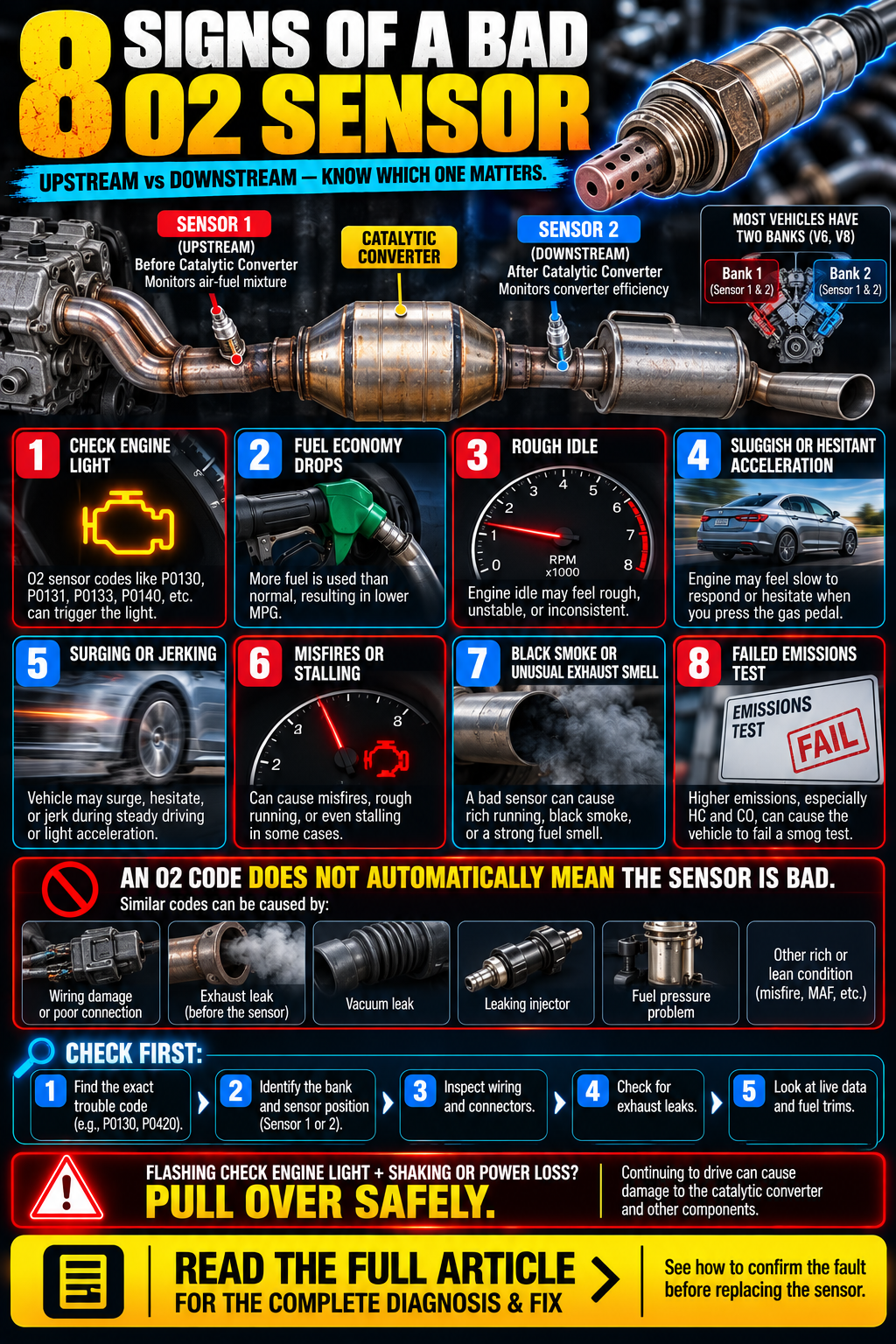
An upstream sensor helps the engine computer manage the air-fuel mixture. A downstream sensor mainly monitors how effectively the catalytic converter is treating exhaust. Because their responsibilities differ, some bad oxygen sensor symptoms affect fuel economy and drivability, while others may produce little more than a warning light.
The code’s location matters just as much as its description. Before replacing anything, the diagnosis should answer three questions: Which bank is involved? Which sensor position is involved? Is the sensor actually faulty, or is it correctly reporting another engine or exhaust problem?
What Does an O2 Sensor Actually Measure?
An oxygen sensor does not measure how much fuel is inside the engine. It monitors oxygen remaining in the exhaust after combustion. The engine control module uses that information to judge whether the air-fuel mixture is relatively rich or lean.
A rich mixture contains more fuel than the engine can burn efficiently. A lean mixture contains too little fuel in relation to the amount of air. When the upstream sensor reports changing exhaust conditions, the computer adjusts fuel delivery to keep combustion within the intended range.
Downstream sensors have a different priority. Located after the catalytic converter, they help the computer determine whether the converter is storing oxygen and reducing harmful exhaust emissions as expected.
Some newer vehicles use wideband air-fuel ratio sensors in upstream positions. These provide more precise mixture information and do not produce the same type of signal as a traditional narrowband sensor. For that reason, sensor type must be confirmed before its data is interpreted.
Decode the Location Before Reading the Symptoms
Before interpreting bad oxygen sensor symptoms, translate the Bank and Sensor labels shown in the trouble-code description.
| Diagnostic label | What it identifies | Primary role or meaning | Likely effect of a fault |
|---|---|---|---|
| Bank 1 | The side of the engine containing cylinder number one | Identifies an engine bank, not a sensor position | Shows which side of a V-type engine requires diagnosis |
| Bank 2 | The opposite side of a V-type engine | Separates one exhaust bank from the other | Usually does not apply to an inline engine with only one bank |
| Sensor 1 / Upstream | A sensor positioned before the catalytic converter | Provides mixture feedback for fuel control | Fuel economy and drivability may be affected |
| Sensor 2 / Downstream | A sensor positioned after the catalytic converter | Helps monitor converter efficiency | A warning light may appear with few drivability symptoms |
| A/F or Wideband Sensor | Often used in an upstream position | Provides precise air-fuel mixture information | Requires sensor-specific data interpretation |
These labels follow common OBD2 conventions, but the vehicle’s service information should be used to confirm the exact arrangement. Some exhaust systems contain additional sensors or use different layouts.
First Signal: What the Computer Notices
1. The Check Engine Light Comes On
The Check Engine Light is often the first visible sign of an oxygen-sensor problem. The engine computer can detect when a sensor responds too slowly, reports an implausibly high or low signal, stops responding, or develops a heater-circuit fault.
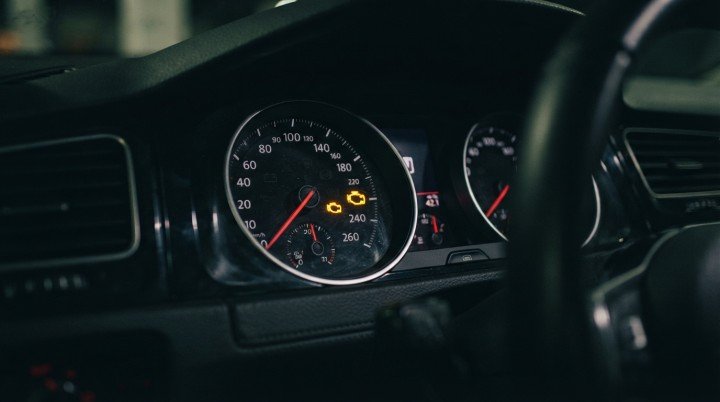
Common code descriptions may include:
- O2 sensor circuit malfunction
- Circuit low or high voltage
- Slow response
- No activity detected
- Heater-circuit malfunction
- System too rich or too lean
These descriptions are diagnostic starting points, not replacement orders. A low-voltage code may be caused by a sensor fault, damaged wiring, an exhaust leak, or a genuinely lean engine condition. A high-voltage code may reflect a wiring issue, rich mixture, leaking injector, or incorrect fuel pressure.
The code family and full description help identify the location. For example, P0130-series codes commonly relate to Bank 1 oxygen-sensor circuits, while P0150-series codes generally concern Bank 2. The final digits help distinguish sensor operation, heater faults, and specific positions.
A steady Check Engine Light calls for timely diagnosis. A flashing light usually indicates a more urgent misfire rather than simply an O2 sensor fault. If the light flashes while the engine shakes, stalls, or loses significant power, stop driving safely and arrange professional assistance.
2. Fuel Economy Drops
A faulty upstream sensor can send inaccurate or delayed mixture feedback. If the computer interprets the exhaust as lean, it may add more fuel than necessary. The vehicle may then use more fuel even though driving habits and conditions have not changed.
A slow sensor can also delay the computer’s corrections as engine load and operating conditions change. The fuel economy decline may develop gradually, making it difficult to notice until the driver compares several fill-ups.
A downstream sensor usually has less direct influence on normal fuel control, although strategies vary between vehicles. A downstream code with no MPG or drivability change may therefore tell a different story from an upstream fault accompanied by poor fuel economy.
Poor mileage alone is weak evidence. Low tire pressure, short trips, cold weather, a stuck-open thermostat, leaking injector, dirty MAF sensor, worn spark plugs, fuel-quality changes, and driving conditions may all increase consumption.
Why Sensor Location Changes the Diagnosis
When bad oxygen sensor symptoms include poor fuel economy and noticeable drivability problems, upstream mixture feedback becomes particularly relevant. When the vehicle runs normally but stores a downstream sensor or catalyst-monitoring code, the diagnostic focus may shift toward the downstream circuit, exhaust leaks, or catalytic-converter performance.
When Fuel Corrections Affect Drivability
The next four bad oxygen sensor symptoms are usually more noticeable when the upstream sensor sends inaccurate information to the engine computer. Because the downstream sensor mainly monitors catalytic-converter performance on most vehicles, a downstream fault may illuminate the Check Engine Light without causing obvious drivability problems.
3. The Engine Idles Roughly
At idle, the engine must maintain a precise air-fuel mixture while operating at a relatively low speed. If the upstream O2 sensor incorrectly reports a lean mixture, the engine computer may add more fuel than necessary. If it reports a rich mixture, the computer may remove too much fuel. Either condition can make the idle feel uneven.
You might notice the engine shaking slightly, the RPM needle moving up and down, or the vehicle vibrating more than usual while stopped. The symptoms may become more noticeable after the engine warms up because the computer begins relying more heavily on oxygen-sensor feedback during closed-loop operation.
However, a rough idle does not automatically prove that the sensor has failed. Vacuum leaks, dirty fuel injectors, worn spark plugs, ignition-coil problems, low compression, or a contaminated mass airflow sensor can produce similar behavior.
A useful diagnostic clue is whether the rough idle appears alongside an oxygen-sensor code and abnormal fuel-trim readings. A technician should still check for intake leaks and ignition problems before replacing the sensor.
4. Acceleration Becomes Sluggish or Hesitant
An engine needs the correct amount of fuel when the driver requests more power. Incorrect feedback from an upstream oxygen sensor can interfere with the computer’s fuel adjustments, causing the vehicle to hesitate or respond slowly.
Instead of accelerating smoothly, the engine may feel as though it pauses briefly after the accelerator is pressed. Power may also feel inconsistent, especially when merging, climbing a hill, or accelerating from a stop.

This symptom requires careful interpretation. The engine computer generally uses several inputs—not only the O2 sensor—to calculate fueling. A weak fuel pump, clogged fuel injector, dirty throttle body, faulty MAF sensor, restricted catalytic converter, transmission problem, or ignition misfire could create the same sensation.
Rather than repeatedly testing the vehicle under heavy acceleration, note when the hesitation occurs and have the system checked safely. Information such as whether the engine was cold or warm, whether the Check Engine Light appeared, and whether the problem occurred at low or high RPM can help narrow down the cause.
5. The Engine Surges or Jerks
A faulty upstream sensor can sometimes cause the fuel mixture to alternate between too rich and too lean. When the computer continually reacts to inaccurate readings, engine output may become inconsistent.
The vehicle may briefly gain and lose power even though the accelerator position remains steady. This can feel like surging, bucking, or jerking during light acceleration or steady-speed driving.

Yet oxygen-sensor failure is only one possible explanation. Intermittent ignition-coil failure, worn spark plugs, fuel-pressure problems, contaminated injectors, vacuum leaks, and transmission issues should also be considered. If the jerking happens while the Check Engine Light flashes, an active misfire may be occurring. Pull over safely, switch off the engine, and arrange professional assistance because continued driving could overheat and damage the catalytic converter.
A downstream sensor alone is less likely to cause strong surging on most vehicles. If a scanner identifies only a downstream-sensor circuit fault while the engine jerks severely, the drivability complaint may have another cause.
6. Misfires or Stalling Begin
Incorrect fuel control can eventually make combustion unstable. If the mixture becomes excessively rich or lean, one or more cylinders may fail to burn the mixture properly. The driver may notice shaking, reduced power, difficult starting, or occasional stalling.
Severe cases can produce misfire codes such as P0300 or cylinder-specific codes in addition to an oxygen-sensor-related code. But the order of events matters: a defective sensor may contribute to poor fueling, while an existing misfire can also send extra oxygen into the exhaust and make the sensor reading appear abnormal.
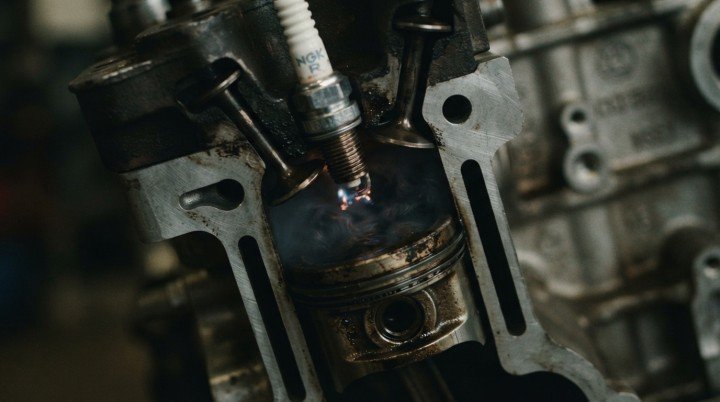
Stalling is especially important to investigate because a failed O2 sensor is rarely the only possible cause. Problems involving fuel delivery, crankshaft or camshaft sensors, electrical connections, airflow measurement, or major vacuum leaks may be responsible.
Is the O2 Sensor the Cause—or Just the Reporter?
Separating genuine bad oxygen sensor symptoms from problems the sensor is merely reporting is one of the most important parts of diagnosis. An O2 sensor can detect an unusual exhaust condition even when it is working correctly.
For example, an exhaust leak ahead of the sensor may allow outside air into the exhaust stream, creating a false lean indication. A leaking fuel injector may create a rich condition, while a vacuum leak can create a genuinely lean mixture. Damaged wiring, a failed heater circuit, or corroded connectors can also interrupt the signal without the sensing element itself being defective.
That is why an OBD2 code should be treated as a starting point rather than a command to install a new part. A reliable diagnosis compares the exact code, sensor location, live sensor response, fuel trims, wiring condition, and possible intake or exhaust leaks. Because exhaust components become extremely hot, inspection around the sensor and exhaust system should be performed only after the vehicle is safely cooled—or left to a qualified technician.
What the Exhaust Is Telling You
The final two bad oxygen sensor symptoms are often discovered through changes in exhaust output or emissions-test results rather than through major drivability problems.
7. Black Smoke or an Unusual Exhaust Smell
If an upstream O2 sensor incorrectly reports that the mixture is lean, the engine computer may add more fuel. An excessively rich mixture can produce black exhaust smoke, a strong fuel smell, or a sulfur-like odor.
These signs should not be blamed on the sensor without testing. Leaking fuel injectors, excessive fuel pressure, a faulty MAF sensor, ignition misfires, or a damaged catalytic converter can create similar symptoms. Blue or thick white exhaust smoke usually points toward oil or coolant problems rather than an oxygen sensor.

A persistent fuel smell or visible black smoke deserves prompt attention. Excess fuel can contaminate spark plugs and overheat the catalytic converter.
8. The Vehicle Fails an Emissions Test
A slow or inaccurate O2 sensor may prevent the engine computer from controlling the air-fuel mixture effectively. That can increase harmful exhaust emissions and cause the vehicle to fail an emissions inspection.
A downstream sensor fault can also interfere with the computer’s ability to monitor catalytic-converter efficiency. In that situation, the car may seem to run normally while the Check Engine Light remains on.

Clearing the code immediately before an inspection is not a real repair. It resets emissions monitors, and the vehicle may show a “not ready” result until the required tests run again. The original fault will normally return if its cause has not been corrected.
What Happens If You Ignore a Bad O2 Sensor?
Ignoring bad oxygen sensor symptoms may initially seem harmless, especially if the car still drives normally. However, the long-term consequences depend on which sensor failed and how severely fuel control is affected.
A faulty upstream sensor can increase fuel consumption, worsen acceleration, foul spark plugs, and contribute to repeated misfires. If the engine continually runs rich, unburned fuel can raise catalytic-converter temperature and eventually damage this expensive component.
A downstream-sensor problem may have less effect on drivability, but ignoring it can hide useful information about catalytic-converter performance and keep the vehicle from passing an emissions inspection.
Not every sensor fault causes immediate engine damage. Still, delaying diagnosis can allow a wiring problem, exhaust leak, fuel-system fault, or genuine rich or lean condition to become more expensive.
What Should You Check First?
Begin with the exact diagnostic trouble code, not the assumption that every O2-related code means the sensor itself is defective. The code should identify the affected circuit and may indicate the bank, sensor position, heater circuit, slow response, or mixture condition.
Next, determine whether the code refers to an upstream or downstream sensor. Remember that Sensor 1 is generally before the catalytic converter, while Sensor 2 is generally after it. On V-type engines, Bank 1 is the side containing cylinder number one.
A proper diagnosis should then check:
- Sensor wiring and electrical connectors for visible damage
- Exhaust leaks near or ahead of the sensor
- Live O2 or air-fuel sensor readings
- Short-term and long-term fuel trims
- Vacuum leaks, misfires, fuel-pressure problems, and contaminated airflow sensors
These checks help determine whether the sensor is producing incorrect information or accurately reporting another engine problem. Cleaning an O2 sensor is generally unreliable because chemicals or physical contact can damage its sensitive element. If testing confirms internal failure, replacement is usually the dependable repair.
Oxygen sensors and nearby exhaust parts can become extremely hot. Allow the vehicle to cool completely and leave under-vehicle inspection or electrical testing to a qualified technician when safe access and proper equipment are unavailable.
Can You Continue Driving?
If the Check Engine Light is steady, the engine runs normally, and there is no smoke or strong fuel smell, a short trip to a repair shop may be reasonable. Schedule diagnosis soon rather than continuing to drive indefinitely.
Stop driving safely and arrange professional assistance if the Check Engine Light flashes or the vehicle develops severe shaking, stalling, major power loss, black smoke, or a strong raw-fuel odor. These signs can indicate an active misfire or excessively rich condition that may quickly damage the catalytic converter.
Final Thoughts
Recognizing bad oxygen sensor symptoms can prevent wasted fuel, failed emissions tests, poor engine performance, and catalytic-converter damage. The most important step is identifying which sensor is involved and confirming whether it has failed or is simply reporting another problem. Diagnose the code and its underlying cause before purchasing replacement parts.
Kevin Nicholas is an automotive mechanic and editor of The Effective Guide. He writes about warning lights, car problems, and diagnostic tools, helping drivers understand what to check before replacing a part.