
Last Updated on October 7, 2026
Your car does not always jerk, shake, or lose power completely. Sometimes, it simply pauses.
You press the accelerator expecting an immediate response, but the engine takes a moment to react. It may stumble briefly, feel flat, and then suddenly begin pulling normally. When your car hesitates when accelerating, that short delay is more than an annoyance—it is a clue to where the power request is being interrupted.
Smooth acceleration follows a chain. The accelerator sends a request, the throttle admits air, sensors measure engine load, fuel reaches the cylinders, the ignition system creates combustion, and the transmission transfers the resulting power to the wheels. A delay anywhere along that chain can produce a similar feeling from the driver’s seat.
The important question is not only what component might be faulty. It is: At what point does the response disappear?
First, Name the Symptom Correctly
Hesitation, jerking, and transmission slipping are often described as the same problem, but they do not feel exactly alike.
Hesitation is a short delay or stumble between pressing the accelerator and receiving power. Jerking usually feels like repeated or sudden forward-and-back movement. Transmission slipping often allows engine speed to rise without a matching increase in vehicle speed.
The symptoms can overlap. An ignition misfire may begin as hesitation and become repeated bucking under heavier load. A transmission problem may feel like engine hesitation until the driver notices that RPM and road speed are not rising together.
If your car hesitates when accelerating, use the timing and character of the symptom to decide which section of the power chain deserves attention first.
The Hesitation Sorter: Where Does the Delay Appear?
This responsive table is designed to narrow the diagnostic direction. Use only conditions you have already observed; do not deliberately recreate severe hesitation, power loss, or unsafe acceleration.
The table provides direction, not a confirmed diagnosis. Several faults can create the same pattern, and trouble codes should be supported by live data and system-specific testing before parts are replaced.
Pattern One: The Delay Happens the Instant You Press the Pedal
When hesitation begins at the first moment of accelerator input, follow the request from the pedal to the engine. The throttle must respond, airflow must be measured correctly, and all incoming air must enter through the expected path.
| When the Delay Happens | What It May Feel Like | First Diagnostic Direction |
|---|---|---|
| Immediately after pressing the accelerator | Brief pause followed by a sudden response | Throttle control, airflow measurement, or intake leak |
| During light, steady acceleration | Uneven response, surging, or mild stumbling | MAF/MAP readings, vacuum leak, or fuel metering |
| During hard acceleration or uphill load | Loss of power, misfire, or repeated hesitation | Fuel pressure, injectors, spark plugs, or ignition coils |
| As engine speed continues to rise | Power becomes progressively weaker | Restricted intake or catalytic converter |
| Around one particular gear change | Delayed movement, RPM flare, or one noticeable surge | Transmission, torque converter, or clutch |
| Soon after refueling | A new hesitation that appeared suddenly | Contaminated fuel, injector delivery, or related fuel-system fault |
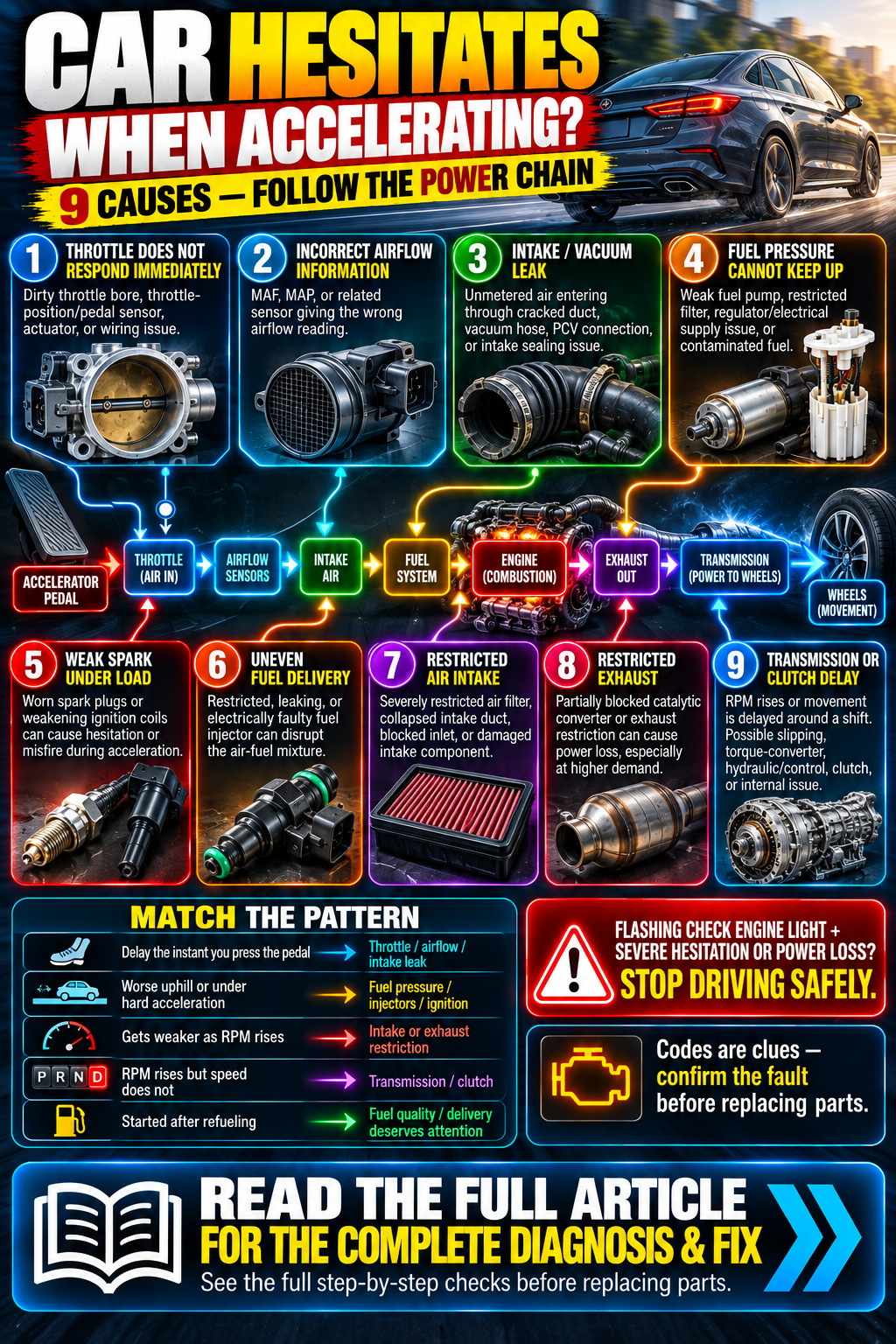
1. The Throttle Does Not Respond Immediately
Modern vehicles commonly use electronic throttle control. Sensors inside the accelerator pedal report driver demand to the engine computer, which then commands an electric motor to open the throttle plate.
A dirty throttle bore may interfere with smooth airflow near the closed position. A throttle-position sensor, accelerator-pedal sensor, actuator, connector, or wiring problem can also make the actual throttle opening disagree with the requested position.
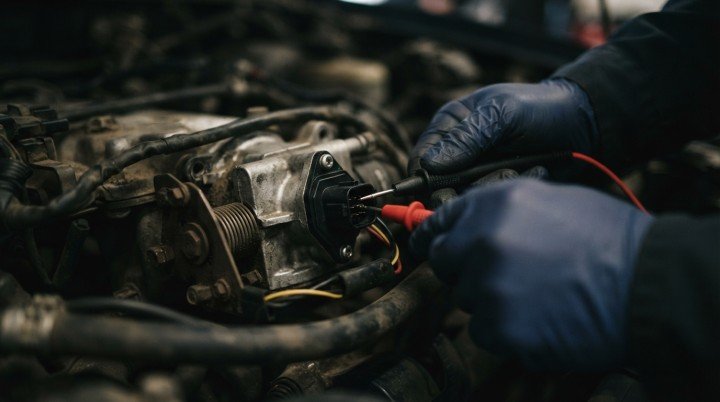
Supporting signs may include delayed off-idle response, unstable idle, reduced-power mode, or throttle-correlation codes. However, a code naming the throttle system does not automatically prove that the throttle body needs replacement. The technician should compare commanded throttle position, actual position, and pedal-sensor data before deciding which component is responsible.
Some vehicles also require a manufacturer-specific relearn after throttle-system service. Cleaning or replacing a component without considering calibration can leave the original symptom unchanged.
2. The Engine Receives Incorrect Airflow Information
The engine computer must know how much air is entering and how heavily the engine is being loaded. Depending on the vehicle, it may rely on a mass airflow sensor, manifold absolute pressure sensor, or a combination of several inputs.
If that information becomes inaccurate or intermittent, the computer may command the wrong amount of fuel as the throttle opens. The result can be a brief lean or rich condition that feels like a pause, stumble, or delayed surge.
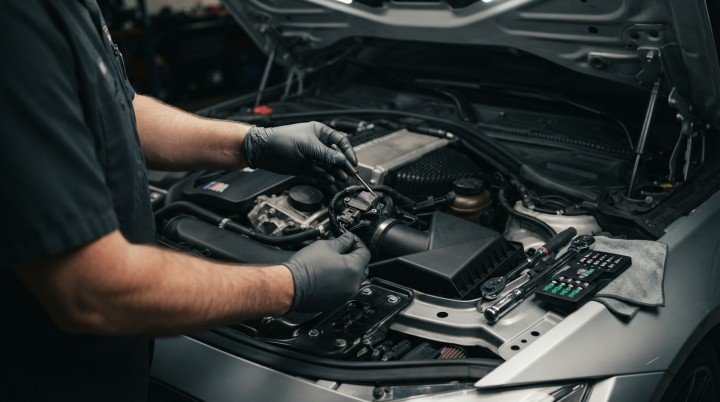
A faulty airflow reading may also appear with rough idle, reduced fuel economy, weak performance, or lean/rich mixture codes. Yet the sensor itself is only one possibility. Contaminated sensing elements, damaged wiring, poor electrical connections, intake leaks, and incorrect pressure information can all distort the reading.
Live data should be compared with expected values for that engine and operating condition. Replacing a MAF or MAP sensor solely because its name appears in a trouble code can miss the actual cause.
3. Unmeasured Air Enters Through an Intake Leak
Every amount of air entering the engine should be measured or calculated before fuel delivery is adjusted. A crack in the intake duct, leaking vacuum hose, damaged PCV connection, or intake-manifold sealing problem can allow additional air to enter without being properly accounted for.
The unexpected air can create a lean mixture, especially at idle and during light throttle. The engine computer may compensate within a limited range, but a changing or larger leak can produce hesitation, surging, rough idle, or lean-condition codes.
Fuel-trim readings and a professional smoke test can help distinguish an intake leak from low fuel pressure or inaccurate airflow data. Spraying flammable products around a running engine is hazardous and should not be used as a diagnostic shortcut.
Pattern Two: The Engine Hesitates Only When You Ask for More Power
Some delays appear the instant the pedal is pressed. Others remain hidden until the engine is asked to produce more torque. When a car hesitates when accelerating only during stronger throttle input, uphill load, or higher demand, the air entering the engine may be adequate—but the fuel or spark may not be keeping up.
That difference moves the investigation farther down the power chain.
4. Fuel Pressure Cannot Keep Up With Demand
An engine requires much less fuel at idle than it does during acceleration. A weak fuel pump, restricted fuel filter, faulty pressure regulator, electrical supply problem, or contaminated fuel can allow the engine to idle normally while leaving it short of fuel as demand rises.
The symptom may feel like a flat spot, temporary loss of power, or repeated stumbling under load. Difficult starting, unusually long cranking, lean-condition codes, or weak performance at higher engine speeds may provide additional evidence.
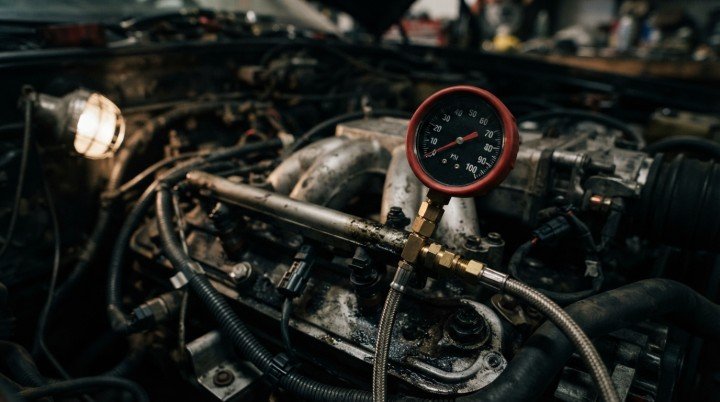
These signs do not identify one specific fuel-system component. Lean readings can also result from intake leaks or incorrect airflow data. A technician should compare fuel pressure and scan data with manufacturer specifications before recommending a pump, filter, or regulator.
Fuel systems may retain pressure even after the vehicle is switched off, and gasoline is highly flammable. Diagnosis involving fuel lines, pressure gauges, or pump access should be left to a qualified technician.
5. The Spark Becomes Weak Under Load
In a gasoline engine, spark plugs and ignition coils must ignite the air-fuel mixture consistently. As engine load increases, cylinder pressure rises and the ignition system must work harder to create a reliable spark.
A worn plug or weakening coil may perform well enough at idle but begin misfiring during acceleration. The driver may notice hesitation, vibration, reduced power, poor fuel economy, or a check engine light. The problem often becomes more noticeable during stronger acceleration or when the engine is carrying additional load.
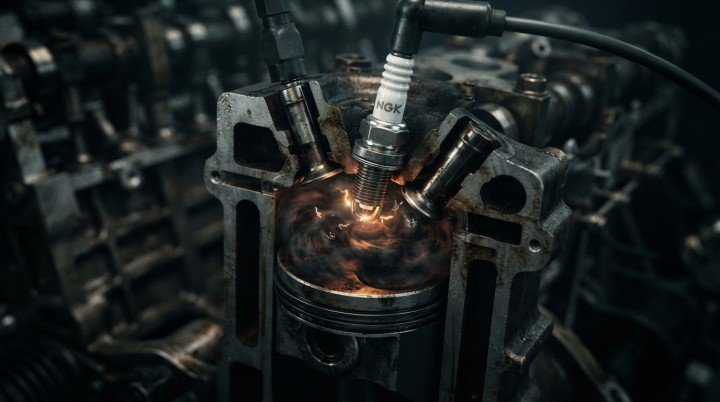
Misfire codes can identify the affected cylinder, but they do not automatically prove that the spark plug or coil has failed. Injector trouble, damaged wiring, low compression, and intake leaks can produce similar codes. Misfire counts, ignition condition, and supporting test results should be evaluated together.
A flashing check engine light can indicate an active misfire capable of overheating the catalytic converter. If the light flashes while severe hesitation or power loss occurs, stop further use and arrange professional assistance rather than trying to reproduce the symptom.
6. Fuel Reaches the Cylinders Unevenly
Fuel pressure may be correct while individual cylinders still receive an inconsistent amount of fuel. An injector can become restricted by deposits, develop an electrical fault, leak, or produce an uneven spray pattern.
The resulting combustion imbalance may feel like a brief stumble, delayed response, or intermittent surge. Rough idle, misfire codes, increased fuel consumption, difficult starting, or a noticeable fuel odor may accompany the hesitation.
Cleaning may help when deposits are the confirmed problem, but it cannot repair a failed injector coil, damaged circuit, internal leak, or mechanical fault. Injector balance testing, electrical checks, and fuel-trim analysis can help separate an injector problem from ignition trouble.
Fuel quality also matters. Water, contamination, incorrect fuel, or an unusual concentration of deposits can affect combustion across multiple cylinders. If the car hesitates when accelerating soon after refueling, record where and when the fuel was purchased and inform the technician. That timing is evidence, although it does not prove the fuel itself caused the problem.
Pattern Three: The Higher the Demand, the Worse the Delay
When a car hesitates when accelerating and the symptom becomes progressively worse as engine speed or load rises, the engine may be struggling to breathe. Air must enter freely before combustion, and exhaust gases must leave without excessive resistance.
7. The Engine Cannot Pull In Enough Air
A mildly dirty air filter does not usually create dramatic hesitation by itself. A severely restricted filter, collapsed intake duct, blocked air inlet, or damaged intake component, however, can limit the amount of air available as the engine demands more.
The vehicle may feel acceptable at idle or under gentle acceleration but become sluggish as engine speed increases. Reduced power and poor fuel economy may accompany the delay, although these symptoms also occur with fuel-delivery and exhaust problems.
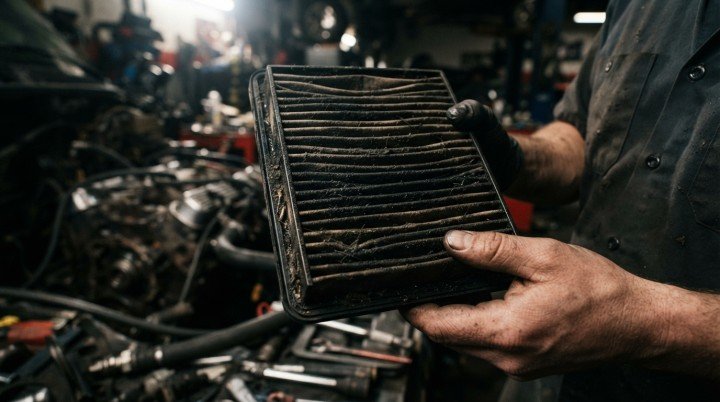
The entire intake path should be considered. Replacing a filter solely because it looks dusty may not solve the problem if the actual restriction is elsewhere. Likewise, removing the filter for continued vehicle use is not an appropriate fix because unfiltered debris can enter and damage the engine.
8. Exhaust Gas Cannot Escape Properly
The engine cannot draw in a fresh air-fuel charge efficiently if exhaust gases cannot leave. A partially restricted catalytic converter or damaged exhaust component can create increasing backpressure as exhaust volume rises.
This often produces a vehicle that starts and idles normally but feels increasingly weak under higher demand. Possible supporting clues include catalyst-related codes, unusual exhaust heat, poor fuel economy, or a sulfur-like odor. These signs are not unique to a blocked converter, so exhaust restriction should be confirmed with appropriate testing.
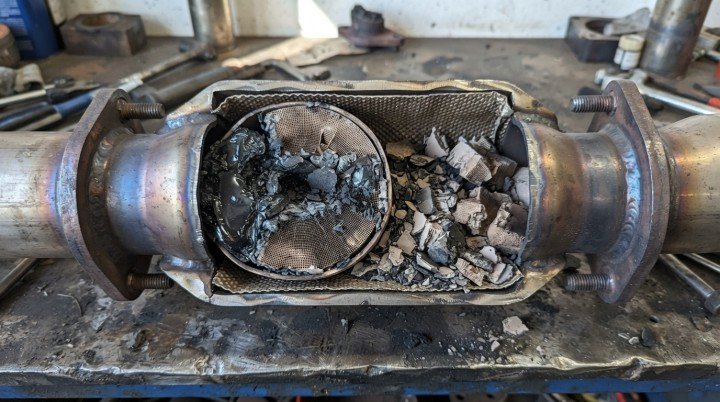
A catalytic converter may be damaged by an unresolved misfire, incorrect fuel mixture, oil consumption, or coolant entering the combustion process. Replacing the converter without identifying the underlying cause can allow the new unit to fail again.
Pattern Four: The Engine Responds, but the Vehicle Does Not
The final pattern begins after the engine has already produced power. If RPM responds but vehicle speed does not increase proportionally, the delay may be occurring during power transfer rather than combustion.
9. Power Is Delayed Inside the Transmission or Clutch
An automatic transmission must select and apply the correct gear while the torque converter transfers engine power. A control fault, internal wear, torque-converter problem, or delayed gear engagement can create hesitation around a particular shift.
Clues include engine-speed flare, delayed movement, slipping, shuddering within a narrow speed range, or a transmission warning. In a manual vehicle, a worn clutch may allow RPM to rise without a matching increase in road speed.
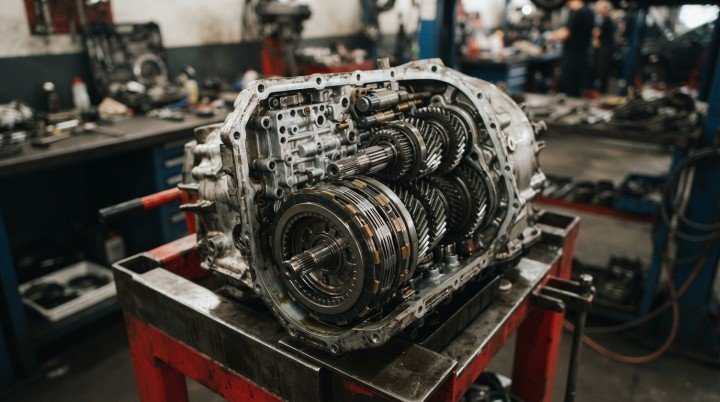
These signs do not automatically mean the transmission needs replacement. Sensor faults, software issues, hydraulic-control problems, clutch wear, and internal damage can overlap. Transmission-specific scan data and professional evaluation are needed before an expensive repair is approved.
The Clue Ladder: Build Evidence From the Bottom Up
Instead of beginning with a suspected part, begin with the strongest information already available.
Clue 1: Identify the Exact Moment
Record whether the delay occurs from a stop, during light acceleration, under higher demand, at higher RPM, after refueling, or around a gear change. Do not deliberately reproduce a severe or unpredictable symptom.
Clue 2: Note What the Engine Does
Previously observed RPM behavior can separate directions. Falling or unstable RPM may suggest a combustion problem, while rising RPM without matching vehicle speed points more strongly toward power-transfer trouble.
Clue 3: Record the Supporting Signs
A steady or flashing check engine light, rough idle, unusual odor, hard starting, reduced fuel economy, or transmission warning adds context. A scan should include stored and pending codes, but codes are clues—not automatic part-replacement instructions.
Clue 4: Consider What Changed Recently
The starting point may be recent refueling, intake-system work, ignition maintenance, battery disconnection, or transmission service. Timing does not prove causation, but it helps determine which evidence should be reviewed first.
Clue 5: Match the Pattern With Test Results
Depending on the pattern, a technician may evaluate throttle commands, airflow readings, fuel trims, misfire counts, fuel pressure, intake sealing, exhaust restriction, or transmission data. The goal is to confirm where the power chain breaks before approving a repair.
The Mechanic Handoff Note
A clear symptom description can prevent wasted diagnostic time. Bring a short note such as:
“My car hesitates when accelerating during ________. The engine is cold/warm, RPM rises/falls/stays steady, and the warning light is off/steady/flashing. The problem began after ________, and I also noticed ________.”
Include any saved code numbers and recent repair or fuel receipts.
The Red-Flag Line
Stop further use and arrange roadside assistance if the check engine light flashes, power loss becomes severe or unpredictable, the engine repeatedly stalls, or a strong fuel or burning odor appears. Overheating, major transmission slipping, or difficulty controlling the vehicle also requires immediate professional attention.
Final Verdict
If your car hesitates when accelerating, the short delay can begin at the pedal, intake, fuel system, ignition system, exhaust, or transmission. The moment it occurs helps identify which section of the power chain deserves attention, but it does not confirm a failed part.
Record the pattern, preserve available scan information, and require supporting test results before replacing components. That approach can prevent unnecessary repairs and keep a smaller drivability problem from developing into a more expensive failure.
Kevin Nicholas is an automotive mechanic and editor of The Effective Guide. He writes about warning lights, car problems, and diagnostic tools, helping drivers understand what to check before replacing a part.