
Last Updated on October 7, 2026
You press the accelerator and hear the engine working harder. The tachometer climbs, but the car does not gain speed as quickly as expected. A moment later, the transmission seems to catch and the vehicle moves forward normally again.
That mismatch between engine effort and road speed is one of the clearest clues that power may not be passing through the drivetrain correctly. Some transmission slipping symptoms are obvious, while others resemble engine hesitation, tire spin, normal CVT operation, or an electronic-control problem.
Instead of treating every unusual shift as internal transmission failure, this guide uses three “witnesses.” The tachometer reveals whether engine speed and vehicle movement still agree. Gear behavior shows whether the transmission can engage and hold the intended ratio. Heat, warning lights, and diagnostic data reveal what the system detects when the problem continues.
First, Know Which Type of Transmission You Have
The word “slipping” does not mean exactly the same thing in every vehicle. Before interpreting transmission slipping symptoms, check the owner’s manual or vehicle specifications to identify the transmission type.
| Transmission type | What slipping may involve | Important distinction |
|---|---|---|
| Traditional automatic | Clutch packs, hydraulic pressure, valve body, solenoid, or torque converter | Usually has noticeable stepped gear changes |
| Continuously variable transmission (CVT) | Fluid pressure, control system, torque converter, or belt-and-pulley mechanism | May hold a steady, elevated RPM during normal acceleration |
| Manual transmission | A clutch that cannot maintain a firm connection between the engine and gearbox | The clutch may be responsible rather than the internal transmission gears |
| Dual-clutch transmission | Clutch engagement, actuator, fluid-pressure, or control fault | Some low-speed behavior may differ from a conventional automatic |
This distinction matters because a behavior that seems abnormal in one transmission may be expected in another. The best evidence is usually a clear change from how that specific vehicle normally operates.
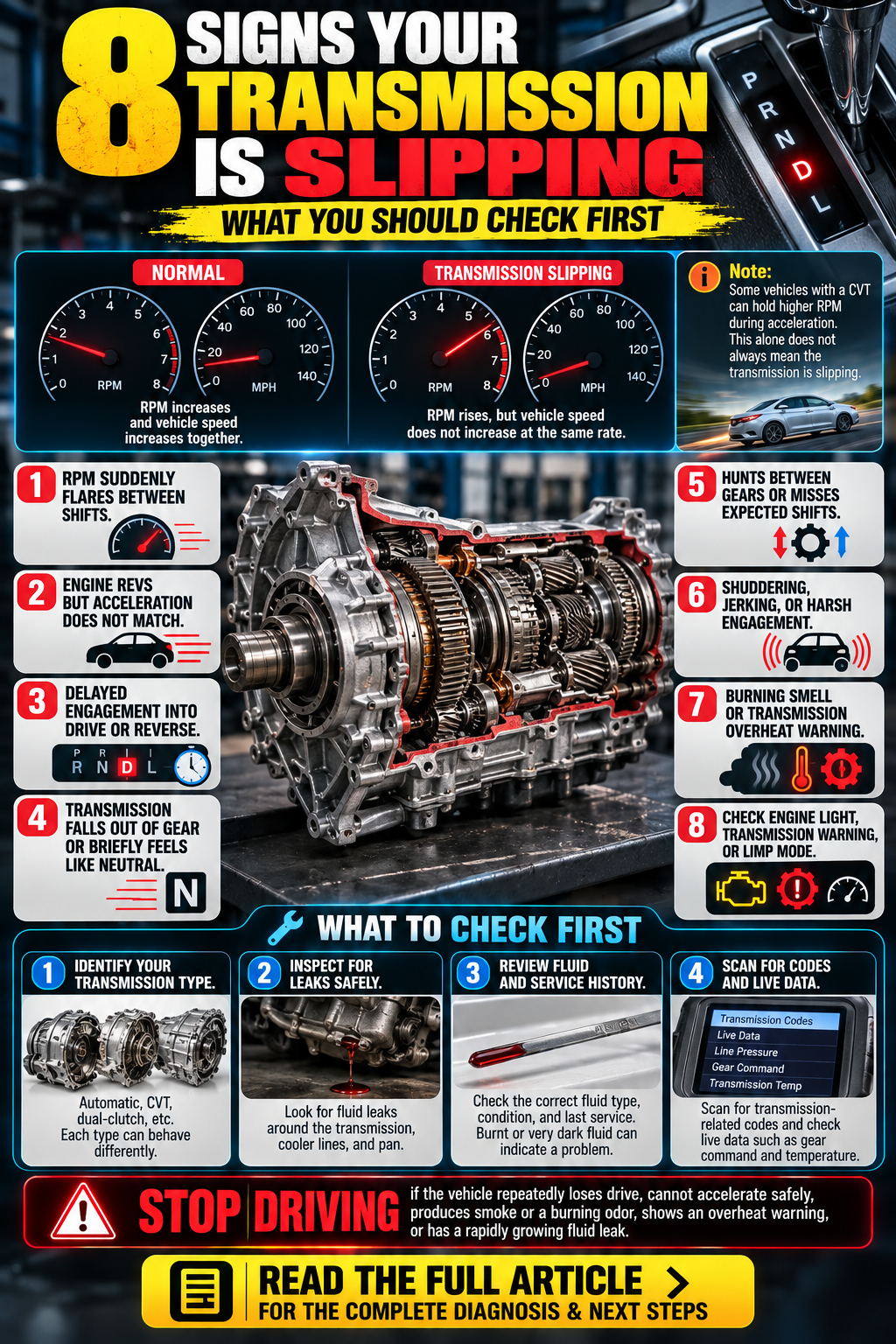
1. RPM Suddenly Flares Between Shifts
What you notice: As an automatic transmission changes gear, the tachometer suddenly jumps higher and the engine becomes louder. Vehicle acceleration briefly pauses, and then the next gear appears to engage.
Why it may be slipping: Inside a traditional automatic transmission, hydraulic pressure applies clutch packs or related components to hold a particular ratio. If pressure is inadequate or a clutch surface is worn, the outgoing gear may release before the next ratio can hold firmly. Engine RPM rises during that gap.
Low or incorrect fluid, leaking internal seals, a pressure-control problem, valve-body wear, or a faulty solenoid may produce similar behavior. Internal clutch wear is another possibility, but it should not be assumed from one RPM flare.
What else can feel similar: A normal downshift may increase RPM when additional power is requested. Certain computer-controlled transmissions also adjust shift timing according to throttle position, load, temperature, and driving conditions. An isolated flare is therefore less convincing than a repeatable pattern during ordinary driving.
Do not accelerate aggressively or deliberately load the transmission to reproduce the symptom. Record when it occurs and let a qualified technician confirm it under controlled conditions.
2. The Engine Revs, but Acceleration Does Not Match
What you notice: The engine responds to the accelerator, but the vehicle feels slow to gain speed. The sound and tachometer suggest that the engine is producing effort, yet forward movement does not increase at the expected rate.
Why it may be slipping: A transmission or clutch that cannot maintain a firm mechanical or hydraulic connection allows engine speed to rise without transferring the same increase in power to the wheels. In a manual vehicle, this commonly points toward a slipping clutch. In a traditional automatic, clutch packs, fluid pressure, or the torque converter may be involved.
What else can feel similar: Engine power loss, turbocharger lag, traction-control intervention, tire spin, restricted exhaust flow, or fuel-delivery problems can also create weak acceleration. A diagnostic comparison should determine whether the engine is failing to produce power or whether the transmission is failing to transfer it.
The CVT Exception That Prevents a False Diagnosis
A CVT does not move through a fixed series of gears in the same way as a traditional automatic. During moderate or heavy acceleration, it may raise the engine to an efficient RPM and hold it there while vehicle speed continues increasing. The engine sound may remain constant even though the car is accelerating normally.
That behavior alone does not prove the CVT is slipping. More concerning clues include a new RPM surge without matching acceleration, a delay that was not present before, repeated loss of drive, warning lights, or a noticeable deterioration in performance.
When reviewing transmission slipping symptoms, avoid relying on an arbitrary RPM number. The stronger question is whether engine effort and road speed have stopped agreeing in a way that differs from the vehicle’s established behavior.
3. Delayed Engagement Into Drive or Reverse
What you notice: After selecting Drive or Reverse, the engine continues running but the vehicle does not respond immediately. Engagement may arrive after a noticeable pause, sometimes with a sudden bump or jolt.
Why it may be slipping: An automatic transmission needs sufficient hydraulic pressure to apply the components that create forward or reverse movement. Low fluid, internal leakage, worn seals, a sticking valve body, or a pressure-control problem may delay that process.
A manual vehicle may hesitate to move for a different reason. If the clutch is worn or cannot maintain a firm connection, engine power may not transfer effectively even though a gear has been selected.

What else can feel similar: Shift-linkage problems, electronic shifter faults, brake drag, unusually high or unstable engine idle, and certain manufacturer-specific operating characteristics can create a delayed response.
A delay that suddenly appears, becomes longer, or is followed by harsh engagement deserves prompt inspection. Avoid increasing engine speed in an attempt to force the vehicle into gear, as engagement may occur unexpectedly.
4. The Transmission Unexpectedly Falls Out of Gear
What you notice: The vehicle is moving normally when engine RPM suddenly rises and forward drive weakens or disappears. It may briefly feel as though the transmission has shifted into Neutral before power returns.
Why it may be slipping: The transmission may be unable to maintain the hydraulic pressure or mechanical holding force required for the selected ratio. Possible causes include low fluid, worn clutch packs, leaking seals, valve-body faults, solenoid problems, or internal wear.
A manual transmission that physically comes out of gear may have a different mechanical problem involving the shifter linkage, synchronizer, mount, or internal gear engagement.

What else can feel similar: Tire spin on a slippery surface, traction-control operation, engine power interruption, or an unexpected downshift may briefly change acceleration. A true loss of drive is more concerning when RPM rises without matching vehicle movement.
If the vehicle repeatedly loses drive, do not continue testing it in traffic. Pull over safely and arrange professional inspection or towing.
5. It Hunts Between Gears or Misses Expected Shifts
What you notice: The transmission shifts up, then quickly shifts down again without an obvious change in driving conditions. It may repeatedly search between ratios, hold a lower gear too long, or fail to make an expected shift.
Why it may be slipping: A transmission control module selects ratios using information such as vehicle speed, throttle position, engine load, and fluid temperature. Incorrect sensor data, solenoid operation, unstable pressure, valve-body trouble, or worn internal components can prevent the commanded ratio from being achieved or maintained.
What else can feel similar: Gear hunting can occur normally on hills, while towing within the vehicle’s rated limits, or when speed and throttle input repeatedly change. Some adaptive transmissions also modify shift behavior according to driving conditions.
The more useful clue is a new or persistent pattern during conditions in which the vehicle previously held a stable ratio.
6. Shuddering, Jerking, or Harsh Engagement
What you notice: Instead of a smooth transition, the vehicle vibrates, jerks, or enters the next gear with a hard bump. A shudder may feel like a rapid vibration during light acceleration or while the transmission is attempting to lock the torque converter.
Why it may be slipping: A torque-converter clutch may be engaging inconsistently, or a clutch pack may alternate between gripping and releasing. Incorrect fluid, fluid deterioration, pressure problems, solenoid faults, and internal wear are possible directions.

What else can feel similar: Engine misfires, worn engine or transmission mounts, CV-joint problems, driveshaft faults, tire issues, and brake problems can all produce vibration or jerking. Harsh shifting and slipping may appear together, but they are not the same condition.
Slipping, Shuddering, and Harsh Shifting Are Different Clues
Separating these behaviors makes transmission slipping symptoms more useful during diagnosis.
| Behavior | What the driver notices | Possible direction |
|---|---|---|
| Slipping | RPM rises without a matching increase in speed | Loss of hydraulic or mechanical power transfer |
| Shuddering | Rapid vibration during engagement or acceleration | Torque converter, clutch, fluid, engine, or driveline problem |
| Harsh shifting | A sudden bump or jolt during a gear change | Pressure, solenoid, valve-body, control, or internal fault |
| Gear hunting | The transmission repeatedly changes ratio | Sensor input, control strategy, vehicle load, or hydraulic problem |
The gearbox witness narrows the problem, but the next evidence may be even more important: heat, warning lights, fluid history, and diagnostic data can show whether the issue is external, electronic, hydraulic, or internal.
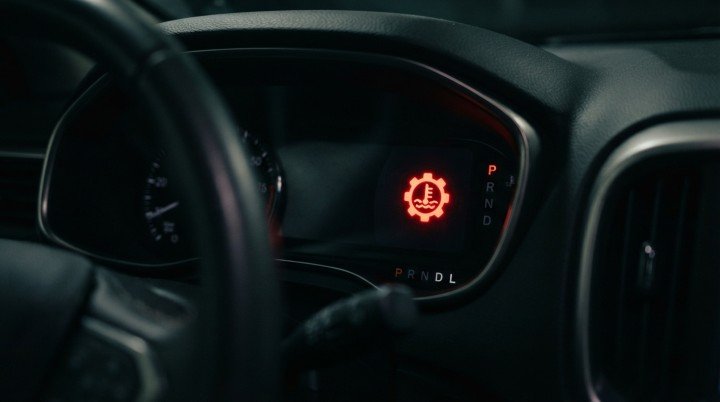
7. A Burning Smell or Transmission-Overheat Warning
What you notice: A sharp burning odor appears during or after driving, or the dashboard displays a transmission-temperature warning. Shifting may become worse as the vehicle warms up.
Why it may be slipping: Transmission fluid provides lubrication, cooling, and—inside many automatic transmissions—the hydraulic pressure needed to apply clutch packs. Low, incorrect, contaminated, or overheated fluid may reduce the transmission’s ability to hold a ratio firmly.
A slipping clutch pack or torque-converter clutch can also create excess friction. That friction generates more heat, which further damages the fluid and reduces its ability to protect the transmission. This can create a cycle in which slipping and overheating make each other worse.
What else can produce the smell: Engine-oil leaks, coolant, electrical faults, brakes, or fluid contacting a hot exhaust component may also create a burning odor. Smell alone cannot identify the source.
If a burning odor, smoke, or transmission-overheat warning appears, stop in a safe place and shut the vehicle off. Do not continue driving to see whether the symptom disappears, and do not touch leaking or recently overheated fluid.
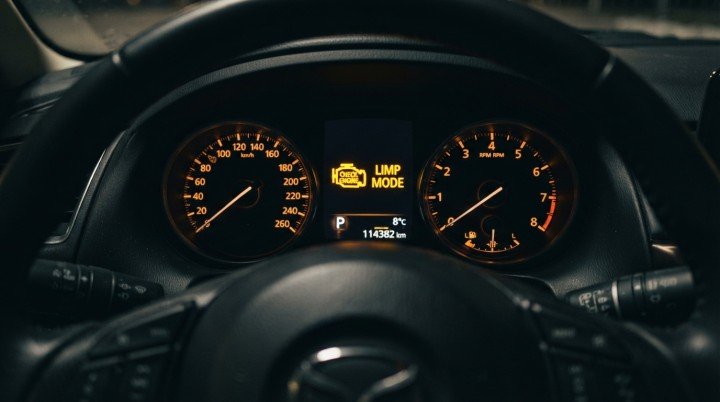
8. Check Engine Light, Transmission Warning, or Limp Mode
What you notice: The Check Engine Light or a transmission-specific warning appears. The vehicle may stop shifting normally, remain in one gear, limit acceleration, or display a message such as “Transmission Fault” or “Service Transmission.”
Why it may be slipping: Modern transmission controllers compare sensor data, commanded gear, input speed, output speed, fluid temperature, and solenoid performance. If the actual ratio does not match the expected ratio, the computer may store a fault code.
The system may then enter limp mode to limit operation and reduce the chance of additional damage. Limp mode is a protective response, not proof that the transmission requires replacement.
What else can trigger it: Shift-solenoid circuits, speed sensors, wiring, connectors, low voltage, TCM communication problems, or engine faults may affect transmission operation. A basic OBD2 scanner may retrieve a general powertrain code, but some manufacturer-specific transmission codes and data require a more capable scan tool.
Clearing a code does not repair the condition. The original code, freeze-frame information, and related data should be recorded before anything is erased.
What You Should Check First
When transmission slipping symptoms appear, begin with evidence that can separate an external or control problem from internal wear. The goal is not to prove immediately that the transmission is bad; it is to identify which layer of the system is failing.
Confirm What “Normal” Means for That Vehicle
Start with the transmission type, the owner’s manual, and the vehicle’s previous behavior. A CVT holding a steady high RPM during acceleration may be operating normally. A conventional automatic that suddenly flares between shifts may not be.
Also note whether the problem began after battery work, transmission service, a fluid leak, overheating, electrical repair, or an extended period of storage. Timing can reveal connections that the symptom alone cannot.
Look for External Evidence Without Taking Risks
From a safe standing position, check the usual parking area for new fluid spots. Do not crawl beneath an unsupported vehicle or touch unidentified fluid. The position and color of a puddle may provide a clue, but transmission fluid is not always red, and other vehicle fluids can look similar.
A visible leak does not show whether internal damage has already occurred. It only confirms that the leak’s source and fluid level require inspection.
Review the Fluid and Service History
Determine when the transmission was last serviced and whether the correct manufacturer-specified fluid was used. Automatic, CVT, dual-clutch, and manual transmissions may require completely different fluids. Using the wrong type can affect lubrication, pressure control, clutch operation, and shift quality.
Not every vehicle has a transmission dipstick. Some systems require the fluid to be checked at a specified temperature with the vehicle level and may need special equipment. Do not add fluid blindly or assume a generic flush is the correct repair. Follow the manufacturer’s procedure or have a qualified shop verify the level and condition.
Scan the Correct Control Modules
Diagnostic codes can identify ratio errors, pressure-control faults, solenoid circuits, speed-sensor problems, overheating, or torque-converter clutch performance. However, a code describes what the computer detected; it does not automatically name the failed part.
A technician may compare commanded gear with actual ratio, input and output speeds, fluid temperature, solenoid commands, and torque-converter clutch slip. Depending on the vehicle, hydraulic-pressure or mechanical tests may also be needed.
The Cause Ladder: From External Problems to Internal Wear
Level 1: Fluid or Leak Problems
Low fluid may reduce hydraulic pressure, while contaminated or incorrect fluid can interfere with lubrication and clutch engagement. Leaking seals, cooler lines, gaskets, or other components may be responsible.
Level 2: Electronic or Hydraulic Control Problems
A faulty solenoid, valve body, speed sensor, wiring circuit, pressure-control component, or transmission control module may command the wrong shift or fail to apply the intended ratio correctly.
Level 3: Power-Coupling Problems
The fault may involve a torque converter in an automatic, a clutch in a manual, or the pressure and pulley system in a CVT. These problems can create RPM rise, shuddering, delayed response, or poor acceleration.
Level 4: Internal Mechanical Wear
Worn clutch packs, bands, seals, bearings, gears, or other internal parts may prevent the transmission from holding a ratio. Internal damage is possible, but it should be supported by test evidence before a rebuild or replacement is approved.
Do Not Approve a Replacement From One Symptom
Before authorizing a major repair, ask:
“What test shows whether the slip is caused by fluid level, hydraulic pressure, electronic control, torque-converter operation, clutch condition, or internal wear?”
A complete answer should include codes, scan data, fluid findings, pressure or mechanical test results, and an explanation of how those findings reproduce the complaint.
When Should You Stop Driving?
Stop driving and arrange roadside assistance if the vehicle unexpectedly loses forward or reverse movement, repeatedly falls into Neutral, cannot accelerate safely with traffic, produces a burning odor or smoke, displays an overheat warning, or develops a rapidly growing fluid leak.
Driving farther may generate additional heat and wear. More importantly, unpredictable power loss can make merging, crossing traffic, or maintaining speed unsafe.
The Final Witness Statement
The tachometer shows whether engine effort matches road speed. Gear behavior reveals whether the transmission can engage and hold a ratio. Heat, warning lights, and diagnostic data show how the system responds when the fault continues.
Taken together, transmission slipping symptoms can identify the most relevant diagnostic direction—but they do not prove that the entire transmission has failed. Check the transmission type, service history, fluid specifications, leaks, codes, and control data before approving major internal work.
Kevin Nicholas is an automotive mechanic and editor of The Effective Guide. He writes about warning lights, car problems, and diagnostic tools, helping drivers understand what to check before replacing a part.