
Last Updated on October 7, 2026
A catalytic converter can fail without becoming completely clogged. In one vehicle, the only clue may be a Check Engine Light. In another, the engine may struggle to breathe because damaged material inside the converter is restricting exhaust flow.
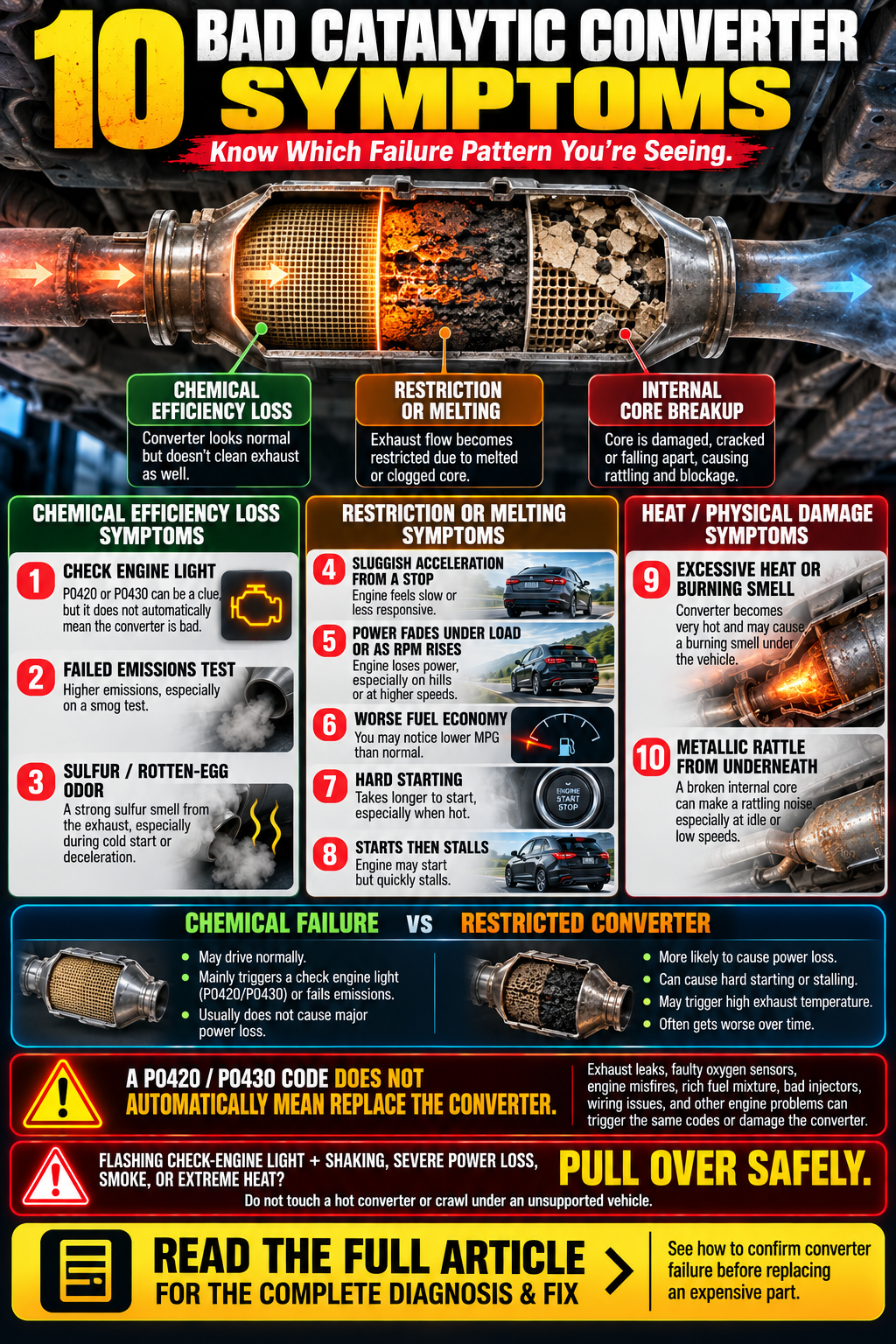
That difference matters. The catalytic converter has to chemically treat harmful exhaust gases, but it must also allow those gases to pass through the exhaust system. Some bad catalytic converter symptoms appear when the chemical reaction stops working efficiently. Others develop only after the internal passage becomes restricted or the ceramic core breaks apart.
Understanding the type of failure can prevent two expensive mistakes: replacing a converter that has not been properly diagnosed and installing a new converter without repairing the engine problem that damaged the original one.
One Converter, Two Jobs, Three Failure Modes
Inside most catalytic converters is a honeycomb-like substrate coated with catalytic materials. As exhaust passes through it, chemical reactions reduce harmful pollutants before they leave the tailpipe.
The passages in that honeycomb must remain open. If they become melted, contaminated, or physically damaged, exhaust flow can be restricted. Before interpreting bad catalytic converter symptoms, it helps to place them into three failure modes.
| Failure mode | What may be happening inside | Common clues |
|---|---|---|
| Chemical-efficiency loss | The catalyst can no longer treat exhaust gases as efficiently as expected. | Check Engine Light, emissions-test failure, or sulfur odor |
| Restriction or melting | The internal passages have become partially or severely blocked. | Weak acceleration, power loss, poor fuel economy, hard starting, stalling, or excessive heat |
| Physical breakup | The ceramic substrate or its internal support has broken loose. | Metallic rattling and possible exhaust restriction |
A converter may experience more than one failure mode. An overheated core can melt, restrict exhaust flow, and eventually break apart. However, a converter that has only lost chemical efficiency may still allow normal exhaust flow and produce no obvious performance complaint.
Failure Mode One: The Chemistry Stops Working
The first three signs occur when the converter is no longer cleaning exhaust effectively. At this stage, the vehicle may still start, accelerate, and drive normally.
1. The Check Engine Light Comes On
The Check Engine Light is often the first indication of reduced catalyst efficiency. Modern vehicles commonly use an oxygen sensor before the converter and another after it. The engine computer compares their signals to evaluate how effectively the converter is treating exhaust gases.
Codes P0420 and P0430 are frequently associated with this problem. P0420 indicates catalyst-system efficiency below the expected threshold on Bank 1, while P0430 refers to Bank 2 on engines that use two banks.

However, neither code automatically proves that the converter itself has failed. An exhaust leak can distort oxygen-sensor readings. A slow or faulty sensor, incorrect fuel mixture, misfire, wiring problem, or other engine fault can also affect the data used to judge converter performance.
A steady Check Engine Light calls for timely diagnosis. A flashing light is more urgent because it can indicate an active misfire capable of sending unburned fuel into the exhaust and overheating the converter. If the light flashes while the engine shakes or loses power, stop driving safely and arrange professional assistance.
2. The Vehicle Fails an Emissions Test
A catalytic converter may lose its ability to reduce pollutants even though the engine still feels normal from the driver’s seat. In that situation, a failed state emissions or smog test may provide the first direct evidence that the exhaust is not being treated adequately.
The converter should not be blamed from the test result alone. High emissions can originate inside the engine because of ignition, fuel-control, air-metering, compression, or sensor problems. An exhaust leak may also interfere with test results or oxygen-sensor data.
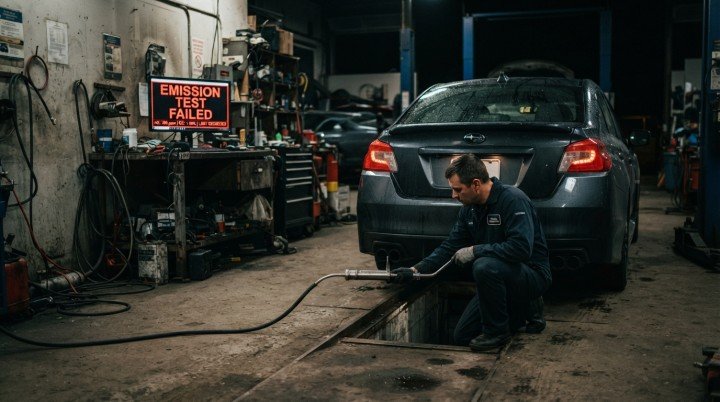
A proper diagnosis should determine whether the engine is producing excessive emissions or the converter is failing to process otherwise manageable exhaust. Replacing the converter without making that distinction can leave the original problem unresolved.
3. A Sulfur or Rotten-Egg Odor Appears
Among bad catalytic converter symptoms, a sulfur-like or rotten-egg odor is one of the most recognizable—but it is not exclusive to the converter.
The smell may appear when sulfur compounds are not being processed as expected. It may be strongest near the exhaust after the engine has warmed up. However, an overly rich air-fuel mixture, leaking injector, ignition problem, unsuitable fuel, or unburned fuel entering the exhaust may create a similar odor and may be the reason the converter is overheating.

If exhaust odor enters the passenger cabin, open the windows, move to a safe location, shut the vehicle off, and arrange an exhaust-system inspection. Exhaust gases can be hazardous even when they do not have a strong smell.
P0420 Is a Direction, Not a Replacement Order
A P0420 or P0430 code means the computer has detected catalyst efficiency below its expected threshold. It does not confirm that every oxygen sensor, exhaust connection, fuel-control input, and engine-performance condition has already been ruled out.
Before approving a converter replacement, the diagnosis should explain why the code appeared, whether the converter is chemically inefficient or physically restricted, and whether an upstream engine problem damaged it. The next failure mode—restricted exhaust flow—usually produces a very different set of signs.
Failure Mode Two: The Exhaust Traffic Jam
A chemically inefficient converter may only trigger a code or emissions failure. A restricted converter behaves differently. Its internal passages have become partially blocked by melted, contaminated, or broken material, making it harder for exhaust gases to leave the engine.
As exhaust backpressure increases, the engine may feel as though it cannot breathe. These bad catalytic converter symptoms usually become more noticeable when the engine must move a greater volume of exhaust.
4. Acceleration Becomes Sluggish From a Stop
A restricted converter may cause the vehicle to respond slowly when the accelerator is pressed. The engine may sound as though it is working harder, but the car does not gain speed with its usual ease.
The problem occurs because each cylinder must push exhaust against an abnormal restriction. If the previous exhaust cannot leave efficiently, the engine has less room to draw in a fresh air-fuel charge for the next combustion cycle. Power production suffers as a result.

Sluggish acceleration does not automatically identify the converter. Low fuel pressure, restricted injectors, ignition faults, airflow-sensor problems, a clogged air filter, transmission slipping, and electronic throttle issues may create a similar complaint.
The important clue is whether weak acceleration appears alongside catalyst-efficiency codes, excessive exhaust heat, stalling, or other restriction-related evidence. Do not deliberately accelerate aggressively to reproduce the symptom; note when it occurs and allow a qualified technician to confirm it safely.
5. Engine Power Fades as Demand Increases
This sign differs slightly from general sluggish acceleration. A vehicle with a partially restricted converter may feel acceptable during light driving but lose power when greater engine output is required.
The driver may notice that the vehicle struggles to maintain speed, feels increasingly weak as RPM rises, or stops accelerating beyond a certain point. Higher engine demand creates more exhaust volume, which makes a restricted passage more limiting.

Fuel-delivery problems, turbocharger faults, ignition breakdown under load, restricted air intake, transmission problems, and engine-protection modes can produce a similar pattern. A technician should compare scan data, engine performance, and measured exhaust restriction rather than assuming the converter is responsible.
A severe or unpredictable loss of power can make it unsafe to merge or maintain traffic speed. If that happens, move to a safe location and arrange professional assistance.
6. Fuel Economy Becomes Noticeably Worse
A restricted exhaust system can reduce engine efficiency. The driver may compensate for weak performance by using more throttle, while the engine computer may adjust fueling in response to abnormal sensor readings.
However, poor fuel economy is one of the least specific converter clues. Low tire pressure, short trips, driving conditions, leaking injectors, oxygen-sensor faults, MAF-sensor errors, thermostat problems, misfires, and many other issues can increase fuel use.
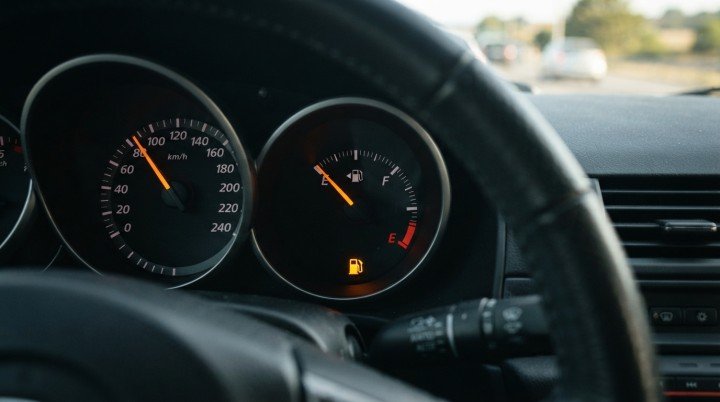
A sudden MPG decline is more useful when it appears with loss of power, a P0420/P0430 code, unusual heat, or a failed emissions test. Fuel-economy change alone is not enough evidence to approve an expensive converter replacement.
7. The Engine Becomes Difficult to Start
If the converter becomes severely restricted, exhaust pressure may remain trapped in the engine and exhaust manifold. The engine may crank at normal speed but take longer than usual to start, run briefly, or fail to start at all.
This is not usually the first sign of converter trouble. By the time blockage affects starting, performance symptoms may already be significant.

Battery, starter, fuel pressure, ignition, compression, security-system, and sensor faults are far more common no-start causes. Those systems should be evaluated rather than jumping directly from “cranks but will not start” to catalytic converter replacement.
The distinction between cranking and starting is useful: a converter restriction does not normally prevent the starter from turning the engine. Instead, it may prevent the running engine from moving air and exhaust efficiently enough to continue operating.
8. The Engine Starts but Stalls
An extremely restricted converter may allow the engine to start using the small amount of available exhaust capacity, then cause it to stall as exhaust flow increases. The engine might idle briefly, run poorly, and shut off.
Stalling may also occur while driving if the restriction becomes severe enough to reduce usable engine power. Inconsistent jerking or surging can appear before a complete stall.
Many other faults can produce the same behavior, including inadequate fuel pressure, a stuck EGR valve, airflow problems, ignition failure, vacuum leaks, electronic throttle faults, or a defective crankshaft or camshaft sensor.
Repeated stalling or a sudden loss of drive should be treated as a safety problem. Do not continue operating the vehicle in traffic or repeatedly restart it to test the condition. Arrange towing or roadside assistance.
Chemical Failure and Restriction Do Not Look the Same
Comparing bad catalytic converter symptoms by operating condition helps clarify which failure mode may be involved.
| Operating condition | Chemical-efficiency failure | Restricted converter |
|---|---|---|
| Starting | Usually unaffected | Severe blockage may cause hard starting or no-start |
| Idle | May feel completely normal | May run roughly or stall as restriction worsens |
| Light cruising | A Check Engine Light may be the only clue | Mild restriction may cause limited power loss |
| Higher engine demand | Emissions remain the primary concern | Power loss often becomes more noticeable |
| Emissions testing | Failure is likely if conversion efficiency is inadequate | May also fail because of damage and abnormal engine operation |
Restriction explains the performance-related signs, but it does not explain why the converter became blocked or overheated. The remaining clues—excessive heat and an internal rattle—can reveal physical damage, while the engine’s other faults may identify what caused that damage.
When Restriction Starts Producing Dangerous Heat
The final bad catalytic converter symptoms reveal what can happen after excess fuel, contamination, or exhaust restriction has already placed the converter under considerable stress. Heat may rise beyond normal operating conditions, and the internal ceramic core may begin to melt or break apart.
9. Unusual Heat or a Burning Smell Develops Under the Vehicle
Catalytic converters normally operate at high temperatures, so warmth from the exhaust area is expected. The warning sign is an obvious change: excessive heat through the floor, a strong burning odor, smoke from underneath, or heat that appears alongside power loss and a warning light.
A restricted converter can retain heat because exhaust gases are not flowing through it normally. However, the converter may also be overheating because the engine is sending unburned fuel into the exhaust. Persistent misfires, leaking injectors, an overly rich mixture, poor ignition, or incorrect fuel control can all create this condition.
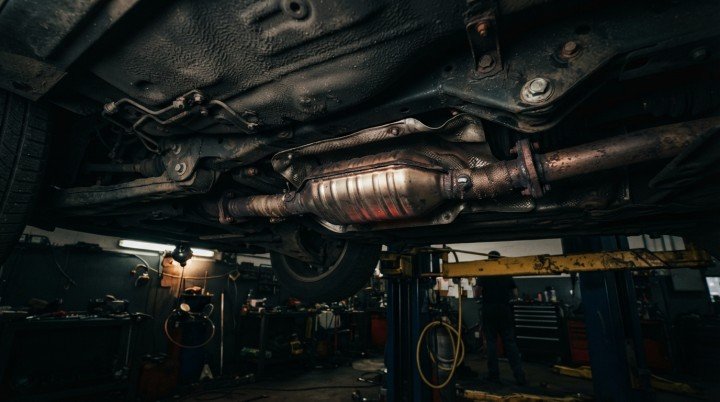
In that situation, the converter is the victim as much as the problem. The excessive temperature may melt the internal substrate, turning an emissions fault into a serious exhaust restriction.
A burning smell may also come from an oil leak, electrical problem, overheated brake, slipping belt, plastic contacting the exhaust, or another hot component. The source must be confirmed rather than diagnosed by odor alone.
If smoke, severe heat, or a strong burning smell appears, pull over safely and shut the engine off. Do not park over dry grass or other material that could be affected by a hot exhaust system. Do not touch the converter, exhaust pipes, or unidentified leaking fluid.
Failure Mode Three: The Internal Core Breaks Apart
10. A Metallic Rattle Comes From Under the Vehicle
Inside the converter, the catalyst-coated substrate is supported within a metal housing. Overheating, impact damage, corrosion, thermal stress, or age can cause that material or its support to break loose.
The driver may hear a metallic rattle from beneath the vehicle. The sound may be more noticeable during startup, at idle, or as engine vibration changes. Loose internal pieces may also shift and partially block exhaust flow, causing the noise to appear together with intermittent power loss.

A converter is not the only possible source. Loose heat shields, damaged exhaust hangers, internal muffler parts, and other underbody components can produce a similar rattle.
Do not strike the converter or crawl beneath an unsupported vehicle to test the noise. An exhaust technician can inspect the system safely after it has cooled and determine whether the sound originates inside the converter or from an external shield or bracket.
Is the Converter the Culprit—or the Victim?
Catalytic converters frequently fail because another problem sends the wrong type or quantity of exhaust into them. Replacing the converter without correcting that upstream fault can damage the new part and bring the same code back.
A persistent misfire can send unburned fuel into the exhaust. A leaking injector or rich mixture can overload the converter with fuel. Oil burning may coat the catalyst, while an internal coolant leak can contaminate its working surfaces. Faulty sensors, low compression, exhaust leaks, unsuitable fuel, and incorrect additives may also contribute.
The diagnostic sequence should therefore move in two directions. First, confirm whether the converter is chemically inefficient, restricted, or physically damaged. Second, determine what caused that condition.
What Should Be Confirmed Before Replacement?
When bad catalytic converter symptoms appear, a complete diagnosis should begin with all stored, pending, and permanent trouble codes. Misfire, fuel-mixture, oxygen-sensor, and other engine-related codes may explain why catalyst efficiency dropped.
The exhaust system should be evaluated for leaks near its connections and oxygen sensors. A leak can distort sensor readings and make a working converter appear inefficient. A technician may then compare upstream and downstream oxygen-sensor data, review fuel trims, and determine whether the engine is running rich, lean, or misfiring.
If restriction is suspected, the shop should provide measured evidence of abnormal exhaust flow or backpressure. Temperature patterns and tailpipe-emissions results may provide additional evidence, but they must be interpreted alongside engine condition and scan data.
No single symptom or P0420/P0430 code proves every one of these possibilities has been eliminated.
The Question to Ask Before Approving the Repair
Before authorizing an expensive converter replacement, ask:
“What evidence shows the converter itself has failed, which failure mode does it have, and what caused that failure?”
A useful answer should identify whether the converter has lost chemical efficiency, become restricted, or suffered physical damage. It should also explain how misfires, fuel control, oil consumption, coolant loss, sensor faults, or exhaust leaks were evaluated.
If the answer relies only on a code number, additional diagnosis may be justified before replacement is approved.
Can a Catalytic Converter Cleaner Fix the Problem?
A fuel additive cannot rebuild a melted substrate, reconnect broken ceramic material, restore a poisoned catalyst coating, or open a severely blocked passage. In those cases, the physical damage remains regardless of what is added to the fuel tank.
Some products may temporarily improve a mild deposit-related condition, but improvement does not prove that the converter is healthy. Cleaners also cannot repair the engine fault that contaminated or overheated it.
Avoid treating an additive as a substitute for diagnosis. If the vehicle has severe power loss, stalling, overheating, a flashing Check Engine Light, or a damaged internal core, professional evaluation is the appropriate next step.
Do Not Remove or Bypass the Converter
Removing, hollowing out, bypassing, or disabling a catalytic converter on a US road vehicle is considered emissions-system tampering under federal law. It also increases harmful emissions and may prevent the vehicle from passing required inspection.
A failed converter should be replaced with an approved component that meets the vehicle’s applicable emissions requirements. The original engine or fuel-system fault must also be repaired so the replacement is not exposed to the same damaging condition.
When Should You Stop Driving?
A steady catalyst-efficiency code with otherwise normal performance may allow time to arrange prompt inspection. The situation changes when the converter becomes restricted or overheated.
Stop driving and use roadside assistance if the vehicle suffers severe power loss, repeatedly stalls, cannot maintain a safe traffic speed, produces smoke from underneath, develops an intense burning odor, or sends exhaust fumes into the cabin. A flashing Check Engine Light with rough running also requires urgent attention because an active misfire can rapidly overheat the converter.
Waiting for the symptom to become constant can increase repair costs and create a safety risk.
The Final Failure-Mode Verdict
A Check Engine Light, failed emissions test, or sulfur odor points toward lost chemical efficiency. Sluggish acceleration, fading power, hard starting, and stalling suggest exhaust restriction. Excessive heat indicates an urgent overheating problem, while a metallic rattle may reveal a broken internal core.
Taken together, bad catalytic converter symptoms help identify which failure mode deserves investigation. They do not replace measured evidence. Confirm converter efficiency or restriction, rule out exhaust leaks and sensor problems, and repair the engine condition that caused the damage before approving a replacement.
Kevin Nicholas is an automotive mechanic and editor of The Effective Guide. He writes about warning lights, car problems, and diagnostic tools, helping drivers understand what to check before replacing a part.