
Last Updated on October 7, 2026
An engine is easiest to judge when it is doing the least amount of work. At idle, it must keep running at a low, controlled speed while still powering electrical, cooling, steering, and climate-control systems.
If combustion becomes uneven or the engine computer cannot maintain the correct air-fuel mixture, the vehicle may shake, sputter, surge, or feel as though it is about to stall. The tachometer may move up and down, although a mild misfire may create vibration without an obvious RPM change.
Because many rough idle causes produce similar symptoms, replacing the first suspected part often wastes money. The better approach is to identify exactly when the problem appears: cold or warm, in Park or Drive, with the A/C on, after refueling, or under every condition.
This article primarily covers conventional gasoline and diesel engines. Hybrids may intentionally stop their gasoline engines while stationary, so their normal idle behavior can be different.
Quick Answer
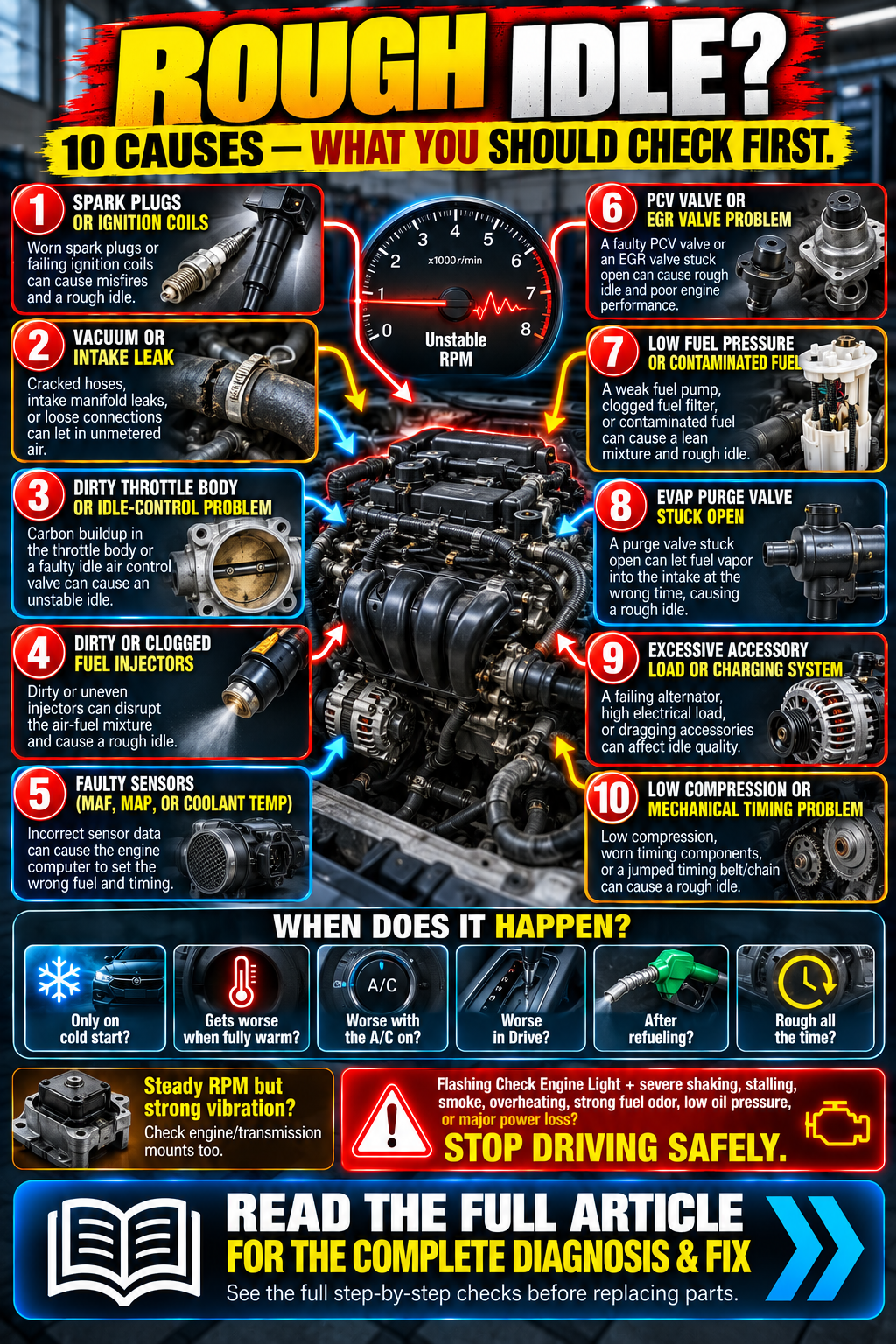
The most common rough idle causes include worn spark plugs, weak ignition coils, vacuum leaks, a dirty throttle body, uneven fuel injectors, incorrect sensor data, PCV or EGR faults, low fuel pressure, a stuck EVAP purge valve, excessive accessory load, and internal mechanical problems.
Before replacing anything, note the operating condition, check whether the Check Engine Light is steady or flashing, preserve stored diagnostic codes, and determine whether the engine is actually running unevenly or the vehicle is simply transmitting more vibration.
First, Identify When the Rough Idle Happens
To narrow down rough idle causes, focus on the condition that makes the symptom appear or become worse.
| When It Happens | Important Clues | More Likely Areas |
|---|---|---|
| Only during a cold start | Improves as the engine warms | Ignition weakness, intake leak, injector issue, temperature sensor, or carbon buildup |
| Only when fully warm | Appears after several minutes of driving | EGR, PCV, EVAP purge, sensor feedback, or fuel-trim problem |
| When the A/C is switched on | RPM dips or vibration increases under added load | Throttle or idle control, compressor drag, charging issue, or weak engine mount |
| Worse in Drive than Park | Vibration increases while stopped in gear | Load compensation, ignition weakness, low idle, or engine/transmission mount |
| After refueling | Hard warm start, fuel odor, or temporary stumbling | EVAP purge fault, contaminated fuel, or fuel-pressure problem |
| Under every condition | Constant shaking, unstable RPM, or poor acceleration | Ignition, intake, injector, fuel-pressure, sensor, or compression problem |
| With a flashing Check Engine Light | Strong shaking, power loss, or active misfire | Urgent ignition, fuel, or mechanical diagnosis; continued driving may cause damage |
Is the Engine Running Rough—or Is the Car Only Vibrating?
A rough-running engine usually produces uneven combustion. You may notice fluctuating RPM, an irregular exhaust sound, stumbling, hesitation, or a Check Engine Light.
A worn engine or transmission mount creates a different problem. The engine may maintain a steady speed and burn fuel normally, but its normal movement is transmitted more strongly into the steering wheel, seat, or cabin.
The distinction is not always obvious. A small misfire may not move the tachometer noticeably, and a damaged mount can make a minor engine problem feel severe. A technician may need to evaluate both engine operation and the mounts before deciding where the fault originates.
1. Worn Spark Plugs or Failing Ignition Coils
In a gasoline engine, each cylinder needs a properly timed spark to ignite its air-fuel mixture. Worn, contaminated, damaged, or incorrectly specified spark plugs may not ignite that mixture consistently.
An ignition coil can create a similar problem if it cannot generate sufficient voltage. The affected cylinder may misfire most noticeably at idle because the engine has less momentum to mask the uneven power contribution.
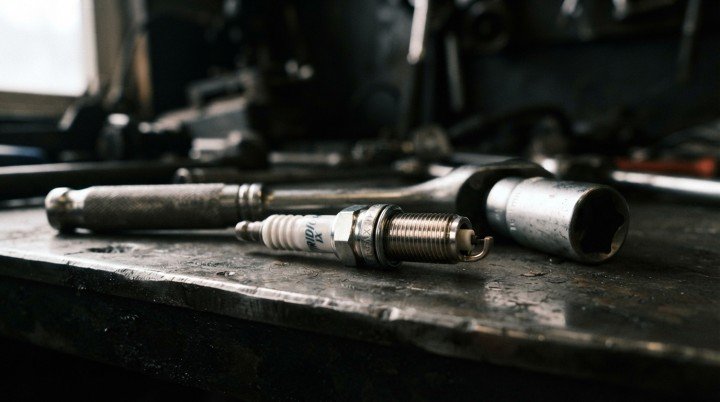
Possible clues include shaking, a skipping exhaust sound, hesitation during acceleration, reduced fuel economy, and cylinder-specific misfire codes. Moisture, damaged connectors, plug-wire problems on older vehicles, and oil entering the spark-plug wells can also interrupt ignition.
Diesel engines do not use spark plugs for normal combustion, so their diagnostic path is different. Glow-plug problems may affect cold starting, but fuel delivery, compression, and injector performance are more relevant once the diesel engine is running.
A diagnostic code can identify which cylinder recorded a misfire, but it does not prove that the spark plug or coil is defective. Fuel, wiring, compression, or air-distribution problems can cause the same cylinder to misfire.
2. A Vacuum or Intake Leak
The engine computer calculates fuel delivery based on the amount of air it expects to enter the engine. If extra air enters through a cracked hose, loose connection, intake gasket, brake-booster circuit, or another leak after the airflow has been measured, the mixture may become too lean.
A relatively small leak can be especially noticeable at idle because the engine is using less total air. The same leak represents a smaller percentage of airflow when the throttle is open, so the engine may run more smoothly as RPM increases.
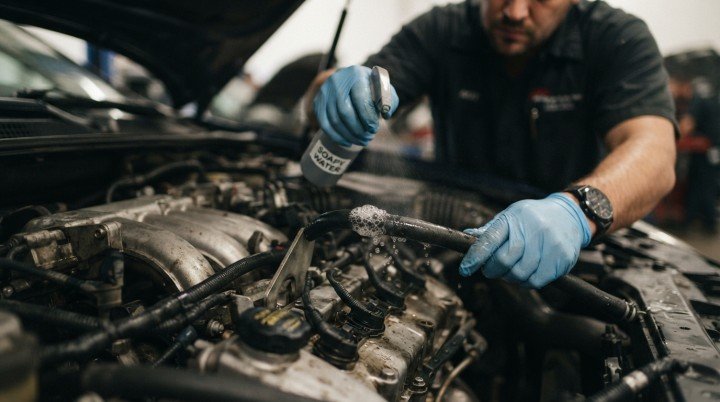
The idle may hunt, dip, surge, or nearly stall. A hissing sound, lean fuel-trim codes, or roughness that changes while braking can provide additional clues, although none confirms the exact leak location.
Do not use starting fluid, carburetor cleaner, propane, or another flammable substance around a running engine to search for leaks. A technician can use a controlled smoke test and scan data to locate unmetered airflow safely.
3. A Dirty Throttle Body or Idle-Control Problem
At idle, the throttle opening is extremely small. A layer of carbon or oily residue around the throttle plate can therefore have a larger effect at idle than during acceleration.
Older vehicles may use a separate idle air control valve to regulate bypass airflow. If that valve sticks or its passage becomes restricted, idle speed may become too low, too high, or unstable. The engine may also stall when the A/C or another load is added.
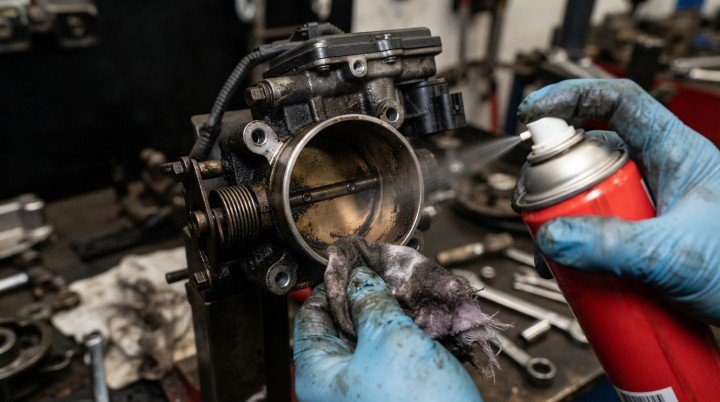
Many modern vehicles use an electronic throttle body instead of a separate idle valve. The powertrain computer moves the throttle plate and adjusts ignition timing to maintain idle speed. A dirty throttle body, actuator problem, incorrect sensor signal, wiring fault, or lost throttle adaptation can interfere with that control.
Do not force an electronic throttle plate or apply an unapproved cleaner. Some vehicles require a manufacturer-specific cleaning procedure and an idle or throttle relearn afterward. Testing the control system first helps avoid replacing a throttle body when the actual problem is an intake leak, sensor fault, or weak ignition component.
4. Dirty, Clogged, or Uneven Fuel Injectors
Fuel injectors must deliver carefully measured amounts of fuel to each cylinder. If one injector becomes restricted by deposits, its cylinder may receive less fuel than the others and contribute less power at idle.
An injector can also develop an electrical problem, poor spray pattern, or internal leak. A leaking injector may deliver too much fuel, creating rich operation, hard starting, fuel odor, or dark exhaust. A restricted injector is more likely to cause a lean misfire, hesitation, and reduced power.

The idle may feel as though the engine skips at regular intervals. A cylinder-specific misfire code can help identify where the imbalance is occurring, but it does not prove that the injector is responsible. Ignition, wiring, compression, and intake-gasket problems can affect the same cylinder.
Idle-condition clue: Roughness affects one cylinder consistently and may continue during light acceleration.
Cleaning may help when deposits are restricting an otherwise functional injector. It will not repair a failed electrical coil, damaged wiring, internal leak, or mechanically defective injector. A professional injector-balance and electrical test can determine whether cleaning or replacement is appropriate.
5. Incorrect MAF, MAP, or Temperature-Sensor Data
The engine computer depends on multiple sensors to calculate fuel delivery and idle control. A mass airflow sensor estimates incoming air, while a manifold absolute pressure sensor helps determine engine load. The engine coolant temperature sensor tells the computer whether the engine is cold or fully warmed.
If one of these sensors provides inaccurate information, the computer may command an air-fuel mixture that is too rich or too lean. The result can include surging, stumbling, poor fuel economy, hard starting, or stalling.
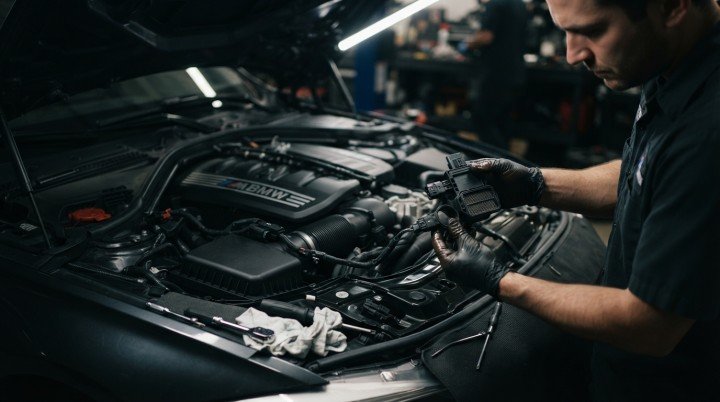
The timing helps separate the possibilities. Roughness that appears mostly during cold starts may involve temperature information or cold-enrichment control. A problem that develops after the engine warms may become more noticeable when oxygen-sensor feedback and fuel-trim corrections are active.
A sensor-related code identifies an abnormal signal or affected circuit; it does not automatically prove that the sensor has failed. Air leaks, wiring faults, poor electrical connections, contamination, or another engine problem can push sensor readings outside their expected range.
Idle-condition clue: The idle changes significantly with engine temperature and is accompanied by implausible live-data readings or mixture-related codes.
Avoid disconnecting sensors while the engine is running or cleaning them with an unapproved product. Diagnosis should compare scan data with actual engine conditions before parts are replaced.
6. A Faulty PCV Valve or EGR Valve Stuck Open
The positive crankcase ventilation system routes crankcase vapors back into the intake. If a PCV valve or related hose allows too much airflow, it can behave like a vacuum leak and make the mixture lean at idle.
Possible clues include whistling or hissing, increased oil consumption, mixture codes, and an idle that improves as engine speed rises. A damaged PCV hose can create the same effect even when the valve itself is functional.
The exhaust gas recirculation system operates differently. It sends a controlled amount of exhaust gas back into the engine under selected driving conditions. It is generally not supposed to flow heavily at idle.
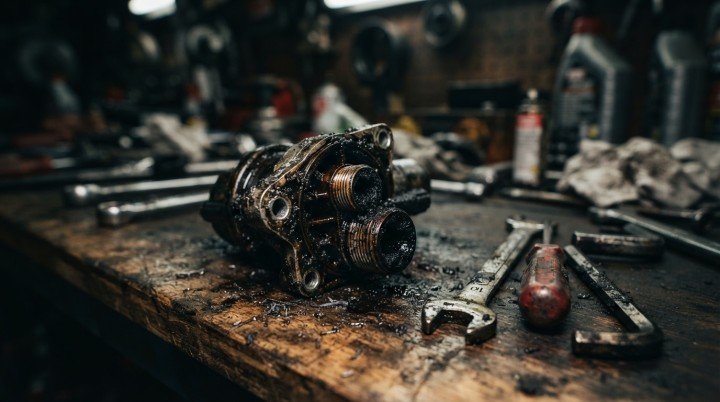
If the EGR valve sticks open or does not seal, exhaust gas can dilute the fresh air-fuel charge. Combustion may become unstable, causing shaking, low idle speed, hesitation, or stalling when the vehicle stops.
Idle-condition clue: The problem is worse at low speed or when warm and becomes less noticeable when the throttle opens.
PCV and EGR codes should be diagnosed as complete systems. A blocked passage, wiring fault, control-solenoid problem, vacuum issue, or incorrect sensor feedback may produce the same code as a defective valve.
7. Low Fuel Pressure or Contaminated Fuel
Among the possible rough idle causes, inadequate fuel supply is often suspected too quickly. A weak fuel pump or restricted fuel filter commonly becomes more noticeable during acceleration, when the engine requires more fuel. However, sufficiently low or unstable pressure can also disturb idle quality and cause stalling.
A faulty pressure regulator, pump-control circuit, leaking line, injector problem, or contaminated fuel can make fuel delivery inconsistent. If the roughness began immediately after refueling, poor-quality or water-contaminated fuel becomes more relevant.
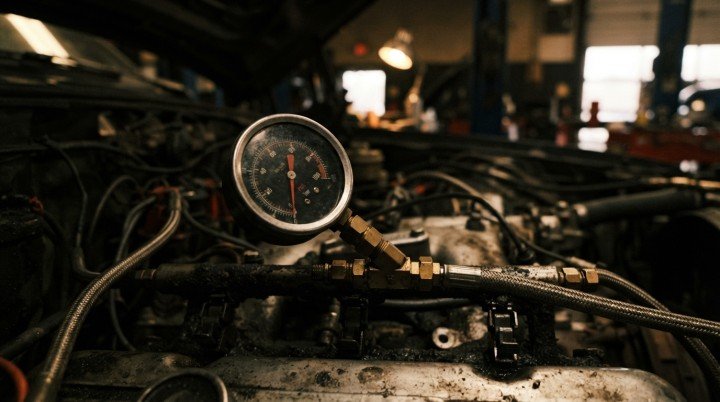
Other clues include difficult starting, hesitation under load, reduced power, surging, or a mixture that remains lean even after intake leaks have been ruled out.
Idle-condition clue: Roughness began after refueling or is accompanied by weak acceleration and fuel-pressure-related data.
Do not open fuel lines or attempt to test pressurized fuel near a hot or running engine. A technician can compare commanded and actual fuel pressure, evaluate pump operation, inspect fuel quality, and determine whether the restriction or pressure loss occurs before parts are replaced.
When the Pattern Points Beyond Basic Maintenance
The remaining rough idle causes are often revealed by a specific trigger, such as refueling, switching on the air conditioner, or reaching operating temperature. The final cause is less common but becomes important when ignition, airflow, fuel, and electronic-control checks do not explain the problem.
8. An EVAP Purge Valve Stuck Open
The evaporative-emissions system stores fuel vapor and releases it into the engine under controlled conditions. The purge valve regulates when and how much vapor enters the intake.
If the valve sticks open, excessive vapor or unwanted airflow may enter at idle. The mixture can become too rich or too lean, causing a hard warm start, unstable RPM, stumbling, or stalling.
The connection to refueling is especially useful. A vehicle that develops roughness immediately after filling the tank may have a purge-control problem, although contaminated fuel, an overfilled tank, or another fuel-system fault can produce a similar pattern.

Idle-condition clue: The engine runs poorly after refueling or during a warm restart, then gradually improves.
A purge-related code does not automatically mean the valve needs replacement. Wiring, hoses, pressure sensors, vent valves, and restrictions elsewhere in the EVAP system should also be checked.
9. Excessive Accessory Load or Charging-System Trouble
Switching on the air conditioner adds load through the compressor and electrical system. The engine computer should respond by adjusting throttle control, ignition timing, or idle airflow.
A small, brief RPM change may be normal. Strong vibration, repeated RPM drops, or stalling is not.
Possible causes include a dirty throttle body, idle-control fault, dragging A/C compressor, worn accessory pulley, weak alternator output, unstable system voltage, or an engine that is already producing too little power because of another fault.

Older vehicles with hydraulic power steering may also experience extra engine load while the steering is being turned at low speed. Modern vehicles often use electric assistance, so the exact behavior depends on vehicle design.
Idle-condition clue: The engine is relatively smooth until the A/C, steering, headlights, or another major load is added.
A worn engine mount may make the added load feel worse without changing combustion. Comparing engine speed, misfire data, system voltage, and accessory operation helps separate an actual engine problem from transmitted vibration.
10. Low Compression or Mechanical Timing Problems
Each cylinder must seal and compress its air-fuel mixture before combustion. A leaking valve, worn piston ring, head-gasket problem, damaged valvetrain component, or cylinder wear can reduce compression and weaken that cylinder’s contribution at idle.
Incorrect camshaft timing can create a broader problem. A stretched timing chain, worn tensioner, variable-valve-timing fault, or incorrectly installed timing component may disturb airflow and combustion across multiple cylinders.
Mechanical faults often create persistent roughness that does not disappear after routine ignition or fuel-system service. Other clues can include difficult starting, ongoing cylinder-specific misfire codes, unusual engine noise, oil or coolant consumption, and reduced power.
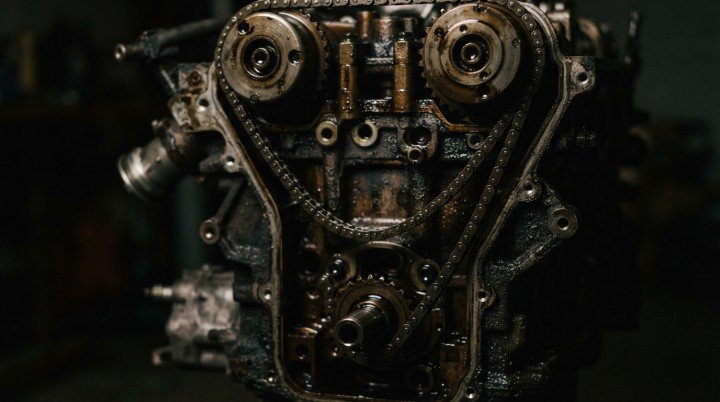
Idle-condition clue: The same cylinder continues misfiring after ignition, injector, wiring, and intake problems have been ruled out.
Compression, leak-down, relative-compression, and mechanical-timing tests can confirm the direction. Internal engine work should not be approved from a diagnostic code alone.
Match the Clue to the Diagnostic Direction
Because rough idle causes overlap, use the strongest accompanying clue to decide which system deserves attention first.
| Clue | Likely Direction | Important Lookalike |
|---|---|---|
| RPM repeatedly rises and falls | Vacuum leak, throttle control, PCV, EGR, or sensor data | Normal cold-start or temporary load adjustment |
| Steady RPM with strong cabin vibration | Engine or transmission mount | Small misfire not visible on the tachometer |
| Hissing or whistling | Intake, vacuum, or PCV leak | Normal intake or accessory noise |
| Begins after refueling | EVAP purge or fuel-quality problem | Unrelated fault appearing at the same time |
| Worse with A/C on | Idle compensation, compressor, charging system, or mount | Minor normal RPM adjustment |
| Smooths out above idle | Vacuum leak, throttle control, PCV, EGR, or mount | Ignition problem masked by higher RPM |
| Flashing Check Engine Light | Active misfire requiring urgent attention | Do not assume the code identifies the failed part |
What Should You Check First?
Begin with severity. A flashing Check Engine Light, repeated stalling, strong fuel odor, smoke, overheating, low-oil-pressure warning, or major power loss requires a safe stop and professional assistance.
For a milder condition, record whether it happens cold or warm, in Park or Drive, with the A/C on, or after refueling. Note recent repairs, maintenance, and fuel purchases.
Scan for stored and pending codes before clearing anything. Codes and freeze-frame data may show engine temperature, load, RPM, and the conditions present when the fault was recorded.
How a Technician Diagnoses a Rough Idle
A technician may review misfire counters, fuel trims, airflow, manifold pressure, coolant temperature, throttle position, charging voltage, and EVAP data.
The next test should follow the evidence. It may include ignition testing, an intake smoke test, injector-balance testing, fuel-pressure measurement, throttle adaptation, purge-valve testing, mount inspection, or compression and timing checks.
This order helps avoid replacing sensors simply because their names appear in a code description.
Can You Continue Driving?
A slight, steady roughness without warning lights may allow time to schedule an inspection, but it should not be ignored.
Do not continue driving with a flashing Check Engine Light, severe shaking, repeated stalling, overheating, smoke, strong fuel odor, low oil pressure, or major power loss. An active misfire can send unburned fuel into the catalytic converter and cause additional damage. Move to a safe location and arrange towing or roadside assistance.
Common Diagnostic Mistakes
Common mistakes include clearing codes before recording them, replacing a sensor based only on its code, cleaning injectors without confirming a fuel problem, overlooking engine mounts, and assuming a dirty throttle body explains every unstable idle.
Do not use flammable spray around a running engine to search for leaks or force open an electronic throttle plate. Vehicle-specific procedures may be required.
Frequently Asked Questions
Can an engine idle roughly without a Check Engine Light?
Yes. A small air leak, dirty throttle body, weak mount, early mechanical problem, or intermittent fault may not immediately trigger the light. Pending codes or abnormal live data may still be present.
Why does it happen only when the engine is cold?
Cold-only roughness may involve ignition weakness, injector deposits, intake leakage, low compression, carbon buildup, or incorrect temperature information. The engine’s richer cold-start strategy can make marginal components more noticeable.
Why is the idle worse in Drive than in Park?
Placing an automatic transmission in Drive adds load to the engine. Weak combustion, poor idle compensation, low idle speed, or damaged mounts may become more noticeable under that load.
Can the A/C cause rough idle?
The A/C adds load, but the control system should compensate. Severe shaking or stalling may indicate throttle-control trouble, compressor drag, charging weakness, an existing engine fault, or worn mounts.
Why did the problem begin after refueling?
A stuck purge valve or contaminated fuel becomes more relevant. The timing is a clue, not proof, so both the EVAP and fuel systems may need testing.
Final Thoughts
Identifying rough idle causes starts with the condition rather than the component. Note whether the problem is cold, warm, load-related, gear-related, or connected to refueling. Preserve diagnostic codes and confirm whether the engine is misfiring or the vehicle is only transmitting vibration. This evidence-first approach makes the repair more accurate and reduces unnecessary parts replacement.
Kevin Nicholas is an automotive mechanic and editor of The Effective Guide. He writes about warning lights, car problems, and diagnostic tools, helping drivers understand what to check before replacing a part.