
Last Updated on October 7, 2026
A weak battery usually causes trouble before the engine starts. Alternator trouble becomes more revealing after the engine is already running.
That difference is important because many bad alternator symptoms look exactly like a dying battery. The car may crank slowly, need assistance to start, or appear completely dead. But if the charging system cannot restore the battery’s power while driving, the problem will soon return—even after the battery has been recharged or replaced.
The best clue is often not the symptom itself, but when it appears: before startup, immediately afterward, while driving, or after the vehicle has been restarted.
Quick Answer
Common bad alternator symptoms include a battery or charging-system warning light, dim or flickering headlights, slow electrical accessories, multiple warning messages, repeated dead batteries, difficulty starting, stalling after a jump-start, engine power loss, unusual bearing or belt noises, and a burning electrical or rubber odor.
None of these signs confirms the alternator by itself. Battery condition, drive-belt problems, wiring resistance, damaged connections, fuses, and charging-control faults can create similar behavior.
How the Battery, Starter, and Alternator Work Together
The battery supplies the initial electrical energy needed to activate the starter. The starter then cranks the engine. Once the engine is running, the alternator supports the vehicle’s electrical systems and replenishes energy removed from the battery during startup.
If the battery is weak, the engine may crank slowly even when the alternator is healthy. If the alternator is weak, the engine may start normally with a charged battery but later develop electrical problems as stored battery power runs down.
This article applies primarily to conventional gasoline and diesel vehicles. Many hybrid and electric vehicles use a DC-to-DC converter instead of a conventional alternator, so their charging warnings and diagnostic procedures may differ.
The Power Timeline
The most useful way to organize bad alternator symptoms is to compare the moment the trouble appears with what the charging system is expected to be doing.
| When It Happens | What You Notice | What It Suggests | Important Limitation |
|---|---|---|---|
| Before the engine starts | Slow crank, clicking, or no electrical power | Battery, connection, or starter problem | A weak alternator may have left the battery discharged earlier |
| Immediately after starting | Charging light stays on or lights fluctuate | Charging-system output or control problem | Belt, wiring, fuse, or connection faults can imitate alternator failure |
| While driving | Electronics weaken, warnings multiply, or the engine stalls | The vehicle may be using remaining battery power | Low voltage does not identify which charging component failed |
| After outside starting assistance | Engine starts but later dies or will not restart | Battery may not be receiving adequate charge | A severely damaged battery or circuit fault can produce the same pattern |
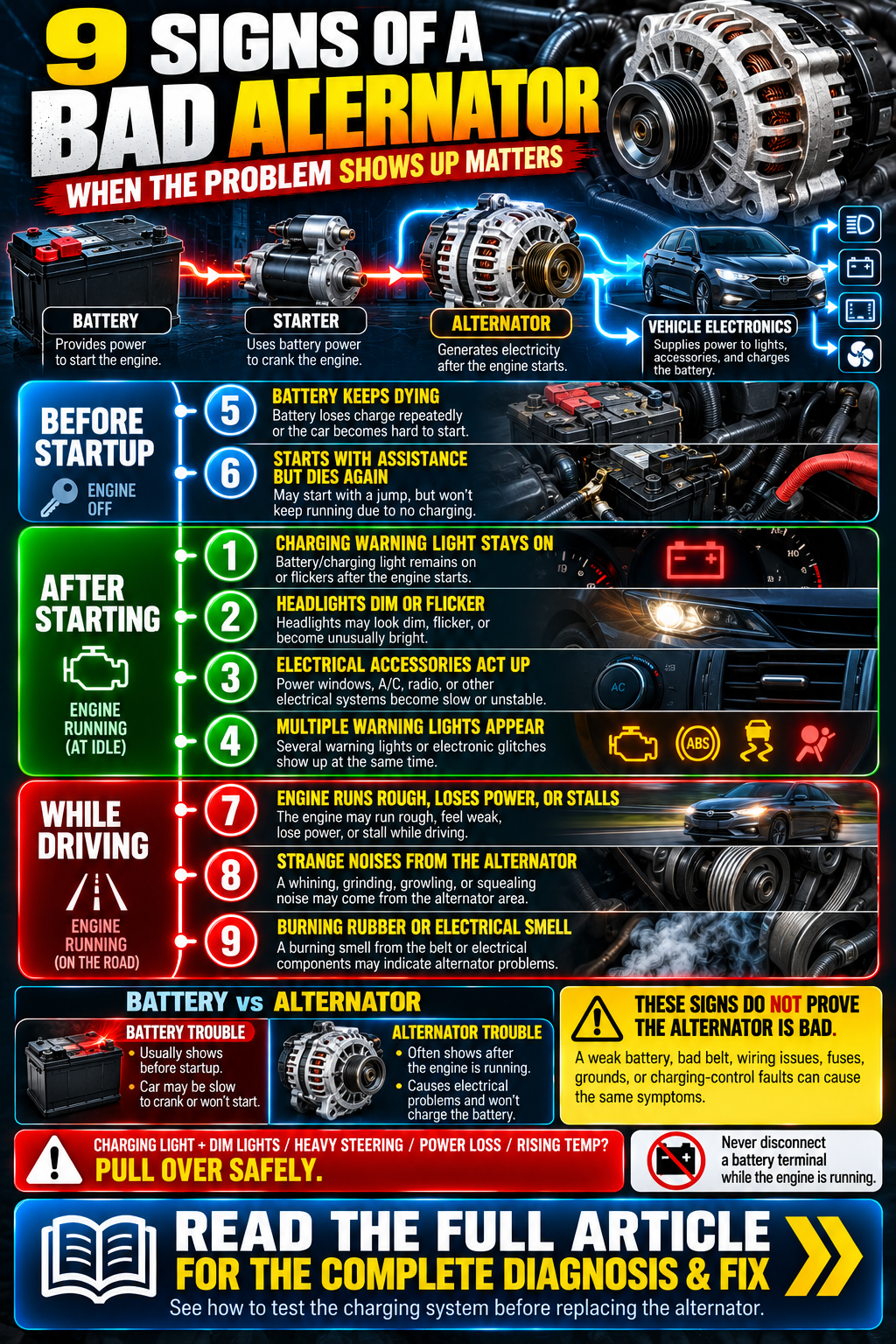
1. The Battery or Charging-System Warning Light Comes On
This warning usually looks like a battery, although some vehicles display “ALT,” “GEN,” or a charging-system message. Despite its appearance, it does not automatically mean that the battery is defective.
The light indicates that system voltage or charging performance is outside the range expected by the vehicle. Possible causes include an alternator or voltage-regulator fault, a damaged drive belt, a blown charging fuse, wiring resistance, a loose connection, or a control-system problem.

Timeline clue: The warning is more suspicious for a charging fault when it stays on or begins flickering after the engine starts.
If the light appears with dimming lights, rising engine temperature, heavy steering, or multiple electronic warnings, move safely out of traffic and arrange assistance. A belt failure can affect more than the alternator on some vehicles.
2. The Headlights Dim, Flicker, or Become Too Bright
A failing charging system does not always produce consistently low power. Alternator or voltage-regulator trouble may cause output to become too low, too high, or unstable.
Headlights may look dim at idle, brighten as engine speed changes, flicker, or appear unusually bright. Interior lighting and dashboard illumination may pulse at the same time.

Timeline clue: Changes that occur only after startup or while driving fit a charging-system problem better than lights that are already weak with the engine off.
A single flickering headlight may instead indicate a bulb, socket, wiring, or ground fault. Brightness changes across several lights and accessories provide stronger evidence of a wider voltage problem.
3. Electrical Accessories Become Slow or Unstable
Modern vehicles depend on steady electrical power for far more than headlights. Power windows may move slowly, the blower may change speed, the radio may cut out, or the infotainment system may restart unexpectedly.
Other possible clues include inconsistent power locks, dim interior displays, changing wiper speed, or accessories that work normally until several electrical loads are used together.

Timeline clue: Multiple accessories weakening while the engine runs suggests that the electrical system is not receiving stable power.
If only one accessory fails, a local motor, switch, relay, fuse, or wiring problem is more likely. The alternator becomes a stronger suspect when several unrelated systems misbehave together and the charging warning is also present.
4. Multiple Warning Lights or Electronic Glitches Appear
Modern vehicles depend on stable voltage to operate their control modules and sensors. If the alternator’s output becomes too low or inconsistent, several warning lights may appear at roughly the same time.
You might see warnings related to the ABS, traction control, power steering, transmission, or airbag system. The infotainment screen may restart, gauges may move unexpectedly, or powered features may temporarily stop working.

This does not necessarily mean that all those systems have failed. Low voltage can interrupt communication between electronic modules and cause misleading warnings. However, the warnings should not be dismissed because an actual fault in one of those systems is also possible.
A technician should check the charging system, battery condition, electrical connections, and stored diagnostic codes before replacing any components.
5. The Battery Keeps Dying or Starting Becomes Difficult
A battery provides the initial power needed to crank the engine, but the alternator must replenish the energy used during startup. When the alternator cannot recharge it properly, the battery gradually becomes discharged.
You may notice that the engine cranks more slowly each morning. Eventually, you might hear clicking, experience intermittent no-start conditions, or find that the vehicle needs outside assistance again.

Among the most commonly misunderstood bad alternator symptoms, a repeatedly dead battery can easily be blamed on the battery alone. Replacing it may seem to solve the problem temporarily, but the new battery can also become discharged if the charging fault remains.
Still, repeated battery failure does not automatically prove that the alternator is defective. A weak battery, loose or corroded connections, excessive electrical draw while the car is parked, a starter problem, or frequent short trips can produce similar results.
The battery and charging system should therefore be tested together.
6. The Vehicle Starts With Assistance but Dies Again
A vehicle that starts with outside assistance but shuts off again soon afterward may not be receiving enough electrical power while the engine is running.
The extra power can help the starter turn the engine, but it cannot repair a weak charging circuit. If the alternator is producing little or no usable output, the vehicle may continue running only until the remaining battery energy is exhausted.

This pattern strongly suggests a charging-system problem, but it is not a final diagnosis. A damaged drive belt, poor battery connection, blown charging-system fuse, faulty cable, or severely damaged battery may behave similarly.
Repeatedly starting the vehicle with assistance is not a repair. It can leave the driver stranded again and may expose sensitive electronics to unnecessary voltage changes. Have a qualified adult, roadside service provider, or technician assess the vehicle safely.
7. The Engine Runs Roughly, Loses Power, or Stalls
The ignition system, fuel injectors, electronic throttle, fuel pump controls, and engine computer all require dependable electrical power. As system voltage falls, these components may stop operating normally.
The engine may hesitate during acceleration, idle roughly, lose power, or stall. Electronic power steering may also become heavier on some vehicles, while dashboard lights and accessories begin switching off. These bad alternator symptoms are especially urgent because the vehicle may no longer be reliable in traffic.
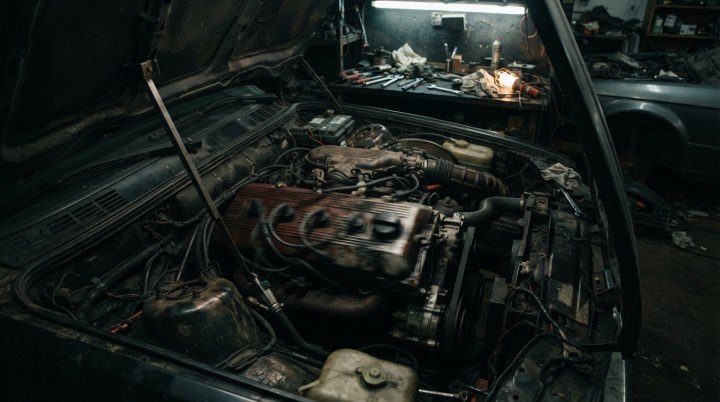
If the charging warning light appears together with dimming lights, reduced engine performance, or heavy steering, move out of traffic as safely as possible and arrange roadside assistance. Do not continue driving simply to see how long the battery will last.
A charging warning accompanied by a rising engine-temperature gauge requires even greater caution. On some vehicles, the same belt that turns the alternator also operates the water pump. If that belt breaks, the charging system may stop working while the engine begins overheating.
Stop in a safe location, switch off the engine, and avoid inspecting belts or pulleys while the engine is running. A tow is safer than risking a sudden stall or serious overheating damage.
8. Whining, Grinding, Growling, or Squealing Noises
A failing alternator bearing may create a whining, grinding, or growling noise that changes with engine speed. A damaged alternator pulley can also affect belt movement and produce unusual sounds.
Squealing often points toward a slipping serpentine belt, weak tensioner, or misaligned pulley rather than the alternator itself. However, these parts are connected to the charging system, so ignoring the noise can eventually prevent the alternator from turning properly.

Because several rotating components are located close together, sound alone cannot identify the failed part. Never reach near a moving belt or pulley while the engine is running. Let a technician locate the source safely.
9. A Burning Rubber or Electrical Smell
A slipping belt can generate heat and produce a burning-rubber odor. An overheated alternator, damaged wiring, or failing electrical connection may create a hot-plastic or electrical smell.

Turn off unnecessary electrical accessories and stop somewhere safe if the odor is strong, smoke appears, or the charging light comes on. Do not touch hot wiring or engine components. Continuing to drive could damage the belt, wiring, battery, or other electronics.
Bad Alternator vs. Weak Battery vs. Other Charging Faults
The symptoms often overlap, so the pattern matters more than one isolated warning.
| Clue | Failing Alternator | Weak Battery | Other Charging Fault |
|---|---|---|---|
| When problems appear | Often while the engine is running | Often during startup or after parking | May be intermittent |
| Common pattern | Dimming lights, warning light, glitches, or stalling | Slow cranking, clicking, or no start | Squealing belt, loose connection, or unstable charging |
| After outside starting assistance | May start but lose power again | May keep running if the charging system is healthy | Behavior depends on the failed belt, cable, fuse, or connection |
| Best next step | Test the complete charging system | Test battery health and state of charge | Inspect the charging circuit and belt drive |
What Else Can Mimic Alternator Failure?
A weak battery, loose battery terminal, damaged ground cable, worn serpentine belt, faulty belt tensioner, blown charging fuse, corroded connector, starter problem, or electrical drain can create similar symptoms.
Some modern vehicles also use computer-controlled charging systems that vary alternator output according to operating conditions. That is why a single observation or basic code scan is not enough to confirm failure.
How a Technician Confirms the Problem
A proper diagnosis usually includes checking battery health, charging output under electrical load, belt condition, pulleys, tensioner, cables, grounds, fuses, and voltage loss across connections. A technician may also check alternator diode ripple and charging-system data on vehicles with smart charging controls.
Do not use the old test of disconnecting a battery terminal while the engine is running. The engine may stall, and the sudden voltage change can damage sensitive electronics.
Can You Drive With a Failing Alternator?
There is no dependable driving-time estimate. A vehicle may continue briefly or shut down unexpectedly once battery power is depleted.
If only a minor symptom appears, avoid unnecessary driving and schedule an inspection. If the charging light stays on, lights are dimming, steering becomes heavy, the engine loses power, or the temperature rises, pull over safely and arrange a tow.
Common Diagnostic Mistakes
The most common mistakes are replacing the battery without testing the charging system, assuming the battery-shaped warning light identifies a bad battery, ignoring belt noise, and continuing to drive after several electrical systems begin failing together.
Replacing the alternator based on symptoms alone is also risky. Testing first helps prevent unnecessary parts replacement.
Frequently Asked Questions
Can an alternator fail without turning on the battery light?
Yes. An intermittent fault, worn bearing, diode problem, wiring issue, or partial loss of output may cause symptoms before the warning light remains illuminated.
Can an OBD2 scanner diagnose a bad alternator?
A capable scanner may reveal low-voltage codes or charging data, but it usually cannot confirm the alternator by itself. Physical inspection and charging-system testing are still required.
Will installing a new battery fix the problem?
Only if the battery is the actual cause. If the alternator, belt, cable, or charging circuit is faulty, the new battery may become discharged again.
Does every unusual alternator-area noise mean the alternator is bad?
No. The serpentine belt, tensioner, idler pulley, air-conditioning compressor, or another driven accessory may be responsible.
Final Thoughts
Recognizing bad alternator symptoms early can help prevent repeated no-starts, unexpected stalling, and damage to other electrical components. Look for a pattern involving the charging warning light, changing headlight brightness, electrical glitches, repeated battery failure, unusual noises, or burning odors. Confirm the cause with a complete battery and charging-system inspection before replacing parts.
Kevin Nicholas is an automotive mechanic and editor of The Effective Guide. He writes about warning lights, car problems, and diagnostic tools, helping drivers understand what to check before replacing a part.