
Last Updated on October 7, 2026
A steering wheel should remain reasonably steady on a smooth road. Minor feedback from the pavement is normal, but repeated trembling, side-to-side movement, or a vibration that appears within a particular speed range usually means something needs attention.
When the steering wheel shakes while driving, it is tempting to schedule an alignment or replace brake rotors immediately. Either repair might be correct, but neither should be the automatic first choice. The source could be an imbalanced wheel, internal tire damage, a bent rim, a worn hub, loose steering components, or a drivetrain problem.
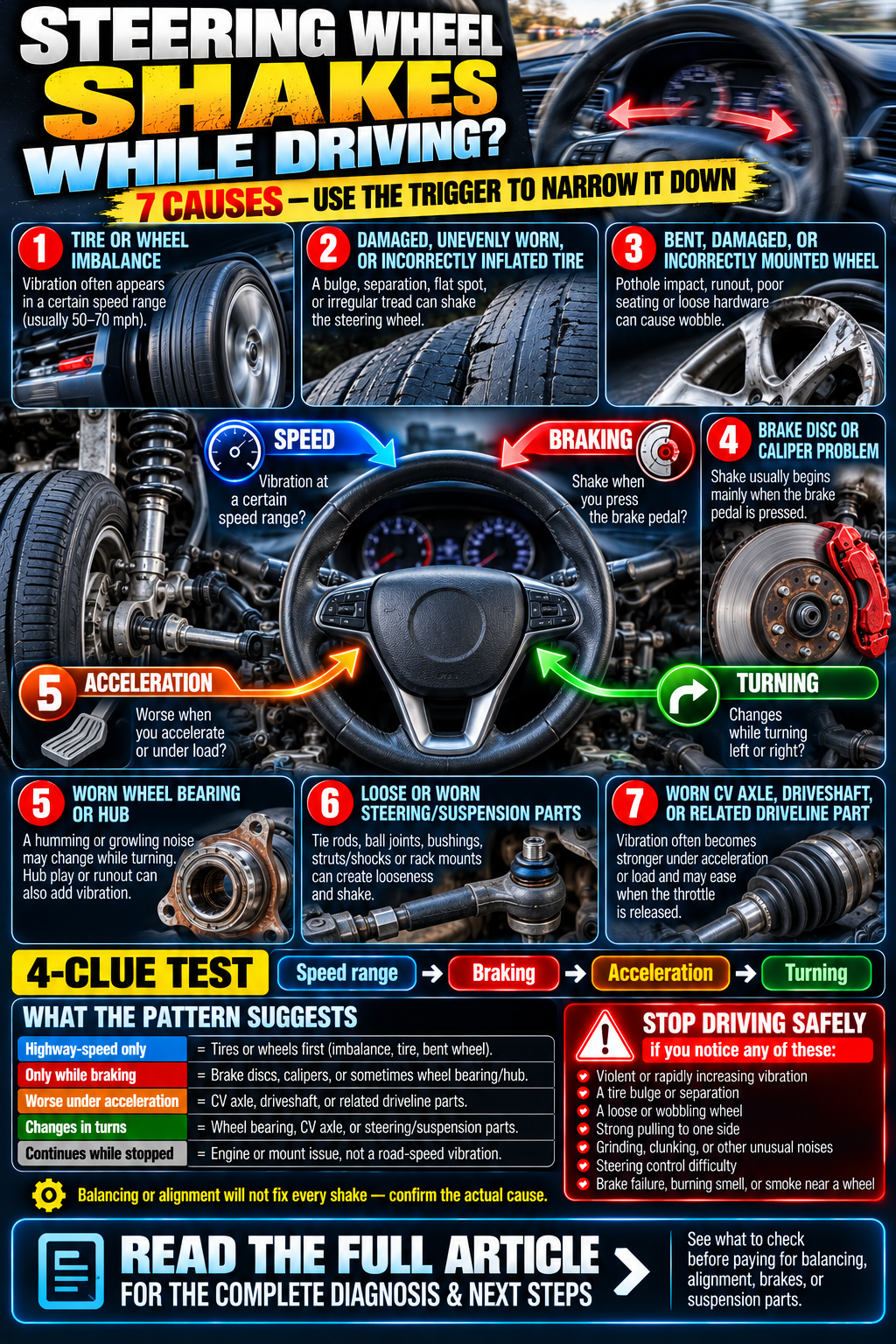
The fastest way to narrow the possibilities is not to guess a part. Instead, notice what changes the vibration:
Road speed → Braking → Acceleration → Turning
Each change places a different load on the vehicle and can expose a different group of problems.
Why Is My Steering Wheel Shaking?
The steering wheel is mechanically connected to the front wheels through the steering column, rack or steering gear, tie rods, steering knuckles, and suspension. This connection allows the driver to control the wheels, but it also provides a path for unwanted movement to travel back toward the driver’s hands.
A tire that does not rotate evenly can create a repeating force. A loose tie rod can allow a wheel to move side to side. A damaged brake disc may push and release against the pads during braking. A worn CV axle can shake when engine torque is applied.
All these problems can produce steering-wheel vibration, but they usually do not behave in exactly the same way.
Use the Four-Clue Steering Wheel Shake Test
Do not deliberately drive faster, brake aggressively, or perform dangerous maneuvers to reproduce a vibration. Instead, notice how the symptom behaves during ordinary driving and explain those conditions to the technician.
| What Changes the Vibration? | Possible Area to Investigate | Supporting Clue |
|---|---|---|
| It appears within a particular speed range | Tire balance, wheel balance, tire variation, or bent wheel | The vibration may fade when driving slower or faster than that range |
| It becomes stronger as road speed increases | Damaged tire, wheel runout, hub, bearing, or driveline | The frequency follows vehicle speed rather than engine RPM |
| It begins when the brake pedal is pressed | Brake disc, caliper, pad, hub, or suspension problem | The steering wheel may be smooth before braking |
| It becomes stronger under acceleration | CV axle, intermediate shaft, driveshaft, or mount | The shake may decrease when the accelerator is released |
| It changes during a left or right turn | Wheel bearing, CV joint, tie rod, or other steering component | Listen for humming, clicking, knocking, or grinding |
| It becomes worse after hitting a bump | Loose steering or suspension component | The wheel may continue oscillating after the road becomes smooth |
| It continues while the vehicle is stationary | Engine, engine mount, accessory, or idle-related problem | The vibration follows engine RPM rather than road speed |
This process does not provide a final diagnosis, but it can separate a road-speed vibration from one related to braking, engine load, turning, or engine operation.
What Should You Check First?
If the steering wheel shakes while driving, begin with the components that connect the vehicle to the road: the tires and wheels.
Check the tire pressures using an accurate gauge and compare them with the specification on the vehicle’s door-jamb label or in the owner’s manual. The maximum pressure printed on the tire sidewall is not normally the vehicle’s recommended operating pressure.
Next, look for visible tire or wheel damage. Important warning signs include:
- A bulge in the sidewall or tread
- Exposed cords
- Cracks, cuts, or obvious tread separation
- A tire that appears out of round
- A bent or cracked wheel
- Missing wheel weights
- Severe or uneven tread wear
- A wheel that appears loose or incorrectly seated
Do not continue driving on a tire with a bulge, exposed structure, or visible separation. A violent shake, loose-wheel sensation, strong pulling, grinding noise, or sudden steering change also requires the vehicle to be stopped safely and inspected before normal driving resumes.
If no severe damage is visible, note whether the problem started after tire installation, rotation, repair, pothole impact, or wheel removal. That timing can help direct the inspection.
1. The Tires or Wheels Are Out of Balance
Every tire-and-wheel assembly has small variations in weight. During balancing, a machine identifies the heavier and lighter areas so corrective weights can be installed. If the weight is not distributed evenly, the rotating assembly can create a repeating force that travels through the suspension and steering system.
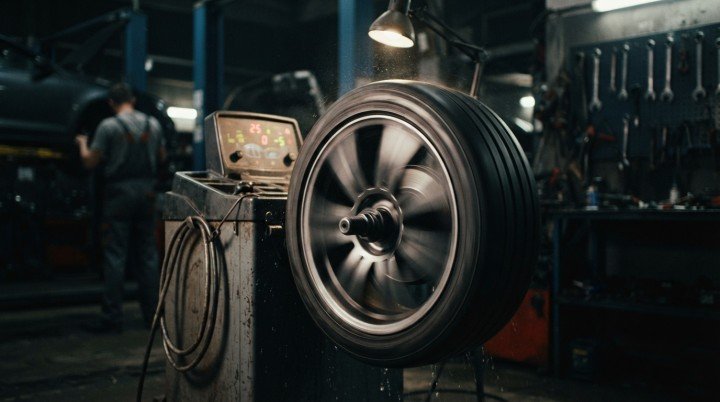
Tire or wheel imbalance is one of the most common explanations for vibration that appears only within a certain speed range. The car may feel smooth around town, begin shaking as highway speed increases, and then change intensity again at a higher or lower speed.
Front-wheel imbalance is often felt through the steering wheel. Rear-wheel imbalance may be more noticeable through the seat or floor, although vibration can travel throughout the vehicle.
Several situations can disturb the balance:
- A balance weight falls off
- A tire is removed and remounted
- Mud, snow, or debris collects inside or around the wheel
- The tire wears unevenly
- The tire shifts slightly on the rim
- A pothole bends the wheel
- A tire repair or rotation changes the vibration pattern
Why Balancing Does Not Always Fix the Shake
A conventional balancing machine corrects uneven weight distribution, but not every tire-related vibration is caused by weight imbalance.
A tire can have excessive road-force variation, meaning it becomes stiffer in one area or does not roll uniformly under load. A wheel can also be bent or have excessive radial or lateral runout. In these cases, a standard balance reading may appear acceptable while the vehicle still vibrates on the road.
A road-force balancing machine applies pressure to the tire while it rotates, helping identify conditions that may not appear during an unloaded spin. However, even road-force balancing cannot make a structurally damaged tire safe or straighten every damaged wheel.
A proper diagnosis should check balance, wheel runout, tire uniformity, mounting, and hub condition. Rebalancing may solve a straightforward imbalance, but replacement or repair may be necessary if the tire or wheel is physically damaged.
2. A Tire Is Damaged, Unevenly Worn, or Incorrectly Inflated
A tire does not need to be completely flat or visibly destroyed to cause vibration. Internal damage, irregular tread wear, or a change in shape can prevent it from rolling smoothly.
One serious possibility is belt separation. Tires contain internal reinforcing layers that help maintain their shape. If those layers begin separating, the tire may develop a bulge, distortion, or repeating thump. The vehicle may shake even at relatively low speed, and the symptom can worsen quickly.
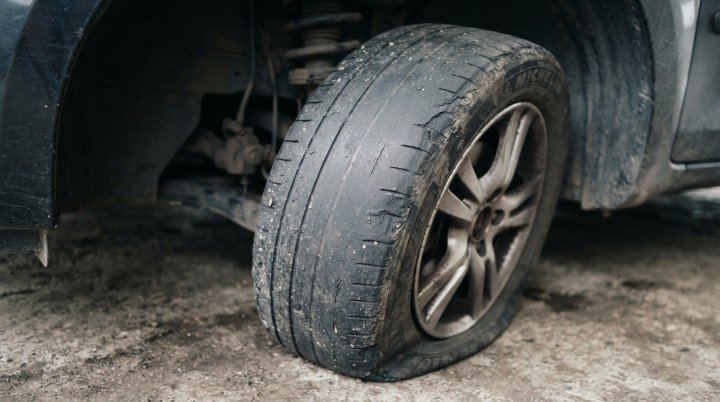
Flat spotting is another possibility. A temporary flat spot may develop after a vehicle sits for an extended period, especially in cold conditions. The vibration may gradually improve as the tire warms. A permanent flat spot, structural defect, or severe impact-related damage will not normally disappear with driving.
What the Tread Pattern Can Reveal
The wear pattern can provide useful evidence:
- Cupped or scalloped patches may suggest imbalance, weak dampers, or suspension movement.
- Wear concentrated on one edge may point toward alignment or worn steering and suspension parts.
- Wear on both outer shoulders may indicate prolonged underinflation.
- Center wear may result from excessive inflation in some applications.
- Irregular high and low spots can create noise and vibration even after balance correction.
Alignment is frequently blamed for steering vibration, but misalignment more commonly causes pulling, an off-center steering wheel, and uneven tire wear. The resulting damaged or irregularly worn tire may then produce the vibration. A loose tie rod, worn ball joint, or damaged bushing may also create both alignment changes and shaking.
For that reason, an alignment should not be performed as the only repair until the tires, wheels, steering, and suspension have been inspected. Adjusting alignment angles cannot repair a separated tire, bent wheel, worn joint, or damaged bushing.
How Tire Problems Are Confirmed
A technician may rotate each tire and look for visible movement in the tread or sidewall, measure runout, inspect the tread pattern, verify pressure, and use a balancing or road-force machine. Moving the front wheels to another approved position may also change where the vibration is felt, providing another clue, but tire rotation is not a repair for structural damage.
A damaged tire must be replaced. Uneven wear may also require replacement if the tread can no longer maintain safe contact with the road. The condition that caused the wear—such as imbalance, misalignment, weak shocks, or worn suspension parts—must be corrected, or the replacement tire may develop the same pattern.
The tire is only the outermost part of the rotating assembly. Movement can also begin at the wheel, hub, bearing, or brake disc and then travel through the steering knuckle and linkage.
When the steering wheel shakes while driving even though the tires have been balanced and show no obvious damage, the inspection should follow this path:
Wheel → Mounting surface → Hub → Bearing → Brake disc → Steering knuckle
A fault anywhere along this route can prevent the assembly from rotating smoothly.
3. A Wheel Is Bent, Damaged, or Mounted Incorrectly
A wheel is designed to rotate in a nearly perfect circle while remaining securely seated against the hub. A pothole, curb impact, road debris, or collision can bend the rim enough to create radial or lateral movement.
Radial runout makes the wheel appear to move up and down as it rotates. Lateral runout produces side-to-side movement. Either condition can create a repeating vibration, but lateral movement is more likely to be transmitted through the front steering system.
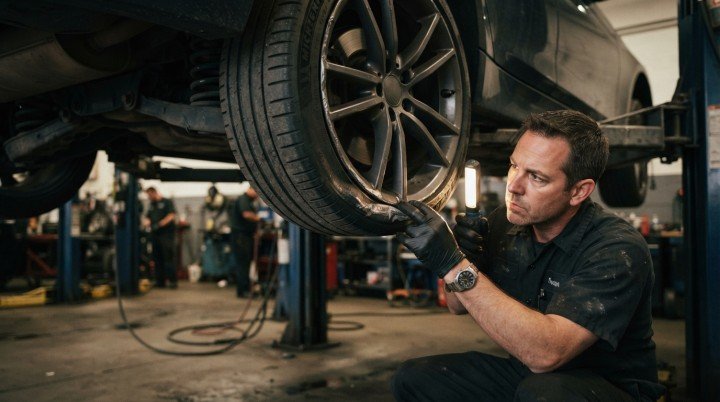
A slightly bent wheel may not be obvious while parked. The tire may hold air normally, and the wheel may appear acceptable during a quick visual inspection. Once road speed increases, however, the movement can become strong enough to shake the steering wheel.
Other possible signs include:
- Vibration beginning after a pothole or curb impact
- A tire that repeatedly loses pressure
- Visible damage to the inner or outer wheel lip
- A wobble seen while the wheel rotates
- Difficulty balancing the assembly
- A vibration that returns soon after balancing
- Cracks or corrosion around the wheel
Incorrect Mounting Can Imitate a Bent Wheel
The wheel must sit flat against a clean hub surface. Rust, dirt, paint buildup, or other debris trapped between the wheel and hub may prevent proper seating.
Incorrect wheel fitment can create a similar problem. The center bore, bolt pattern, wheel-offset specifications, and required hardware must match the vehicle. Some aftermarket wheels use hub-centric rings to center the wheel correctly. A missing, damaged, or incorrect ring may allow the wheel to sit off-center.
Wheel fasteners must also be tightened in the correct sequence and to the manufacturer’s specified torque. Uneven clamping can prevent the wheel from seating correctly, while loose fasteners may allow dangerous movement.
A loose-wheel sensation, knocking sound, or visible wheel movement is an urgent safety concern. Do not continue driving to “see if it gets worse.” Stop safely and arrange an inspection.
A balancing machine can detect imbalance and may reveal wheel runout, but adding weights does not straighten a bent rim. Depending on the wheel material, location of the damage, and manufacturer guidance, professional repair may be possible. A cracked or severely distorted wheel usually requires replacement.
4. A Brake Disc or Caliper Problem Appears During Braking
Brake-related steering vibration usually follows a specific rule: the steering wheel remains relatively smooth while cruising but begins shaking when the brake pedal is pressed.
The front brake discs rotate with the wheels. If a disc develops thickness variation, excessive lateral runout, or an uneven layer of friction material, braking force may rise and fall as the disc passes between the pads. That repeating force can travel through the front suspension and steering linkage.
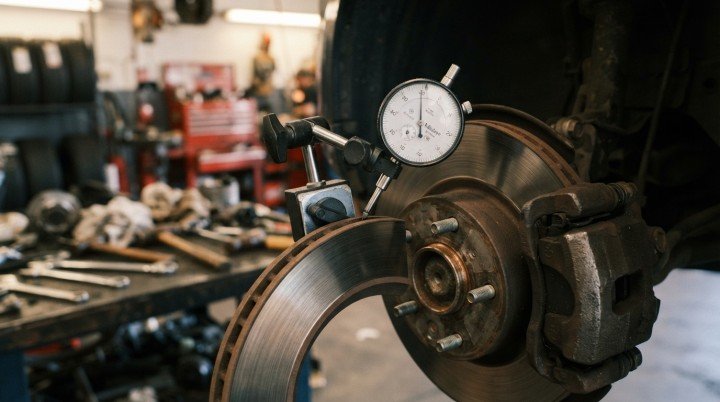
Drivers often describe this condition as “warped rotors,” but physical distortion is not the only possibility. Brake judder may also result from:
- Disc thickness variation
- Excessive rotor or hub runout
- Uneven pad deposits
- Rust between the rotor and hub
- Incorrect wheel-fastener torque
- Overheated or glazed pads
- A sticking caliper piston or slide pin
A front-brake problem is more likely to affect the steering wheel, while a rear-brake problem may be felt more through the seat, floor, or brake pedal. This distinction is useful, but vibration can travel through the vehicle, so it is not conclusive.
How Brake-Related Vibration Behaves
The shake may become stronger during high-speed stops because the brakes must absorb more energy. A rhythmic pulse may also be felt through the pedal. The pulse usually slows as vehicle speed decreases because the affected disc is rotating more slowly.
A dragging caliper can create a different pattern. If a piston, guide pin, pad, or brake hose prevents the brake from releasing fully, one wheel may overheat. The vibration may become more noticeable after repeated stops rather than during the first few minutes of driving.
Other possible clues include pulling, a burning smell, excessive brake dust, reduced acceleration, or one wheel becoming much hotter than the others. Never touch a wheel, disc, or caliper immediately after driving; brake components can cause severe burns.
Diagnosis should include measuring disc thickness at several points and checking runout with a dial indicator. Pad wear, caliper movement, hub condition, and wheel-bearing play should also be inspected. Replacing the rotors without correcting a dirty hub, sticking caliper, bearing problem, or installation error may allow the vibration to return.
5. The Wheel Bearing or Hub Is Worn
The wheel bearing allows the hub and wheel to rotate with minimal friction while supporting the vehicle’s weight. When the bearing wears or the hub becomes damaged, the wheel assembly may no longer rotate accurately.
A worn bearing can produce humming, growling, grinding, or rumbling that increases with road speed. The sound may change when the vehicle turns because cornering shifts load from one side to the other.
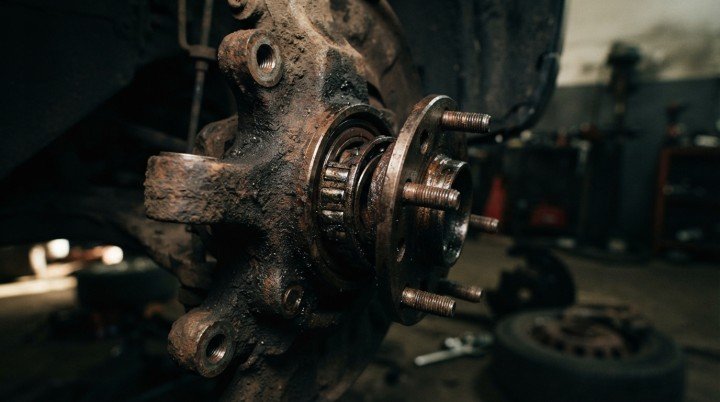
Steering vibration is also possible. Excessive bearing clearance may allow the hub, brake disc, and wheel to move under load. The driver may notice looseness, wandering, uneven tire wear, or a shake that becomes more obvious on curves.
However, diagnosis based only on noise can be misleading. Tire tread patterns can imitate bearing noise, and some worn bearings produce vibration before they become noticeably loud. A noise that changes during a turn helps narrow the search but does not identify the failed side with certainty.
The Hub Can Cause Vibration Without Obvious Bearing Noise
The brake disc and wheel mount to the hub. If the hub face is corroded, damaged, or has excessive runout, the components attached to it may rotate inaccurately even when they are new.
This can create several confusing situations:
- New brake discs still produce judder
- A balanced tire and wheel continue to vibrate
- Rotor runout remains excessive after replacement
- Vibration returns shortly after a brake service
- The ABS light appears because the hub assembly contains a wheel-speed sensor
A technician may inspect for bearing play, rotate the assembly while listening for roughness, and measure hub or rotor runout. Some bearings can remain tight during a basic hand check but become noisy or unstable under vehicle load. Model-specific diagnostic procedures are therefore important.
Replacing the bearing or hub assembly may be required if internal wear, roughness, excessive play, sensor damage, or unacceptable runout is confirmed. Cleaning the mounting surface may correct corrosion-related seating problems, but it cannot repair internal bearing damage.
Why Does the Steering Wheel Shake at High Speeds?
High-speed vibration is commonly associated with tire or wheel imbalance, but speed alone does not prove that balancing is the correct repair.
As a wheel rotates faster, even a small imbalance or irregular shape creates a more noticeable repeating force. The vehicle’s suspension may respond especially strongly within a particular speed window. This is why a car can feel smooth at lower speeds, begin shaking around highway speed, and then change intensity again.
Possible high-speed causes include:
- Tire or wheel imbalance
- A separated or out-of-round tire
- Excessive tire road-force variation
- A bent wheel
- Improper wheel mounting
- Hub or bearing wear
- Loose steering or suspension parts
- Axle or driveline imbalance
The way the vibration responds to driver input remains important. If it follows road speed regardless of throttle position, the tires, wheels, or hubs deserve early attention. If it becomes stronger only while accelerating and decreases when the accelerator is released, a CV axle or driveline component becomes more likely. If it starts only when braking, the brake discs, calipers, hubs, and suspension should be investigated.
Do not attempt to identify the exact speed at which the shake becomes severe by repeatedly driving faster. Record the conditions already observed during normal use and allow a qualified technician to reproduce the symptom under controlled conditions.
If the steering wheel shakes while driving at highway speed and is accompanied by a tire bulge, loose steering, strong pulling, grinding, or a sensation that a wheel is wobbling, reduce speed smoothly, avoid abrupt inputs, and stop in a safe location.
6. Steering or Suspension Parts Are Loose or Worn
The front wheels must remain pointed in the intended direction while moving over bumps, turning, accelerating, and braking. Tie rods, ball joints, control arms, bushings, struts, shocks, and steering-rack mounts all help maintain that control.
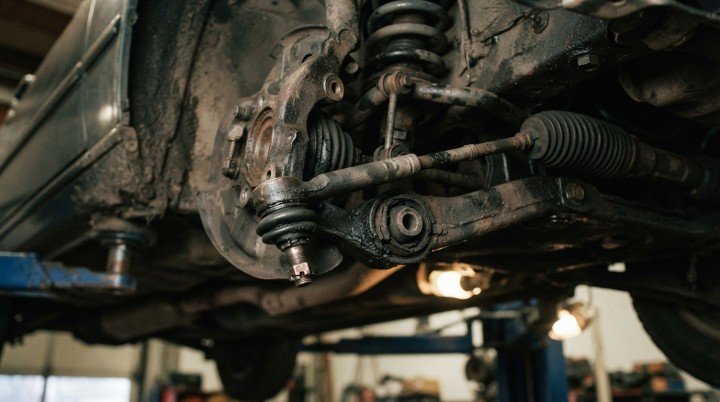
When one of these components develops excessive movement, the wheel can shift or oscillate instead of following a stable path. That movement may travel through the steering linkage and become noticeable in the steering wheel.
Worn Tie-Rod Ends
Tie rods connect the steering rack or steering gear to the steering knuckles. Because they transmit every steering input, looseness in a tie-rod joint can make the steering feel vague or unstable.
Possible symptoms include:
- Steering-wheel vibration
- Excessive steering play
- Vehicle wandering
- Uneven front-tire wear
- Knocking or clunking while turning
- A shake that becomes stronger with speed
A severely worn tie rod is a major safety concern because complete separation can result in loss of steering control.
Worn Ball Joints or Control-Arm Bushings
Ball joints allow the suspension and steering knuckle to move while keeping the wheel connected to the control arm. Control-arm bushings isolate vibration and help control fore-and-aft wheel movement.
Wear in either component may allow the wheel to change position when the vehicle hits a bump, turns, brakes, or accelerates. The driver may hear clunks, feel instability, or notice that the steering wheel continues shaking after the vehicle returns to a smooth road.
Bushings can deteriorate without becoming completely detached. Cracked rubber, separation from the sleeve, fluid leakage from hydraulic bushings, or excessive movement under load may indicate failure.
Weak Shocks, Struts, or Mounts
Shocks and struts control suspension movement and help the tires maintain consistent contact with the road. They do not normally create a rhythmic steering vibration in the same way an imbalanced tire does. However, weak damping can allow tire bounce, reduce control over uneven pavement, and contribute to cupped tread wear.
The irregular tire wear may then become the direct source of the vibration.
Worn strut mounts, bearings, or loose attachment points can also create noise and movement during steering. Possible clues include excessive bouncing, poor cornering stability, knocking over bumps, or vibration that is more noticeable on rough roads.
Steering Rack or Mounting Problems
A steering rack that is internally worn, loose at its mounts, or connected through damaged bushings may allow unwanted movement. Hydraulic power-steering problems can also cause shudder or inconsistent assistance while turning, particularly if the system contains air or is low on fluid.
Electric power-steering faults are less likely to cause a speed-related mechanical vibration, but abnormal assistance, warning lights, or steering effort changes should still be diagnosed using the manufacturer’s procedures.
A proper inspection may require loading the suspension because some worn joints appear tight when the wheels hang freely on a lift. Repair any loose or damaged parts before attempting an alignment.
7. A CV Axle, Driveshaft, or Related Driveline Part Is Worn
Wheel imbalance usually follows road speed. Driveline vibration often changes with torque.
If the vehicle shakes more strongly while accelerating, climbing a hill, or carrying additional load—and the vibration decreases when the accelerator is released—the CV axles, intermediate shaft, driveshaft, or mounts deserve attention.
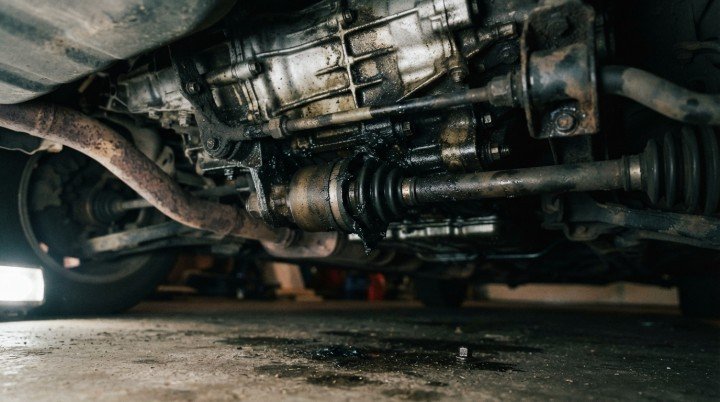
Inner and Outer CV-Joint Symptoms Are Different
Front-wheel-drive and many all-wheel-drive vehicles use CV axles to transfer power while allowing the wheels to steer and the suspension to move.
An outer CV joint is commonly associated with clicking or popping during tight turns. An inner plunge joint is more likely to produce shudder or vibration under acceleration. The vibration may travel through the body, floor, and steering system rather than remaining limited to the steering wheel.
A torn boot does not automatically prove that the joint has already failed, but it allows grease to escape and contaminants to enter. Grease splattered around the suspension, a cracked boot, clicking during turns, or load-dependent vibration should prompt a detailed inspection.
Bent Axles, Intermediate Shafts, and Driveshafts
An axle can bend after a collision, curb strike, or severe pothole impact. A bent shaft may produce vibration that follows road speed and becomes stronger as the vehicle accelerates.
Some vehicles use an intermediate shaft and support bearing between the transmission and CV axle. Wear in the bearing or shaft can create a vibration similar to an inner CV-joint problem.
Rear-wheel-drive, four-wheel-drive, and all-wheel-drive vehicles may also develop vibration from an imbalanced or damaged driveshaft, worn universal joints, incorrect driveline angles, or support-bearing wear. The vibration may be felt throughout the vehicle, but it can still reach the steering wheel.
Engine and Transmission Mounts Can Change the Pattern
Mounts hold the engine and transmission in position while isolating vibration from the cabin. A collapsed or broken mount can allow excessive movement during acceleration. It may also change CV-axle or driveshaft operating angles, creating or magnifying a load-dependent shudder.
Mount problems become more likely when the vehicle vibrates while stationary in Drive, clunks when shifting between Drive and Reverse, or moves excessively when engine torque is applied.
Replacing a CV axle without checking its operating angle, related support bearings, and mounts can leave the vibration unchanged. Diagnosis should confirm whether the symptom follows vehicle speed, engine RPM, or drivetrain load.
Does Bad Wheel Alignment Cause Steering-Wheel Vibration?
Wheel alignment describes the angles at which the wheels sit relative to the vehicle and road. Incorrect toe, camber, or caster can cause pulling, an off-center steering wheel, poor handling, and uneven tire wear.
Misalignment may contribute to vibration, but it is often not the direct source of a rhythmic shake. The uneven tire wear created by poor alignment may eventually cause the vibration. A worn tie rod, ball joint, bushing, or damaged wheel may also produce both misalignment and shaking.
This distinction matters because alignment cannot repair physical looseness or damaged tires. If a shop adjusts the alignment without identifying a worn component, the settings may not remain correct.
Balancing and alignment are also different services. Balancing corrects uneven weight distribution within the rotating tire-and-wheel assembly. Alignment adjusts wheel angles. A car may require either service, both services, or neither—depending on the actual fault.
How Mechanics Diagnose a Shaking Steering Wheel
A useful diagnosis follows the symptom instead of beginning with the most commonly replaced part.
1. Record the Trigger
The technician should determine:
- At what speed the vibration begins
- Whether it follows road speed or engine RPM
- Whether braking changes it
- Whether acceleration makes it stronger
- Whether it changes during turns
- Whether bumps trigger continued oscillation
- Whether it remains while the vehicle is stationary
2. Inspect the Tires and Wheels
The inspection should include tire pressure, tread condition, internal-damage clues, wheel mounting, balance weights, fasteners, and visible runout. Road-force testing may be useful when standard balancing does not identify the problem.
3. Check the Brake and Hub Assemblies
Brake discs should be inspected if the vibration appears during braking. Wheel bearings and hubs should be checked for play, noise, roughness, and runout.
4. Inspect Steering and Suspension Movement
Tie rods, ball joints, control-arm bushings, struts, shocks, steering mounts, and related components should be checked under the appropriate load. Worn parts must be repaired before alignment.
5. Inspect the Axles and Driveline
If the vibration changes with throttle, inspect the CV joints, boots, shafts, intermediate bearings, driveshafts, universal joints, and mounts. The operating angles and installation of recently replaced parts should also be verified.
6. Confirm the Repair
The vehicle should be tested under the original conditions that produced the symptom. Replacing a part without confirming that the vibration has disappeared can allow multiple faults or an incorrect diagnosis to go unnoticed.
Is It Safe to Drive With a Shaking Steering Wheel?
The risk depends on the cause and severity. A mild imbalance may not cause immediate loss of control, but continued vibration can increase tire wear and place extra stress on steering and suspension components.
When the steering wheel shakes while driving, stop as soon as it is safe and arrange professional assistance if you notice:
- Violent or rapidly increasing vibration
- A tire bulge, separation, or exposed cords
- A wheel that appears loose or wobbles
- Severe steering looseness
- Strong pulling
- Grinding or heavy clunking
- Difficulty controlling the vehicle
- Vibration immediately after a severe pothole impact
- A burning smell or smoke near a wheel
- Brake-pedal failure or a red brake warning light
If severe shaking begins at speed, keep a controlled grip, ease off the accelerator, avoid abrupt steering or hard braking when possible, and move toward a safe stopping location. Do not continue driving at high speed to reproduce the symptom. If you are unsure whether the car should keep moving, treat it like a safe-to-drive decision, not a comfort issue.
Frequently Asked Questions
Why Does My Steering Wheel Shake at 60–70 MPH?
A vibration limited to a highway-speed range often points toward tire or wheel imbalance, excessive tire road-force variation, a bent wheel, or tire damage. Hub, bearing, suspension, and driveline faults are also possible, especially when balancing does not solve the problem.
Why Does My Steering Wheel Shake When Braking?
If the wheel is smooth while cruising but shakes when the brakes are applied, inspect the front brake discs, pads, calipers, hubs, and suspension. Disc thickness variation and runout are common, but they should be measured rather than assumed.
Why Does My Steering Wheel Shake When Accelerating?
Acceleration-dependent vibration may indicate inner CV-joint wear, a bent axle, intermediate-shaft bearing, driveshaft problem, or damaged engine or transmission mount. If the shake remains unchanged when the accelerator is released, tire or wheel problems become more likely.
Why Does My Steering Wheel Shake at Low Speeds?
Low-speed shaking can result from a severely deformed tire, separated belt, bent wheel, loose wheel, or significant suspension wear. If the vehicle also vibrates while stopped, inspect engine operation and mounts rather than focusing only on road-speed components.
Will Wheel Balancing Fix the Vibration?
Balancing can correct uneven weight distribution. It cannot repair a separated tire, bent wheel, worn bearing, loose steering joint, brake-disc variation, or damaged axle. If balancing does not change the symptom, further inspection is necessary.
Final Takeaway
If the steering wheel shakes while driving, change one variable at a time in your observations: road speed, braking, acceleration, turning, and road surface. The way the vibration responds can reveal whether the investigation should begin with the tires, brakes, hubs, steering, suspension, or driveline.
Start with tire condition and wheel mounting because those problems are common and can become immediately dangerous. Then move inward through the hub, bearing, brakes, steering, and suspension. If throttle changes the vibration, include the axles, driveshafts, and mounts.
Do not assume that balancing, alignment, or brake replacement will fix every shake. A careful inspection that reproduces the original symptom and confirms the repair is safer—and usually less expensive—than replacing parts based on guesswork.
Kevin Nicholas is an automotive mechanic and editor of The Effective Guide. He writes about warning lights, car problems, and diagnostic tools, helping drivers understand what to check before replacing a part.