
Last Updated on October 15, 2026
Tekton is a well-known hand tool brand offering torque wrenches for different jobs, from bicycle maintenance to automotive repairs and lawn equipment servicing. Whether you need a smaller wrench for delicate fasteners or a larger one for wheel lug nuts, Tekton has offered several options over the years.
One thing I like about Tekton torque wrenches is their straightforward design. You don’t need a complicated digital display to tighten a fastener correctly. A properly calibrated click-type torque wrench can do the job well when used within its specified range.
In this Tekton Torque Wrench review, we’ll look at three popular models: the TEKTON 24340, 24330, and 24320. We’ll discuss their features, advantages, limitations, and the jobs each wrench is best suited for.
These three models are now discontinued by Tekton, but they remain useful references for anyone who already owns one or finds unused stock through another retailer. We’ll also look at newer Tekton alternatives worth considering.
[toc]
Best Tekton Torque Wrench Review 2026
Tekton offers different drive sizes and torque ranges, so choosing the right wrench depends on the job you plan to perform.
A 1/2-inch drive wrench is generally suitable for higher-torque automotive fasteners, while a 3/8-inch model handles many medium-duty jobs. For smaller bolts and more delicate components, a 1/4-inch drive wrench is usually a better fit.
Before going into the individual reviews, here’s a quick comparison of the three original models.
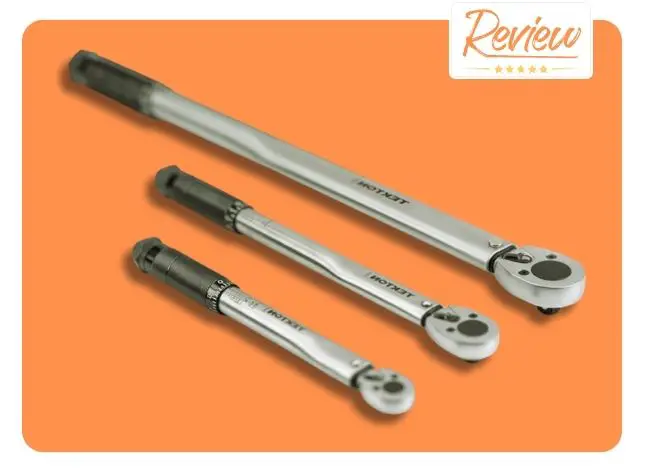
Tekton Torque Wrench Comparison Table
| Feature | TEKTON 24340 | TEKTON 24330 | TEKTON 24320 |
|---|---|---|---|
| Drive Size | 1/2 inch | 3/8 inch | 1/4 inch |
| Torque Range | 25–250 ft-lb | 10–80 ft-lb | 20–200 in-lb |
| Approx. Metric Range | 33.9–339 Nm | 13.6–108.5 Nm | 2.26–22.6 Nm |
| Type | Click / Micrometer | Click / Micrometer | Click / Micrometer |
| Best For | Wheels and higher-torque automotive work | General automotive maintenance | Smaller fasteners and light mechanical work |
| Manufacturer Status | Discontinued | Discontinued | Discontinued |
All three use a mechanical click mechanism to signal that the preset torque has been reached. They also feature adjustable scales and reversible ratchet heads. However, the reversible ratchet doesn’t mean these older models measure torque accurately in both directions.
TEKTON 24340 1/2-Inch Drive Click Torque Wrench (Our Top Pick)
The TEKTON 24340 is a practical choice for people who regularly work on cars, light trucks, tractors, and other equipment that requires relatively high tightening torque.
Its 1/2-inch drive makes it suitable for larger sockets, while the 25–250 ft-lb range covers many common automotive tightening jobs.
One of its strongest features is the high-contrast dual-range scale. You can set the required torque without dealing with batteries or electronic controls. The knurled handle also provides a secure grip when working with the wrench.
Like other traditional click-type torque wrenches, the 24340 produces a mechanical click when you reach the selected torque value. Once you feel or hear that click, you should stop applying force.
The reversible ratchet allows you to change the ratcheting direction, but the original wrench is designed to measure torque in the specified clockwise direction. It should not be treated as a dual-direction measuring wrench.
Its main limitation is size. A larger wrench can be difficult to use in cramped engine compartments, and the minimum setting of 25 ft-lb makes it unsuitable for many small fasteners.
Technical Features of TEKTON 24340
| Specification | TEKTON 24340 |
|---|---|
| Drive Size | 1/2 inch |
| Torque Range | 25–250 ft-lb |
| Metric Equivalent | Approximately 33.9–339 Nm |
| Type | Micrometer click torque wrench |
| Ratchet | Reversible |
| Measuring Direction | Clockwise |
| Advertised Accuracy | ±4% clockwise under specified conditions |
| Adjustment Increment | 1 ft-lb |
| Scale | High-contrast dual-range |
| Construction | Steel construction |
| Handle | Knurled metal grip |
| Storage | Protective case |
| Current Manufacturer Status | Discontinued |
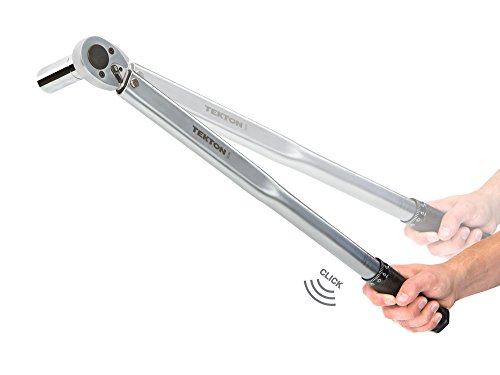
Main Features
- 1/2-inch drive for larger automotive sockets.
- 25–250 ft-lb adjustable torque range.
- Mechanical click feedback.
- High-contrast dual-range scale.
- Reversible ratchet head.
- Durable steel construction.
- Knurled handle for a secure grip.
Pros
- Wide torque range for many automotive jobs.
- Simple adjustment system without batteries.
- Click mechanism helps reduce the risk of overtightening when used properly.
- Metal handle provides good control.
- Useful for wheel service and other higher-torque applications.
- Protective storage case helps keep the wrench organized.
Cons
- Too large for many confined work areas.
- Not ideal for low-torque fasteners below 25 ft-lb.
- The click may be difficult to notice in noisy surroundings.
- Does not provide a digital torque display.
- Now discontinued, so replacement purchases depend on remaining retailer stock.
My verdict: The TEKTON 24340 remains a useful wrench for owners who need a broad, higher-torque range. If you’re buying new, though, it’s worth comparing it with Tekton’s newer 1/2-inch drive models before choosing an older listing.
TEKTON 24330 3/8-Inch Drive Click Torque Wrench
The TEKTON 24330 is another solid option from the brand. Its 3/8-inch drive is useful for many general automotive repair and maintenance jobs, particularly when a large 1/2-inch torque wrench would be inconvenient.
With a range of 10–80 ft-lb, this model handles medium-torque applications. The smaller size makes it easier to maneuver around many engine and accessory components.
Like the 24340, it features a high-contrast dual-range scale and a click mechanism that signals when the preset torque has been reached.
The steel construction gives it a sturdy feel, while the reversible ratchet allows you to reposition the wrench conveniently. Torque measurement is specified for the clockwise direction.
The biggest drawback is its limited upper range. If you’re tightening wheel lug nuts or larger suspension fasteners, the required specification may exceed 80 ft-lb. Always compare the fastener’s required torque with the wrench’s range.
Technical Features of TEKTON 24330
| Specification | TEKTON 24330 |
|---|---|
| Drive Size | 3/8 inch |
| Torque Range | 10–80 ft-lb |
| Metric Equivalent | Approximately 13.6–108.5 Nm |
| Type | Micrometer click torque wrench |
| Ratchet | Reversible |
| Measuring Direction | Clockwise |
| Advertised Accuracy | ±4% clockwise under specified conditions |
| Adjustment Increment | 1 ft-lb |
| Scale | High-contrast dual-range |
| Construction | Steel construction |
| Storage | Protective case |
| Current Manufacturer Status | Discontinued |
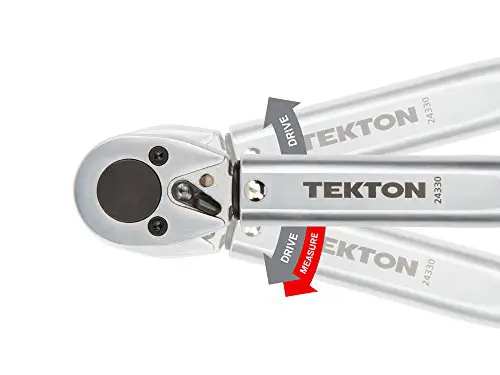
Main Features
- 3/8-inch drive size.
- 10–80 ft-lb torque range.
- High-contrast adjustment scale.
- Reversible ratchet mechanism.
- Mechanical click feedback.
- Steel construction.
- Protective storage case.
Pros
- Useful size for many automotive maintenance tasks.
- Easier to handle in tighter spaces than a larger 1/2-inch wrench.
- Simple, mechanical operation.
- Good range for medium-torque fasteners.
- Convenient scale markings.
- Doesn’t require batteries or charging.
Cons
- Maximum torque of 80 ft-lb limits higher-torque applications.
- Too large or high-range for some delicate fasteners.
- Click feedback requires attention, especially at lower settings.
- No electronic torque recording or display.
- Discontinued by the manufacturer.
My verdict: The TEKTON 24330 is probably the most versatile of these three older models for everyday medium-duty automotive work. However, it isn’t a replacement for both a low-torque and a high-torque wrench.
TEKTON 24320 1/4-Inch Drive Click Torque Wrench
The TEKTON 24320 is designed for smaller fasteners where a large automotive torque wrench would be unsuitable.
Its 1/4-inch drive and 20–200 in-lb range make it useful for lighter mechanical work, including selected motorcycle, bicycle, engine accessory, and small equipment fasteners.
The most important thing to understand is that this model uses inch-pounds rather than foot-pounds as its primary range. Confusing these units can result in a serious tightening error.
For reference, 12 in-lb equals 1 ft-lb. That means the 24320’s 20–200 in-lb range is approximately 1.67–16.67 ft-lb.
This smaller wrench uses the same basic mechanical click principle as its larger counterparts. It has an adjustable dual-range scale and a reversible ratchet head.
The compact design helps when working around smaller components, but you should never use it for high-torque applications outside its rated range.
Technical Features of TEKTON 24320
| Specification | TEKTON 24320 |
|---|---|
| Drive Size | 1/4 inch |
| Torque Range | 20–200 in-lb |
| Metric Equivalent | Approximately 2.26–22.6 Nm |
| Type | Micrometer click torque wrench |
| Ratchet | Reversible |
| Measuring Direction | Clockwise |
| Advertised Accuracy | ±4% clockwise under specified conditions |
| Adjustment Increment | 1 in-lb |
| Scale | High-contrast dual-range |
| Construction | Steel construction |
| Storage | Protective case |
| Current Manufacturer Status | Discontinued |
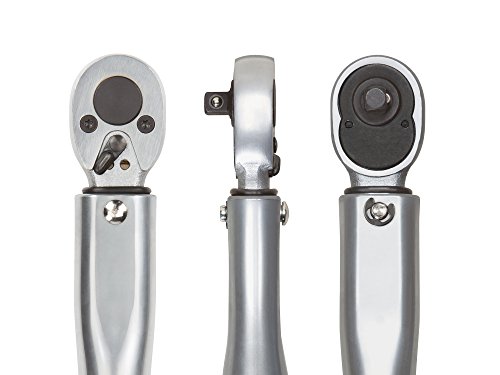
Main Features
- 1/4-inch drive size.
- 20–200 in-lb adjustable range.
- Mechanical click feedback.
- High-contrast dual-range scale.
- Reversible ratchet head.
- Steel construction.
- Compact design for smaller fasteners.
Pros
- Suitable for many low-torque mechanical applications.
- Compact enough for smaller work areas.
- Easy-to-understand mechanical operation.
- No batteries required.
- Useful addition to a larger automotive torque wrench.
Cons
- Not suitable for high-torque automotive fasteners.
- The click can be subtle at low torque settings.
- Inch-pound and foot-pound measurements can be confused if you’re not careful.
- Lacks a digital display.
- Discontinued, so new stock may be harder to find.
My verdict: The TEKTON 24320 is useful for small fasteners where accuracy matters and excessive torque could damage parts. For bicycle components made from carbon fiber or other delicate materials, always follow the component manufacturer’s torque and tool requirements.
Are These Older Tekton Torque Wrenches Still Worth Buying?
The TEKTON 24340, 24330, and 24320 remain capable torque wrenches for their intended applications. However, Tekton no longer lists them as available for direct purchase.
If you already own one and it is in good condition, there is no automatic reason to replace it simply because the model has been discontinued.
If you’re buying a wrench today, the situation is different. An older model may still appear through third-party sellers, but you should check its condition, seller reliability, and whether it has been stored properly.
A torque wrench that has been dropped, overloaded, or stored incorrectly may need its calibration checked before use.
Newer Tekton Torque Wrench Alternatives
Tekton now offers newer micrometer torque wrenches with updated ratchet mechanisms and additional capabilities.
| Older Model | Newer Tekton Option | Torque Range | Important Difference |
|---|---|---|---|
| 24340 | TRQ52403 | 40–300 ft-lb | Higher upper range; different minimum torque |
| 24330 | TRQ51402 | 10–100 ft-lb | Higher upper range and dual-direction measurement |
| 24320 | TRQ50402 | 20–200 in-lb | Similar range with updated dual-direction design |
These aren’t exact one-for-one replacements in every respect. For example, the newer TRQ52403 starts at 40 ft-lb, while the older 24340 starts at 25 ft-lb.
That difference matters if your normal repair work frequently requires torque settings between 25 and 39 ft-lb.
The newer dual-direction models also offer updated features, including a 90-tooth ratchet mechanism and specified torque measurement in both clockwise and counterclockwise directions.
Before choosing a newer model, compare its working range with the fastener specifications you commonly use.
Why Choose Tekton Torque Wrenches?
Construction
Tekton has built a reputation for offering practical hand tools with straightforward designs.
Many of its traditional click-type torque wrenches use steel construction and metal handles. This makes them suitable for regular garage use when handled and stored correctly.
However, steel construction doesn’t mean a wrench is immune to damage. A hard drop, internal wear, or excessive force can affect calibration even when the tool looks fine.
Drive Size
Drive size is one of the first things to consider when choosing a torque wrench.
- 1/4-inch drive: Best suited for smaller fasteners and low-torque applications.
- 3/8-inch drive: A practical choice for many general automotive maintenance jobs.
- 1/2-inch drive: Often used for wheel lug nuts and larger automotive fasteners.
Remember that drive size and torque range are related but not identical. Always choose a wrench based on its rated torque range, not just the socket drive size.
If you’re interested in comparing different brands, our CDI torque wrench review covers another established option for automotive and mechanical work.
Torque Range
Every torque wrench has a minimum and maximum rated working range.
For example, if a fastener requires 15 ft-lb, the TEKTON 24340 isn’t suitable because its minimum setting is 25 ft-lb.
Likewise, a 3/8-inch model with an 80 ft-lb maximum shouldn’t be used to tighten a fastener requiring 100 ft-lb.
For good results, choose a wrench that covers your required torque without operating beyond its specified limits.
Price and Value
Tekton torque wrenches have traditionally appealed to buyers looking for capable tools without spending professional-shop prices.
However, prices vary depending on the model, current availability, and seller. Discontinued products may also be priced differently from newer alternatives.
Instead of buying the cheapest model available, consider the torque range, included storage case, calibration information, and warranty support.
You can also compare other options in our guide to the best torque wrenches for cars and bikes.
Warranty Support
Tekton’s published warranty policy is one of the reasons people consider the brand.
The company currently describes its tool warranty as having no time limits and no receipt requirement. It also explains how owners can request replacement support.
For discontinued tools without direct replacements, Tekton states that eligible owners may receive store credit under its warranty process.
Warranty fulfillment and shipping availability can depend on location. Always review the current policy directly with Tekton, especially when purchasing through a third-party seller or outside the United States and Canada.
How to Use a Tekton Torque Wrench Correctly
Even the best torque wrench won’t help much if it’s used incorrectly. A few simple habits can make a big difference.
- Find the correct torque specification. Check the vehicle or equipment manufacturer’s service information. Never guess a tightening value.
- Choose the correct wrench. Make sure the required torque falls within the wrench’s rated range.
- Set the torque carefully. Use the adjustment mechanism and lock the setting according to the model’s instructions.
- Use the correct socket. Make sure it fits the fastener securely.
- Apply steady pressure. Pull smoothly using the intended grip position.
- Stop at the first click. Don’t keep pulling or repeatedly click the same fastener to make it feel tighter.
- Store it correctly. Return the adjustment to the manufacturer’s recommended storage setting and put the wrench away in its case.
For fasteners requiring a particular tightening sequence, angle measurement, lubrication condition, or one-time-use hardware, follow the exact service procedure rather than relying on torque alone.
Common Mistakes When Using a Click Torque Wrench
Confusing Inch-Pounds With Foot-Pounds
This is an easy mistake to make, especially when moving between smaller 1/4-inch wrenches and larger automotive models.
Remember that 1 ft-lb equals 12 in-lb. Always verify the measurement unit before setting the wrench.
Using a Wrench Outside Its Rated Range
Setting a wrench below its minimum or above its maximum can produce unreliable results or damage the tool.
Continuing to Pull After the Click
The click is your signal to stop applying tightening force. Continuing to pull can overtighten the fastener.
Using the Wrong Extension Setup
A straight socket extension generally doesn’t change the effective torque setting in the same way an inline crowfoot or other offset attachment can.
If you’re using a crowfoot adapter that changes the effective lever length, calculate the proper setting according to the tool manufacturer’s instructions.
Ignoring Calibration
A torque wrench can lose accuracy through damage, wear, improper storage, or heavy use.
If the wrench has suffered an impact, been overloaded, or produces inconsistent results, arrange a calibration check before relying on it for important tightening work.
Tekton Torque Wrench Maintenance Tips
Maintaining your Tekton torque wrench is important if you want it to remain accurate and reliable over time.
After each use, adjust a micrometer-style wrench to the lowest recommended setting shown in its manual. Don’t automatically turn it below the marked minimum.
Store the wrench in its protective case and keep it away from excessive moisture, dirt, and physical impact.
Wipe the exterior clean after use, but avoid taking apart the calibration mechanism unless you’re following an approved service procedure.
Regular calibration checks are especially important for professionals who use torque wrenches frequently. There isn’t one universal recalibration interval suitable for every owner. The appropriate schedule depends on usage, tool condition, manufacturer instructions, and the accuracy required for the job.
If you depend on a torque wrench for critical mechanical work, professional calibration or recertification is preferable to an improvised home test.
Final Verdict: Which Tekton Torque Wrench Should You Choose?
After comparing the three models in this Tekton Torque Wrench review, I think each one has a clear purpose.
The TEKTON 24340 is the strongest choice of these older models for higher-torque automotive tasks. Its 25–250 ft-lb range makes it useful for many wheel and larger fastener applications.
The TEKTON 24330 is a good middle-ground option for general maintenance. It’s easier to handle than the larger model and covers many everyday tightening jobs.
The TEKTON 24320 is best for smaller fasteners requiring inch-pound measurements. It complements a larger wrench rather than replacing one.
Because all three models have been discontinued, I would compare the price and condition of any remaining stock with Tekton’s newer torque wrenches before making a purchase.
A newer model may offer improved ratchet design, dual-direction torque measurement, and additional calibration documentation.
Ultimately, the best torque wrench is the one that matches your required torque specifications, fits your work area, and maintains reliable calibration. Choose based on the jobs you actually perform rather than simply buying the largest or most expensive wrench.
Frequently Asked Questions About Tekton Torque Wrenches
1. Are Tekton torque wrenches accurate?
Tekton torque wrenches are designed to meet the accuracy specifications published for each model. Many older click-type models advertised ±4% clockwise accuracy under specified conditions, while some newer models offer tighter tolerances. Actual accuracy depends on tool condition, calibration, and correct use.
2. How often should I recalibrate my Tekton torque wrench?
The proper interval depends on frequency of use, tool condition, and your accuracy requirements. Heavy professional use may justify a scheduled calibration program. A wrench that has been dropped, overloaded, or damaged should be checked before further precision work.
3. Can I use a Tekton torque wrench to loosen bolts?
A traditional click-type torque wrench should not be used as a breaker bar to loosen tight or seized fasteners. Use a suitable ratchet or breaker bar instead. Follow the specific wrench manual for any permitted reverse-direction operation.
4. Are TEKTON 24340, 24330, and 24320 still available?
Tekton has discontinued these three models. Some third-party retailers may still have remaining stock, but availability and condition should be checked before purchasing.
5. What is the difference between a 1/4-inch and 1/2-inch torque wrench?
A 1/4-inch drive torque wrench is generally used for smaller, lower-torque fasteners. A 1/2-inch drive model is usually intended for larger fasteners requiring higher torque. Always check the wrench’s actual working range instead of relying on drive size alone.
6. Do Tekton torque wrenches come with calibration certificates?
The older 24320, 24330, and 24340 micrometer models did not include individual calibration certificates. Some newer Tekton models include calibration documentation. Check the exact product listing and manufacturer’s specifications before buying.
Russell D. Steele writes trouble-code and repair guides for The Effective Guide. His work helps drivers understand what a code means, what might cause it, and which checks to make first.