
Last Updated on October 7, 2026
An overheating engine rarely begins with dramatic steam pouring from under the hood. It often starts quietly: the temperature gauge sits slightly higher than usual, the heater changes temperature, or the coolant level keeps dropping without an obvious explanation.
Most causes of engine overheating interfere with one basic process. The engine produces heat, coolant carries that heat away, and the radiator releases it into the surrounding air. If coolant is lost, circulation stops, airflow becomes restricted, or system pressure falls, engine temperature can rise rapidly.
Continuing to drive may turn a manageable cooling-system problem into expensive internal engine damage. That is why the warning signs—and when they appear—matter.
Overheating Safety Rule: If the temperature gauge moves toward the red zone, a high-temperature warning appears, or steam comes from under the hood, pull over in a safe location and shut off the engine. Stay clear of traffic and hot engine components. Never remove the radiator cap or pressurized coolant-reservoir cap while the engine is hot, because hot coolant and steam may escape under pressure. Arrange roadside assistance if the engine has seriously overheated.
Overheating Safety Rule: If the temperature gauge moves toward the red zone, a high-temperature warning appears, or steam comes from under the hood, pull over in a safe location and shut off the engine. Stay clear of traffic and hot engine components. Never remove the radiator cap or pressurized coolant-reservoir cap while the engine is hot, because hot coolant and steam may escape under pressure. Arrange roadside assistance if the engine has seriously overheated.
Quick Answer
The most common causes of engine overheating include low coolant, external or internal leaks, a stuck thermostat, poor coolant circulation, radiator restrictions, cooling-fan failure, trapped air, a damaged hose, pressure-cap failure, and incorrect or contaminated coolant. Instead of guessing at individual parts, it helps to determine which stage of the cooling process has failed.
The Engine Heat-Flow Failure Map
| Failure Route | What Goes Wrong | Related Causes | Common Clue |
|---|---|---|---|
| Coolant loss | Too little liquid remains to absorb and transport heat | External leak or internal leak | Coolant level repeatedly drops |
| Restricted circulation | Coolant cannot move through the engine and radiator | Thermostat, pump, belt, hose, or trapped air | Temperature rises quickly or fluctuates |
| Poor heat release | The radiator cannot release enough heat | Radiator or cooling-fan problem | Overheating changes with vehicle speed |
| Lost protection | The system loses pressure or proper coolant performance | Weak cap or unsuitable coolant | Overflow, deposits, or repeated overheating |
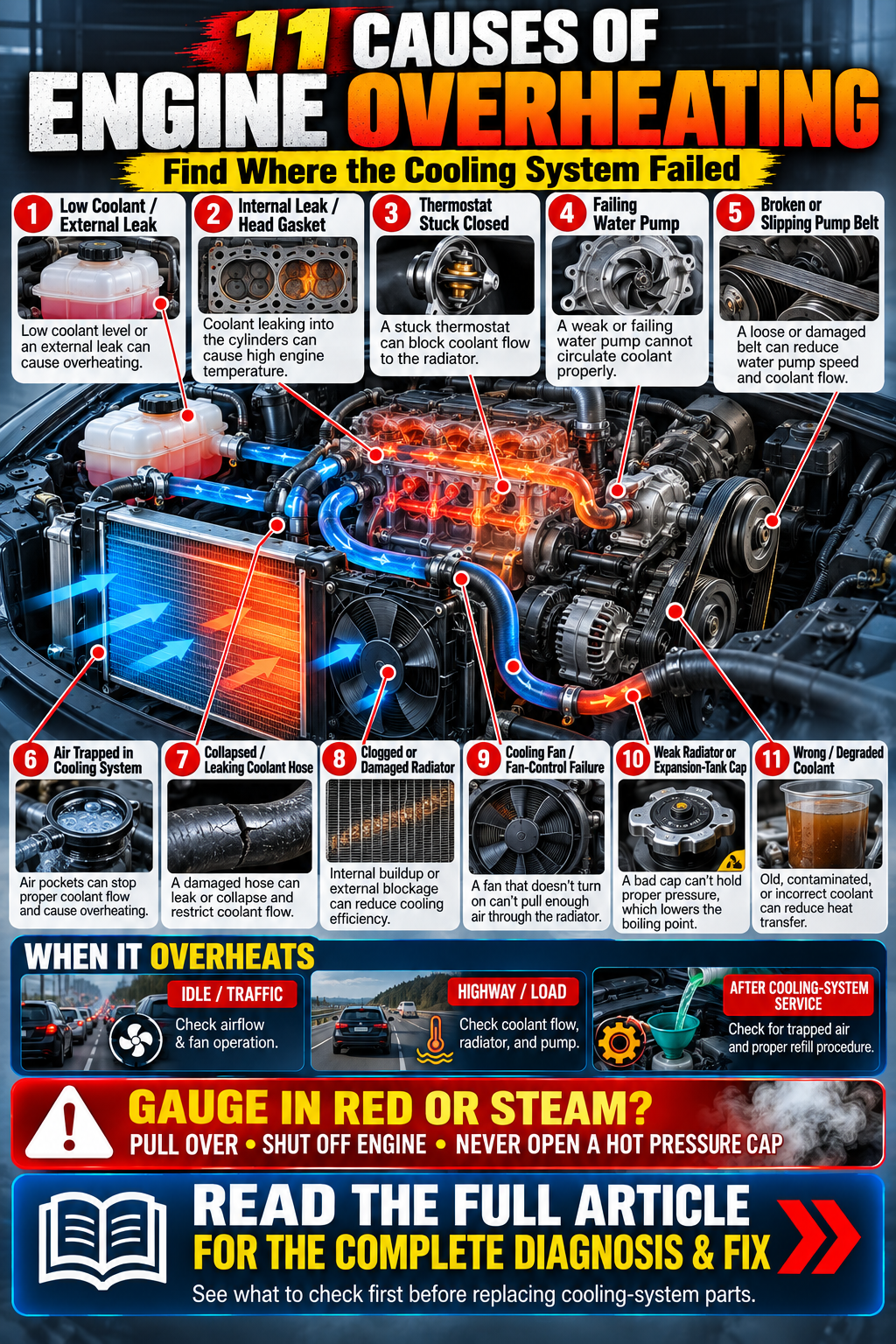
1. External Coolant Leak or Low Coolant Level
Coolant must remain at the correct level to absorb heat from the engine and carry it to the radiator. When the level falls, some areas may receive inadequate coolant flow, allowing localized temperatures to increase.
An external leak may come from a radiator, hose, connection, reservoir, heater-core circuit, water-pump seal, or another cooling-system component. A puddle is not always present. A small leak may occur only when the system becomes hot and pressurized, while leaked coolant can evaporate on warm engine surfaces.
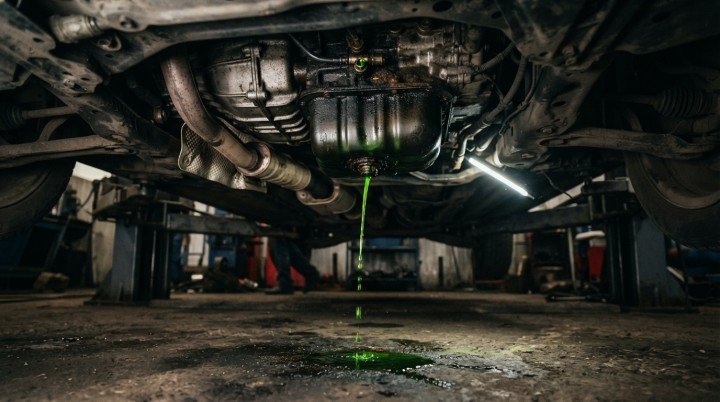
The clue pattern may include repeated coolant loss, a sweet odor, colored residue around a connection, or dampness beneath the vehicle. Coolant normally should not keep disappearing from a sealed system, so repeatedly topping it off without locating the leak does not solve the underlying problem.
2. Internal Coolant Leak or Head-Gasket Failure
Sometimes coolant disappears without leaving visible evidence outside the engine. A damaged head gasket, cracked cylinder head, or another internal sealing problem may allow coolant to enter a combustion chamber or mix with engine oil. Combustion gases may also enter the cooling system, creating abnormal pressure and forcing coolant out.
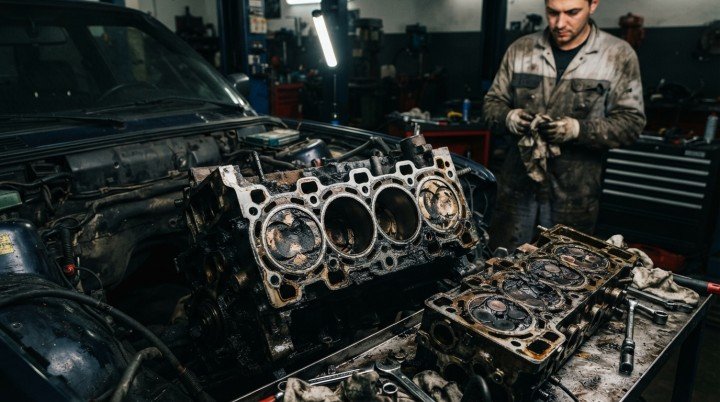
Possible clues include unexplained coolant loss, persistent exhaust vapor after the engine is warm, bubbling in the reservoir, rough running, or repeated overheating soon after coolant is added. However, these symptoms are not proof by themselves, and a failing head gasket does not always produce every familiar warning sign.
A technician may use cooling-system pressure testing, combustion-gas testing, scan data, and other inspections to separate an internal leak from a simpler external cooling-system problem.
3. Thermostat Stuck Closed
The thermostat acts as a temperature-controlled valve. While the engine warms up, it limits coolant flow to the radiator. Once operating temperature is reached, it opens so hot coolant can travel to the radiator and release heat.
If the thermostat remains stuck closed, that circulation path stays restricted. The engine may warm normally at first and then become hot quickly because the radiator cannot receive enough heated coolant.
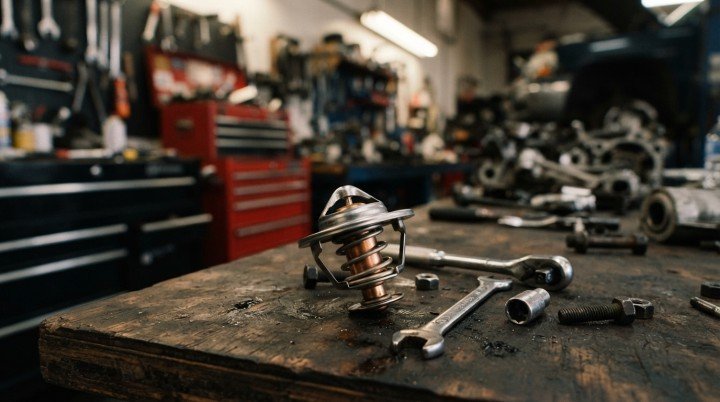
It is important to distinguish this from a thermostat stuck open. An open thermostat more commonly causes slow warm-up, weak cabin heat, or below-normal operating temperature—not rapid overheating. Because several circulation problems can imitate a stuck thermostat, diagnosis should come before replacing the part.
After coolant loss and thermostat failure, the next causes of engine overheating involve circulation and heat release. These problems can produce different patterns depending on engine speed, road speed, and whether the cooling system was recently serviced.
4. Failing Water Pump or Damaged Impeller
The water pump keeps coolant moving through the engine, radiator, and related passages. If the pump stops creating sufficient flow, heat remains concentrated inside the engine instead of being carried to the radiator.
A pump may fail because of a worn bearing, damaged seal, loose internal impeller, corrosion, or an electrical problem in vehicles equipped with an electric pump. Some failures create coolant residue or noise near the pump. Others reduce circulation without producing an obvious external leak.
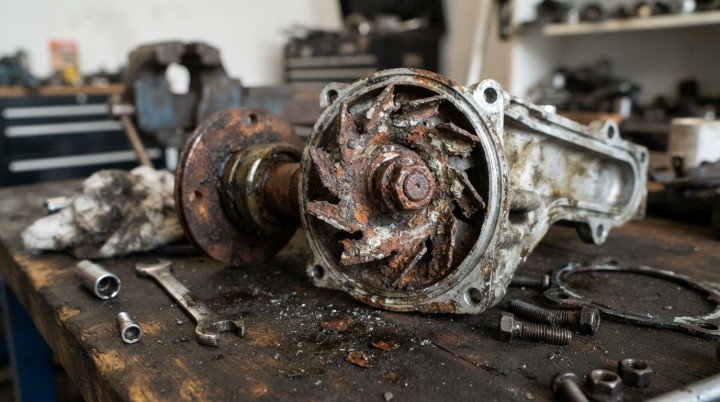
Because a bad thermostat, trapped air, and a restricted radiator can produce similar symptoms, overheating alone cannot confirm water-pump failure.
5. Broken or Slipping Water-Pump Drive Belt
On many engines, the water pump is driven by a serpentine belt, accessory belt, or timing drive. If the applicable belt breaks, slips, loses tension, or stops turning the pump correctly, coolant circulation may fall sharply.
This problem may appear with a battery warning light, heavy steering on vehicles with belt-driven power steering, belt noise, or several accessories failing at once. However, the exact symptoms depend on the vehicle’s belt layout. Some modern water pumps are electrically operated and are not affected by an accessory-belt failure.
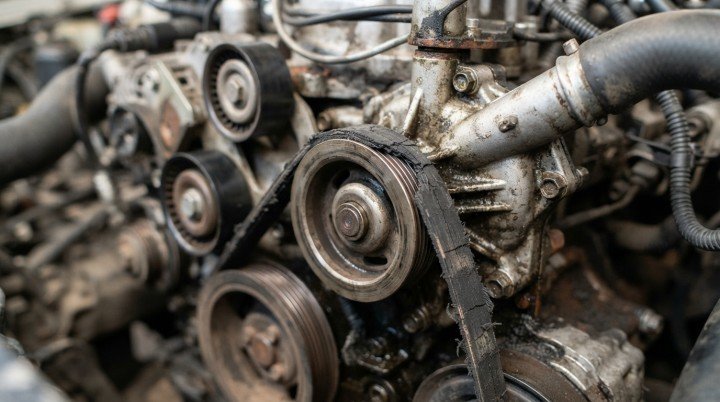
A belt problem belongs among the possible causes of engine overheating, but it should only be suspected after confirming how the pump is driven on that specific vehicle.
6. Air Trapped Inside the Cooling System
Liquid coolant transfers heat far more effectively than an air pocket. If air becomes trapped in a cooling passage, it can interrupt circulation, create localized hot areas, and produce unstable temperature readings.
This commonly appears after cooling-system work, an improper refill, or a leak that allows coolant to escape and air to enter. Possible clues include a temperature gauge that rises and falls, gurgling sounds, weak or inconsistent cabin heat, and overheating that began shortly after a repair.
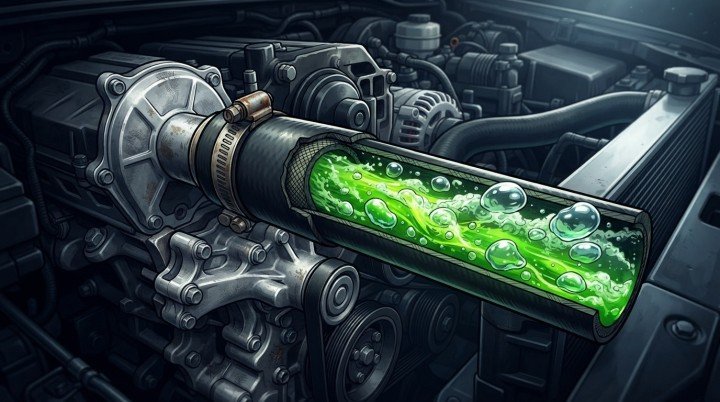
Adding more coolant does not automatically remove trapped air. Some vehicles require a manufacturer-specific filling or bleeding procedure, and modern systems may need professional equipment. The system should also be checked for the leak or repair issue that allowed the air to enter.
7. Collapsed, Blocked, or Leaking Coolant Hose
Cooling-system hoses provide the paths between the engine, radiator, reservoir, heater core, and other components. A visible split can release coolant quickly, but hose failure is not always that obvious.
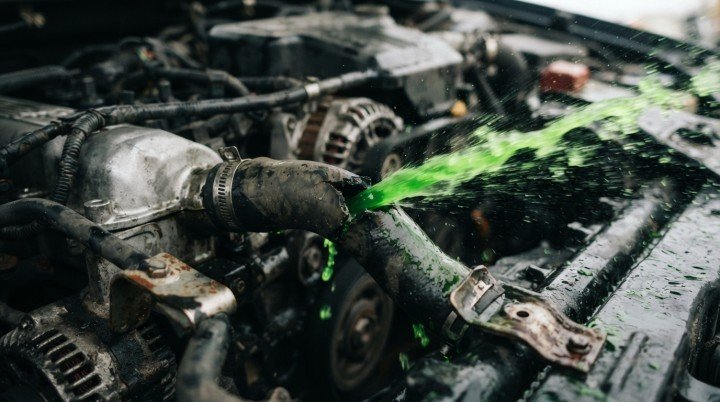
A deteriorated hose may become soft, swell, leak only under pressure, or collapse internally when the engine is running. Internal deterioration may also restrict flow even when the outside of the hose appears acceptable. Either coolant loss or restricted circulation can cause the temperature to rise.
Dried coolant residue near a connection, recurring coolant loss, or a hose that appears unusually swollen can support this diagnosis. Inspection should be performed only after the engine and cooling system have cooled completely.
8. Clogged, Restricted, or Damaged Radiator
The radiator must accept hot coolant and transfer its heat to passing air. It can fail in two different directions: coolant may be unable to flow through it, or air may be unable to move across it.
Internal restriction may develop from corrosion, deposits, contaminated coolant, or incompatible coolant products. External airflow may be reduced by damaged fins or material blocking the radiator surface. A radiator can also leak, lowering the coolant level and adding a second overheating problem.
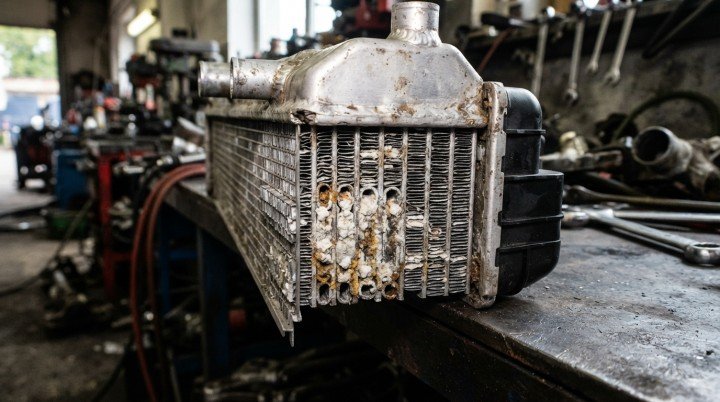
Overheating at sustained speed can point toward inadequate coolant flow or limited radiator capacity, although water-pump, thermostat, hose, and engine-load problems can create a similar pattern. A technician may compare temperatures across the radiator and evaluate system flow rather than replacing it based on appearance alone.
When Does the Engine Overheat?
The driving pattern does not prove which component failed, but it can narrow the likely causes of engine overheating and help prevent unnecessary parts replacement.
| Overheating Pattern | Possible Direction | Why the Pattern Matters |
|---|---|---|
| Mainly at idle or in traffic | Cooling fan, fan control, or reduced airflow | The radiator receives little natural airflow while the vehicle is stationary |
| At highway speed or under load | Restricted radiator, low coolant flow, weak pump, or combustion leak | The engine produces more heat even though road airflow has increased |
| Soon after cooling-system service | Trapped air, incorrect fill, leak, or installation problem | The timing connects the symptom to recent work |
| Gauge repeatedly rises and falls | Air pocket, low coolant, intermittent circulation, or sensor fault | The temperature signal or coolant flow may be unstable |
The final causes of engine overheating involve insufficient radiator airflow, loss of cooling-system pressure, and coolant that can no longer provide the protection the engine requires.
9. Cooling Fan or Fan-Control Failure
A radiator needs airflow to release the heat carried by the coolant. While a moving vehicle receives natural airflow, a vehicle sitting in traffic depends heavily on its cooling fan.
If the fan motor, fan clutch, fuse, relay, wiring, control module, or temperature input fails, the engine may overheat mainly at idle or low speed. The temperature may then drop after the vehicle begins moving because road speed pushes more air through the radiator.
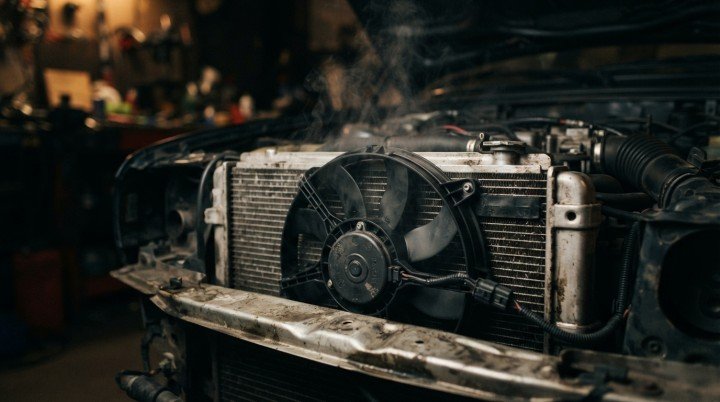
This pattern strongly suggests an airflow problem, but it does not prove that the fan itself is defective. A blocked radiator surface, low coolant level, or incorrect temperature-sensor information may produce similar behavior.
10. Weak Radiator or Expansion-Tank Pressure Cap
The cooling-system cap does more than cover an opening. It helps the system maintain a specified pressure, which allows the coolant to resist boiling at normal engine operating temperatures.
A damaged seal, weak spring, incorrect cap, or defective pressure valve may allow pressure to escape too early. Coolant may then boil or move into the overflow area before it should, eventually leaving the system low.
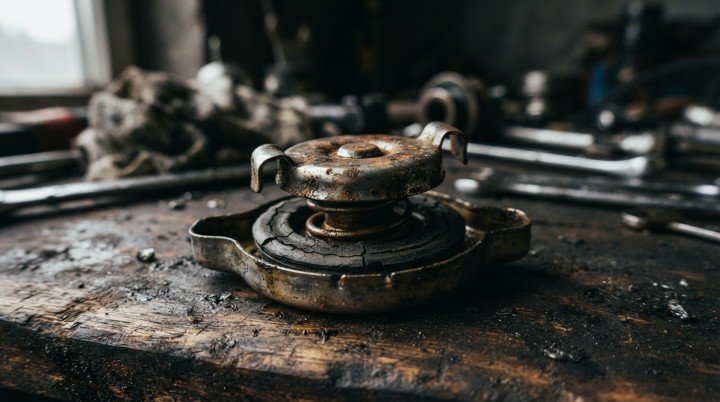
Possible clues include coolant around the filler neck or reservoir, repeated overflow, a collapsed hose after cooling, or overheating with no immediately obvious leak. Because pressure specifications vary by vehicle, the cap should match the manufacturer’s requirements rather than being selected by appearance alone.
11. Incorrect, Degraded, or Contaminated Coolant
Coolant must absorb heat while also protecting the system against freezing, boiling, corrosion, and deposits. Using the wrong specification, an unsuitable concentration, plain water as a long-term substitute, or coolant that has deteriorated can reduce that protection.
Mixing incompatible coolant formulas may also create deposits or contamination that restrict narrow passages. Coolant color alone is not a reliable way to determine compatibility because similar colors can represent different chemical specifications.
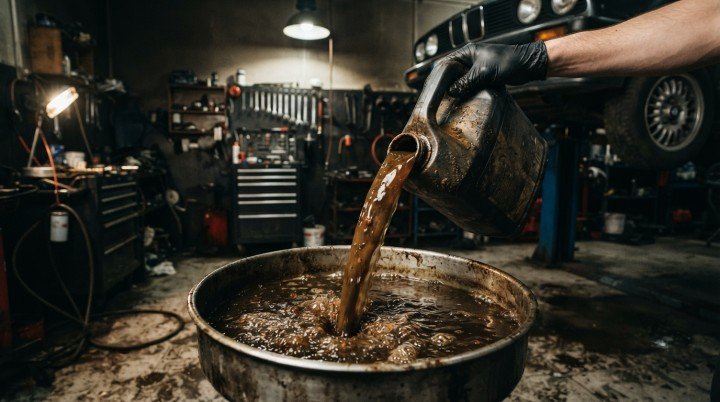
The correct coolant type and service interval should come from the owner’s manual or manufacturer information. If contamination is suspected, a technician should inspect the system and determine why it occurred before new coolant is added.
Warning Signs You Should Not Ignore
An engine may be overheating if the temperature gauge moves toward the red zone, a coolant-temperature warning appears, steam comes from under the hood, or a sweet smell becomes noticeable. Repeated coolant loss, inconsistent cabin heat, bubbling in the reservoir, reduced engine power, or the cooling fan running unusually often can provide additional clues.
No single symptom identifies the failed component. However, a rising gauge combined with steam or coolant loss should be treated as an immediate stop-driving warning.
Is the Engine Actually Overheating?
A faulty coolant-temperature sensor, damaged wiring, poor electrical connection, or instrument-cluster problem can produce an inaccurate reading. In some vehicles, incorrect sensor information can also affect fan operation.
A suspected sensor fault should not be used as a reason to continue driving. A technician can compare scan-tool temperature data with an independent temperature measurement and evaluate whether the engine is genuinely hot or the displayed information is incorrect.
What Should You Do First?
Pull over in a safe location, activate the hazard lights, and shut off the engine. Keep passengers away from traffic and avoid touching steaming or hot cooling-system components. Never open a pressurized cooling-system cap while the engine is hot.
After the vehicle has cooled completely, a visible leak or an empty reservoir may provide a clue, but neither result confirms the failed part. If the gauge reached the red zone, steam appeared, coolant escaped, or the engine lost power, arrange roadside assistance rather than restarting it to “see if it happens again.”
How a Technician Finds the Cause
A proper diagnosis may include checking stored trouble codes and live temperature data, testing cooling-system pressure, inspecting for external leaks, verifying fan operation, and evaluating thermostat, pump, belt, hose, and radiator performance. If coolant loss has no visible source, the technician may test for an internal leak or combustion gases in the cooling system.
This process matters because several failures create nearly identical symptoms. Replacing the thermostat, fan, or water pump based only on a high temperature reading can waste money while leaving the real fault unresolved.
Mistakes That Can Make Overheating Worse
The most dangerous mistake is opening a hot pressure cap. Other common errors include continuing to drive with the gauge in the red, adding coolant repeatedly without finding the leak, mixing coolant based only on color, using leak-sealing products without understanding their limitations, or clearing a temperature-related code and assuming the mechanical problem is fixed.
Frequently Asked Questions
Can low engine oil cause overheating?
Yes. Low oil increases friction and can add heat, although cooling-system failures are more common direct causes. If both the oil-pressure and temperature warnings appear, stop the engine immediately.
Why does a car overheat only in traffic?
Low-speed overheating often points toward inadequate radiator airflow, especially a fan or fan-control problem. It may also result from low coolant, radiator restriction, or weak circulation.
Why does it overheat when the coolant reservoir is full?
A full reservoir does not prove that coolant is circulating correctly. A stuck thermostat, failed pump, trapped air, blocked radiator, internal leak, or inaccurate sensor reading may still be responsible.
Can hot weather or air-conditioning cause overheating?
A healthy cooling system should normally manage warm weather and air-conditioning load. These conditions often expose a system that already has reduced cooling capacity rather than creating the original fault.
Final Thoughts
Understanding the causes of engine overheating is less about guessing which part failed and more about identifying where the heat-flow process stopped working. Whether the system lost coolant, circulation, airflow, pressure, or proper coolant protection, the warning should never be ignored. Stop the engine safely, avoid opening hot cooling components, and have the underlying fault diagnosed before it becomes more expensive.
Kevin Nicholas is an automotive mechanic and editor of The Effective Guide. He writes about warning lights, car problems, and diagnostic tools, helping drivers understand what to check before replacing a part.