
Last Updated on October 7, 2026
Your engine may idle roughly, hesitate during acceleration, or suddenly lose fuel economy. These problems can feel unrelated, but they may share one cause: incorrect exhaust-gas recirculation.
Recognizing the bad EGR valve symptoms is not as simple as watching for one warning light. An EGR valve may become stuck open, remain closed, move intermittently, or receive the wrong command from another component. Each failure pattern affects the engine differently.
A stuck-open valve usually creates problems when the engine needs clean intake air for stable combustion. A stuck-closed or restricted valve may be less noticeable at idle but can increase combustion temperature and emissions under load. Understanding this difference can help prevent the wrong component from being replaced.
Quick Answer
Common bad EGR valve symptoms include a Check Engine Light, rough idle, stalling, hard starting, hesitation, weak acceleration, fluctuating RPM, increased fuel consumption, engine knocking, dark exhaust smoke, and a failed emissions test. However, these signs can also come from clogged EGR passages, wiring faults, vacuum leaks, sensors, ignition problems, or incorrect fuel delivery.
What Does the EGR Valve Do?
EGR stands for exhaust gas recirculation. The system routes a controlled amount of exhaust gas back into the engine’s intake. Because this recirculated gas contains less oxygen than fresh air, it helps reduce peak combustion temperature and nitrogen-oxide emissions.
The valve does not simply stay open whenever the engine is running. The engine computer controls EGR flow according to factors such as temperature, engine speed, and load. Exact operating strategy differs between gasoline and diesel engines and among vehicle designs.
Problems begin when exhaust gas enters at the wrong time, cannot enter when commanded, or flows in the wrong amount. Carbon deposits can restrict the valve or passages, while electrical, vacuum, actuator, and feedback-sensor faults can interfere with operation.
The EGR Failure Signature
| Failure Pattern | What Is Happening | Typical Signature | Possible Lookalike |
|---|---|---|---|
| Stuck open | Exhaust gas enters when little or none is commanded | Rough idle, stalling, hard starting, or hesitation | Vacuum leak, ignition misfire, or fuel problem |
| Stuck closed or restricted | Commanded exhaust flow cannot reach the intake | Knocking under load, higher emissions, or an EGR-flow code | Blocked passage, sensor fault, or control problem |
| Intermittently sticking | The valve responds inconsistently | Surging, occasional jerking, or changing idle quality | Loose connector or unstable sensor signal |
| Electrical or control fault | Valve position does not match the computer’s command | Check Engine Light, intermittent power loss, or reduced-power mode | Wiring, actuator, solenoid, or feedback-sensor fault |
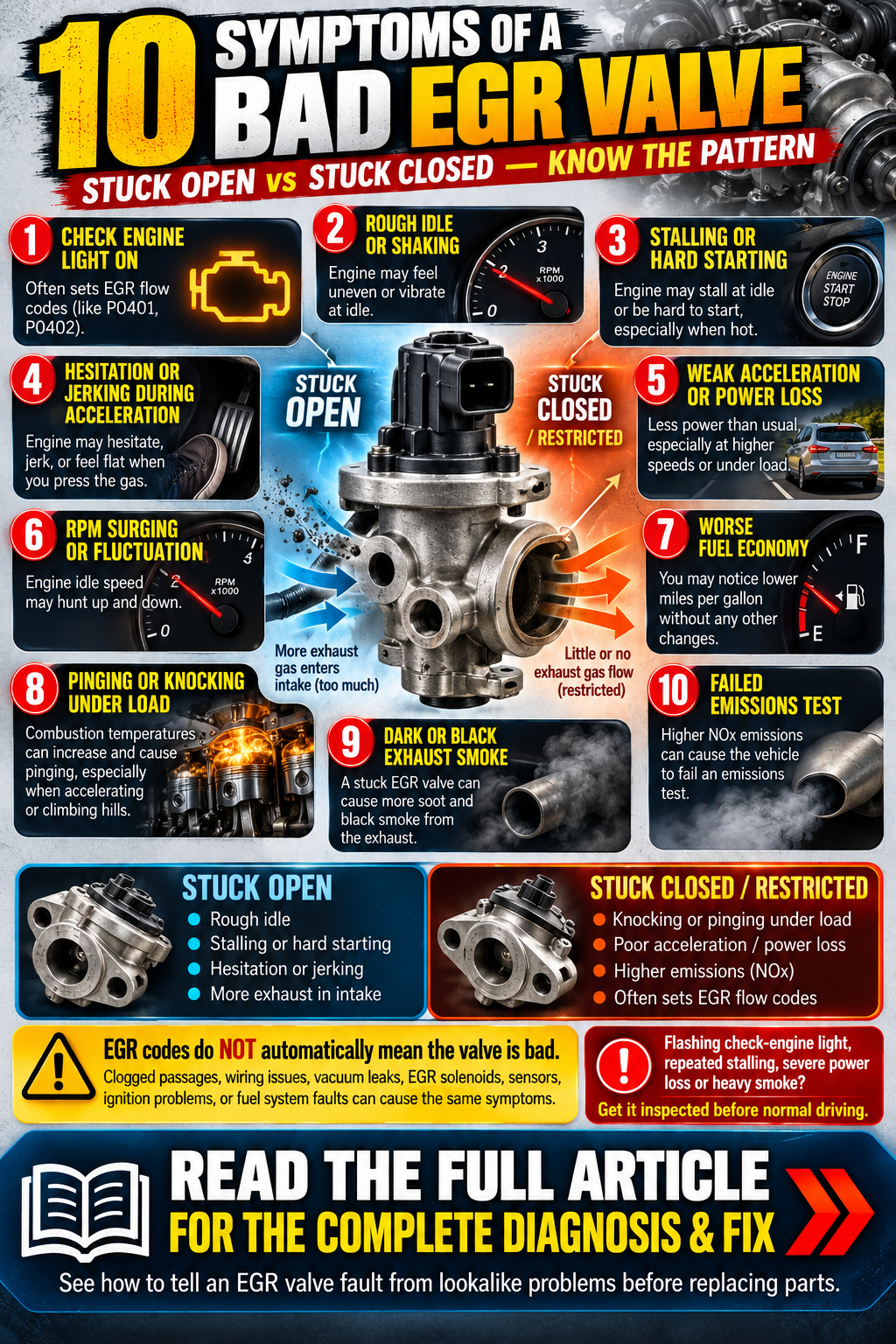
1. The Check Engine Light Comes On
A Check Engine Light is often the first visible warning because the engine computer monitors EGR flow, valve position, or the system’s effect on other sensor readings. A detected problem may store a code from the P0400 family, such as insufficient flow, excessive flow, circuit malfunction, or position performance.
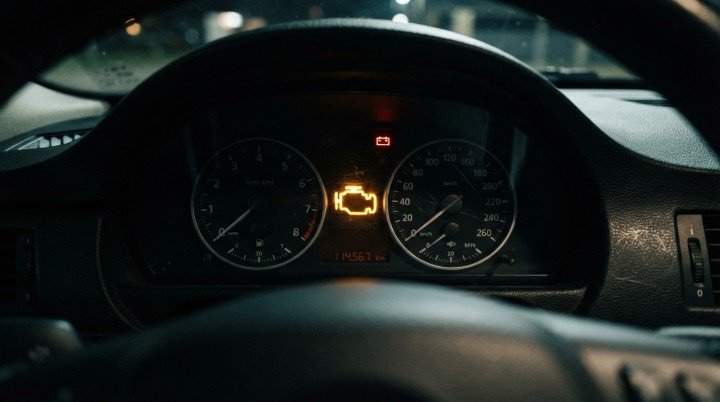
The important clue is what the code actually describes. For example, an insufficient-flow code does not automatically prove that the valve itself has failed. Carbon-blocked passages, a damaged vacuum line, faulty wiring, an EGR solenoid, or an incorrect feedback signal can produce a similar code.
A steady warning light calls for timely diagnosis. If the light flashes and the engine runs badly, the vehicle may have an active misfire or another damaging problem and should not continue to be driven.
2. The Engine Idles Roughly or Shakes
A healthy EGR system supplies only the amount of exhaust gas the engine can tolerate at that operating condition. If the valve allows excessive flow at idle, the recirculated gas displaces too much fresh air and makes combustion unstable.
You may feel the engine shaking through the seat or steering wheel while stopped. The RPM may move slightly up and down, and the engine may sound uneven. The symptom can become more noticeable after the engine warms up or as the vehicle comes to a stop.
Rough idle alone cannot identify an EGR failure. Dirty fuel injectors, worn spark plugs, ignition-coil faults, intake leaks, low compression, and MAF or MAP sensor problems can create nearly identical behavior. The timing of the symptom and supporting scan data are what make the EGR system a stronger suspect.
3. The Engine Stalls or Becomes Difficult to Start
A valve stuck open may allow too much exhaust gas into the intake during startup, low-speed operation, or deceleration. The engine may start and then stall, struggle to maintain idle, or shut off when the vehicle stops at an intersection.

This failure signature often appears together with rough idle or hesitation rather than as an isolated no-start condition. A completely dead or non-cranking engine is generally not explained by the EGR valve.
Stalling can affect driving safety, so repeated stalling should not be treated as a minor emissions issue. Fuel-pressure loss, ignition failure, a contaminated throttle body, a major vacuum leak, or incorrect crankshaft-sensor information should also be ruled out before blaming the valve.
4. The Car Hesitates or Jerks During Acceleration
What you feel: You press the accelerator, but the engine pauses, stumbles, or delivers power unevenly. The car may jerk briefly before it begins accelerating normally.
When it appears: This symptom often becomes noticeable while pulling away from a stop, accelerating at light or moderate throttle, or driving at a speed where the EGR system changes its commanded flow.
A valve that remains too far open can introduce more exhaust gas than the engine expects. Because recirculated gas displaces some of the oxygen available for combustion, excessive flow may cause hesitation or unstable power delivery.

However, acceleration hesitation is not specific to the EGR system. Weak fuel pressure, dirty injectors, worn spark plugs, ignition-coil failure, throttle-body problems, and MAF or MAP sensor faults can produce the same feeling. The EGR system becomes a stronger suspect when hesitation occurs with an EGR-related code, rough idle, or inconsistent valve-position data.
5. Acceleration Feels Weak or the Engine Loses Power
What you feel: The vehicle still moves, but it requires more throttle than usual. Merging, passing, or climbing a hill may feel harder, and the engine may seem unable to produce its normal power.
When it appears: Power loss can develop under moderate or heavy load. On some diesel vehicles, an EGR control fault may also contribute to reduced-power or limp-mode operation when the engine computer detects airflow or valve-position readings outside the expected range.
A stuck-open valve can dilute the intake charge at the wrong time. A blocked passage or valve that fails to open may also disturb the airflow calculations used by the engine computer. In turbocharged engines, an EGR, intake, or boost-control problem can create overlapping symptoms.

These bad EGR valve symptoms should not be separated from the rest of the intake and exhaust system. A clogged air filter, boost leak, restricted catalytic converter, failing fuel pump, or turbocharger problem can cause equal or more severe power loss.
If the vehicle cannot accelerate safely with traffic, produces heavy smoke, or enters reduced-power mode, it should be inspected before normal driving continues.
6. The Engine Surges or the RPM Fluctuates
What you feel: Engine speed rises and falls even though the accelerator position remains steady. The car may feel as though it is gaining and losing power in a repeating pattern.
When it appears: Surging may occur at idle, during steady-speed cruising, or as the engine transitions between low and moderate load.
An EGR valve that sticks intermittently can alternate between too much and too little exhaust flow. A loose electrical connection, unstable position sensor, defective control solenoid, or changing vacuum supply may create a similar on-and-off response.
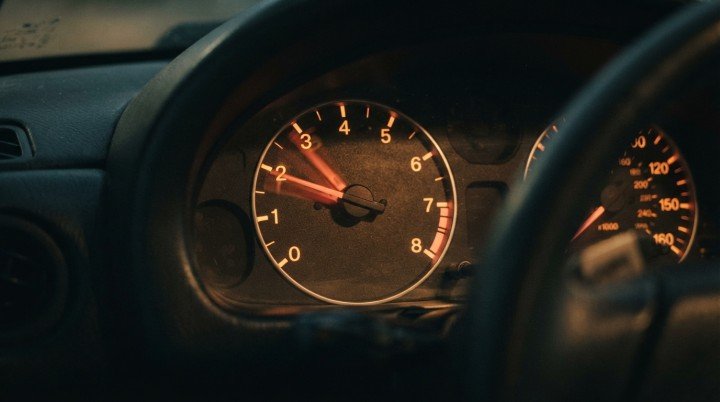
The exact timing provides an important clue. Surging only at idle may point toward excess EGR flow or an intake leak. Surging while cruising may also involve fuel delivery, throttle control, oxygen-sensor feedback, transmission behavior, or turbo boost. Scan data is needed to determine whether the commanded and actual EGR operation change when the symptom occurs.
7. Fuel Economy Gets Worse
Among the symptoms of a bad EGR valve, reduced fuel economy is one of the easiest to overlook because it often develops gradually. The vehicle may travel fewer miles on the same amount of fuel without showing an immediate drivability problem.
Incorrect EGR flow can reduce combustion efficiency or cause the engine computer to make compensating fuel and airflow adjustments. A valve stuck open may contribute to incomplete or unstable combustion, while restricted flow can affect combustion temperature and emissions control.
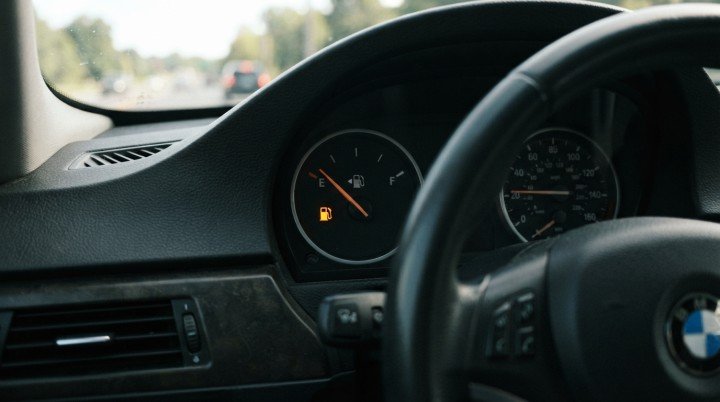
Fuel economy alone is weak evidence of EGR failure. Tire pressure, driving conditions, cold weather, short trips, worn ignition parts, oxygen-sensor problems, fuel-injector faults, and MAF sensor errors are often more common explanations. Fuel consumption becomes more meaningful when it changes alongside rough running, power loss, or EGR-related diagnostic codes.
8. The Engine Pings or Knocks Under Load
What you hear: A light metallic pinging or rattling sound may appear during acceleration, hill climbing, or other high-load conditions.
When it appears: This symptom is more closely associated with insufficient EGR flow on applicable gasoline engines. If the valve remains closed or the passages become restricted, peak combustion temperature may rise and increase the chance of abnormal combustion.
Not every engine uses EGR in the same way, and not every knocking noise is caused by the valve. Low-octane or contaminated fuel, excessive carbon deposits, incorrect ignition timing, overheating, lean operation, or internal mechanical wear may also produce a similar sound.

Persistent knock should not be ignored or tested by repeatedly accelerating the engine. If the sound is strong, continues under normal driving, or appears with overheating or power loss, the vehicle needs prompt professional diagnosis.
Stuck Open vs. Stuck Closed: Which Pattern Fits Better?
Comparing the symptoms of a bad EGR valve by operating condition is more useful than treating every warning sign as equal evidence.
| Observed Pattern | More Consistent With Stuck Open | More Consistent With Stuck Closed or Restricted | Important Limitation |
|---|---|---|---|
| Rough idle or stalling | More likely when excessive exhaust enters at idle | Usually less characteristic | Ignition, fuel, or intake faults may look identical |
| Hesitation or weak acceleration | Possible from excessive flow | Possible when commanded flow is blocked | The symptom cannot identify valve position by itself |
| Pinging under load | Less typical | More consistent on applicable gasoline engines | Fuel quality and other engine faults must be considered |
| Check Engine Light only | Possible | Possible | The trouble code and test results are needed |
9. Dark or Black Smoke Comes From the Exhaust
Incorrect EGR operation may contribute to dark exhaust smoke, particularly on diesel engines. If the valve, passages, or control system disrupts the expected balance between fresh air and recirculated exhaust gas, combustion may not occur as efficiently as intended.
The smoke may appear during acceleration or when the engine is under load. It may occur with reduced power, hesitation, increased fuel consumption, or an EGR-related warning code.

However, black smoke is not proof of a failed EGR valve. A restricted air filter, boost leak, turbocharger problem, injector fault, incorrect sensor information, or another air-fuel control issue may be responsible. On gasoline vehicles, visible black exhaust more commonly points toward an excessively rich fuel mixture and requires broader diagnosis.
Heavy or persistent smoke should be inspected promptly. It may indicate an emissions fault or another problem capable of affecting the catalytic converter, diesel particulate filter, or turbocharger.
10. The Vehicle Fails an Emissions Test
An EGR system is designed primarily to reduce nitrogen-oxide emissions by controlling peak combustion temperature. If the valve remains closed, the passages become restricted, or the commanded flow never reaches the intake, NOx emissions may increase.
A vehicle may fail an emissions inspection even when it seems to drive normally. In other cases, the failure appears with a Check Engine Light, poor acceleration, reduced fuel economy, or engine knock.
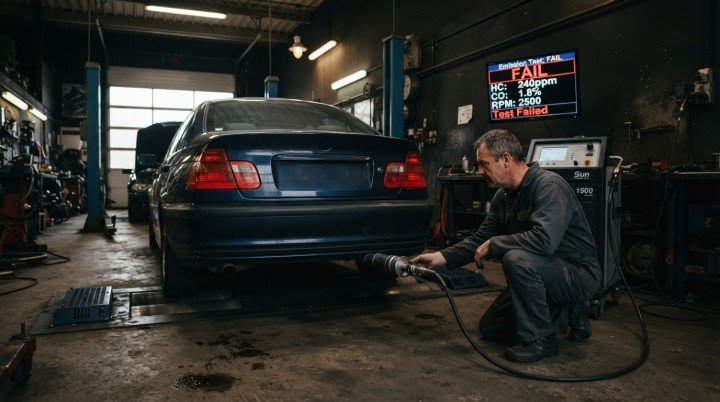
An emissions failure does not identify the valve by itself. The EGR passages, vacuum system, solenoid, position sensor, pressure-feedback sensor, wiring, or engine-management software may prevent correct flow. The inspection results and stored diagnostic information should be evaluated before parts are replaced.
An EGR Code Does Not Automatically Mean a Bad Valve
Common EGR-related codes include P0400 for a general flow malfunction, P0401 for insufficient flow, P0402 for excessive flow, P0403 for a control-circuit fault, and P0404 for a range or performance problem.
These codes describe what the engine computer detected—not necessarily which component caused it. For example, P0401 may result from a clogged passage even when the valve can move correctly. P0403 may point more directly toward an electrical circuit, connector, solenoid, or actuator problem.
A code is therefore the beginning of diagnosis, not a replacement instruction.
Problems That Can Imitate EGR Failure
Rough idle, stalling, hesitation, power loss, smoke, and poor fuel economy overlap with many other faults. Possible lookalikes include ignition misfires, intake-vacuum leaks, low fuel pressure, contaminated injectors, dirty throttle components, and inaccurate MAF or MAP sensor readings.
The EGR system also contains more than the valve. Depending on the vehicle, it may include passages, vacuum hoses, a control solenoid, position or temperature sensors, a pressure-feedback sensor, and an EGR cooler. A fault in any of these areas may create a code or symptom that appears to blame the valve.
Turbocharged diesel engines add further possibilities, including boost leaks, turbo-control faults, intake restrictions, diesel particulate-filter problems, and EGR-cooler issues.
How a Technician Confirms the Cause
Diagnosis normally begins by reading stored and pending codes, freeze-frame information, and live engine data. A technician can compare the EGR position or flow requested by the computer with the response reported by the system.
The inspection may also cover electrical connections, wiring, vacuum supply, valve movement, carbon-restricted passages, and feedback from related sensors. On applicable vehicles, an actuator test can show whether the valve responds when commanded.
This matters because replacing a functional valve will not correct a blocked passage, broken wire, vacuum leak, failed sensor, or control problem.
When Can Cleaning Help?
Cleaning may help when carbon deposits prevent an otherwise functional valve from moving or restrict an EGR passage. It is less likely to help when the actuator motor, internal position sensor, vacuum diaphragm, electrical circuit, or valve mechanism has failed.
Replacement may be necessary if the valve is electrically defective, physically damaged, excessively worn, or unable to respond correctly after the surrounding system has been checked. An EGR cooler leak or failed control component requires a different repair.
Because EGR components operate around hot exhaust gases and vehicle-specific procedures vary, inspection and service should follow the manufacturer’s repair information.
Can You Drive With an EGR Problem?
A steady Check Engine Light with no major change in drivability may not require an emergency stop, but the fault should still be diagnosed promptly.
Driving should not continue normally if the warning light flashes, the engine stalls repeatedly, acceleration becomes unsafe, heavy smoke appears, or strong knocking develops. Exhaust odor inside the passenger compartment also requires immediate attention: stop safely, leave the vehicle in a safe area, and arrange professional assistance.
Common Mistakes to Avoid
One common mistake is replacing the valve solely because an EGR-related code was stored. Others include ignoring clogged passages, overlooking wiring or vacuum faults, assuming every rough idle is an EGR problem, or expecting cleaning to repair an electrical failure.
Clearing a trouble code does not repair the condition that caused it. If the fault remains, the warning will usually return after the system reruns its monitor.
Frequently Asked Questions
Can a bad EGR valve cause a misfire?
Excessive EGR flow may produce rough running that feels like a misfire and may contribute to combustion instability. Ignition, fuel, compression, and intake problems must also be considered.
Is code P0401 always caused by the valve?
No. P0401 indicates insufficient EGR flow. A clogged passage, vacuum problem, sensor fault, control issue, or wiring problem may cause the same code.
Can an EGR valve be cleaned instead of replaced?
Cleaning may restore a carbon-stuck valve or restricted passage, but it cannot repair a failed motor, position sensor, diaphragm, connector, or damaged mechanism.
Are the signs different on diesel and gasoline engines?
There is overlap, but diesel engines may show more noticeable smoke, boost-related power loss, or reduced-power operation. Gasoline engines with insufficient EGR flow may be more likely to develop pinging under load.
Can a faulty EGR valve cause a complete no-start?
A valve stuck open may make starting difficult or cause the engine to start and stall. A complete no-crank condition is unrelated, while a total no-start usually requires broader diagnosis.
Final Thoughts
Recognizing the bad EGR valve symptoms requires more than matching one complaint to one component. The strongest diagnosis comes from combining when the symptom appears, whether the failure resembles excessive or insufficient flow, the stored codes, and the actual valve response. Confirm the cause before cleaning or replacing parts, especially when the same warning signs could come from the intake, ignition, fuel, turbo, or sensor systems.
Kevin Nicholas is an automotive mechanic and editor of The Effective Guide. He writes about warning lights, car problems, and diagnostic tools, helping drivers understand what to check before replacing a part.