
Last Updated on September 22, 2026
If your scanner shows a C1234 code, check the vehicle’s make and the full code description before buying a part. On certain Fords, C1234 means the ABS module has lost the right-front wheel-speed signal. On some Toyotas, including the 2001–2002 Sequoia covered by a Toyota service bulletin, it points to a yaw-rate sensor problem instead. The same four characters can send you to two different parts of the car.
Start by saving every code from the ABS or stability-control module, along with the year, make, model, and any description your scan tool displays. A basic engine-code reader may not show the information you need. If you are choosing a tool, our OBD2 scanner guide covers both basic readers and tools with ABS functions; check coverage for your specific car before buying. If the brake pedal feels abnormal or the red brake warning light is on, address that before trying to diagnose an ABS sensor.
What does the C1234 code mean on your car?
C1234 is a chassis-system trouble code. It is not a universal instruction to replace the right-front wheel-speed sensor. A Ford service code chart, for example, lists it as RF Wheel Speed Input Signal Missing. Toyota’s bulletin for 2001–2002 Sequoia labels its C1234 fault as a yaw-rate sensor issue in the vehicle stability control (VSC) system. Match the code to the repair information for your exact vehicle before following either path.
The wheel-speed sensor tells the ABS module how fast a wheel is turning. A yaw-rate sensor measures how the vehicle rotates as it turns; stability control uses that information along with other inputs. They do different jobs. That is why an ABS warning light and the code number alone cannot identify the failed part.
First, pay attention to the warning lights and braking
An ABS light, a traction-control or stability-control warning, or more than one warning at once may accompany C1234. The check engine light is not a reliable symptom of this code by itself. Record every light and every code before clearing anything.
If only the amber ABS light is on and the pedal feels normal, the conventional brakes may still work while anti-lock braking is unavailable. Ford’s owner information makes that distinction, but you should still arrange a prompt inspection and take extra care on wet or slippery roads. If the red brake warning stays on with the parking brake released, the pedal feels soft, braking changes, or the vehicle unexpectedly pulls or applies a brake, stop somewhere safe and arrange an inspection before driving on. Follow your owner’s manual for the warnings on your vehicle.
If the description says “right-front wheel-speed signal missing”
On some Ford models, a C1234 code means the ABS module is not receiving the signal it expects from the right-front wheel. That tells you where to test; it does not prove the sensor itself has failed. Depending on the vehicle, damaged wiring, a loose or corroded connector, a damaged tone ring or magnetic encoder, bearing or hub trouble, an incorrectly fitted sensor, or a failed sensor can interrupt the reading. If your scan also shows a different wheel-speed code, such as C1225, read its description separately; the codes do not automatically point to the same wheel.
Ask what happened just before the warning appeared. If someone recently worked on that corner’s hub, axle, brake, or suspension, inspect anything that could have been unplugged, stretched, or disturbed. If the warning arrived after a pothole or the wheel bearing has play or noise, mention that too. Those details can save a lot of guessing.
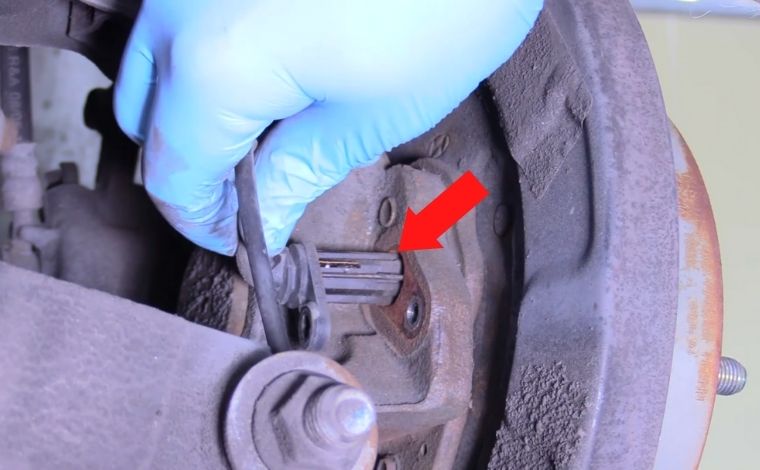
With the vehicle parked, a visual check of accessible wiring and connectors is a sensible start. The harness near a wheel moves with steering and suspension and is exposed to water and road debris. Look for a broken clip, rubbed insulation, corrosion, or an unplugged connector. If inspection requires lifting the vehicle or removing a wheel, use proper support equipment or have a shop handle it.
A technician can then watch the available wheel-speed readings on an ABS-capable scan tool during a safe road test. A right-front reading that drops out or stays at zero while the others agree helps focus the next test. The shop may check the sensor signal, circuit, connector, and ring or encoder using the specifications and test method for that vehicle. Some wheel-speed sensors are active devices, so a generic resistance test is not a reliable go/no-go check for every car. Replacing the ABS module is a last conclusion after the signal and wiring have been proved good.
If the description points to a yaw-rate sensor
Do not start at the right-front wheel. On the 2001–2002 Toyota Sequoia covered by Toyota’s bulletin, a C1234 code calls for confirming the fault in the skid-control computer and checking the yaw-rate sensor harness and connector for an open or short. The bulletin’s repair path then calls for the specified sensor replacement and a zero-point calibration. It does not tell every Toyota owner to replace a yaw-rate sensor as soon as C1234 appears.
Ask the technician to compare the full scan result and your exact vehicle with the current repair manual and any applicable bulletin. If stability control activated unexpectedly, mention when and how it happened. On the Sequoia case studied by NHTSA, drivers sometimes reported VSC/TRAC warnings and pulsed brake application; that is a reason to describe the behavior clearly, not to assume another model has the same fault.
What actually fixes C1234?
The repair follows the confirmed fault. For a missing Ford-style right-front wheel-speed signal, that could mean repairing the harness or connector, correcting a damaged ring or hub, or replacing a sensor that fails the vehicle’s test. For the specific Toyota yaw-rate case, follow its harness checks and manufacturer procedure, including calibration when required. Clear the code only after the repair, then repeat the appropriate self-test or drive cycle and check whether the warning returns.
There is no useful single repair price for this code: a wiring repair and a hub or stability sensor job involve different parts and labor. Before approving work, ask the shop to show the full code description, which module stored it, the failed test, and the proposed repair. If the estimate simply says “replace ABS sensor” without naming the vehicle-specific fault, ask for a diagnosis first.
A loose gas cap, dirty engine oil, a fuel-position problem, or cleaning the gas tank is not a repair for a C1234 code with either meaning discussed here. The quickest reliable first step is much simpler: identify the car and read the complete ABS or stability-control code description.

Kevin Nicholas is an automotive mechanic and editor of The Effective Guide. He writes about warning lights, car problems, and diagnostic tools, helping drivers understand what to check before replacing a part.